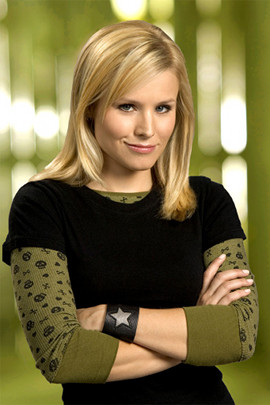
 The internet’s been awash the past 24 hours with excitement over a Kickstarter campaign that will bring Veronica Mars, a cult favorite TV series that was canceled three seasons in, to the big screen. The campaign’s a resounding success, reaching its $2,000,000 goal in the span of less than a day.
The fans that contributed are rightfully exalted, celebrating another beloved-but-cancelled TV show’s resurrection. That in and of itself isn’t a terrible thing. It only get’s terrible when you realize what their hard-earned dollar has merited them:
Nothing but an idea that’s already owned, and by a multi-billion dollar corporation no less.
$10 guarantees you a PDF, $25 a shirt, $10,000 a speaking part in the film. Here’s what your money won’t guarantee: a ticket to a good movie, or any movie. Payment for services not rendered because no service is being provided.
Instead, fans’ money now signifies a placeholder: $2,000,000 up front for the privilege to pay more later. In return, Warner Brothers is now tasking themselves (remember, it’s still ultimately their decision) with delivering a product to a very small, segmented part of nerd culture; a part of the culture that’s now redefining “pay for play” as “pay to pay for play”.
This could very well signal a paradigm shift as an already stingy industry finds out fans are willing to float the dough if they want something badly enough. Want Marvel to make a Dazzler movie? Howabout Freddy vs. Jason. vs. Ash? Here comes a cigar chomping studio exact ready to ask “How much is it worth to ya?” You say those projects are of no interest to you? Fine, but they are of interest to someone. And what happens when voting with your ticket-buying dollar gets replaced with actually voting with your dollar?
While it hasn’t occurred yet, what’s been inferred can potentially open a brand new revenue stream; one the movie-going populace seems all too ready to give in to as studios go about finding new ways to exploit anticipation. This potential game-changer, good or bad, leaves us pondering the likelihood of ideas paid for by the people, for the people, but leveraged by big business to create the world’s largest focus group – one where membership comes at the price not of a ticket, but instead the promise of one at a later date.
This of course reeks of another project championed by the internet, one whose supporters were all too ready to pat themselves on the back about until it finally manifested and reality sunk in. If Kickstarter had existed then, would similar hysteria have helped finance Snakes on a Plane? And would the end result have meant anything more than another middling effort clogging up theatres?
Fans hoping for a great Veronica Mars film could very well end up with one, but it doesn’t change the fact that Warner Brothers is by no means beholden to deliver anything of quality. All that was proven is how willing we are to pay for nothingness now so we can pay for something later on.
15 comments
This would be a very intriguing article… if it wasn’t founded on a complete lapse in understanding. Yes, there is no mention of a movie ticket anywhere in the prizes, and yes, making donations of $10 or $25 won’t get the patron to see the movie.
However, donations of $35 or more yield “a digital version of the movie within a few days of the movie’s theatrical debut.” Donations for $50 or more yield a physical DVD. Therefore, your central argument — that the fans have to pay later for something they’ve already paid for — is not necessarily true.
Also, you are correct with the statement that WB is not “beholden to deliver anything of quality” in return for the fan donations. But then, you could say that for any Kickstarter project.
Oh come on. A Veronica Mars movie can be shot mostly on location or with simple sets, off-the-rack costumes, simple stunts, no special effects, in other words, your basic indie film. Kirsten Bell is your only cast member who will likely be getting paid much, as everyone else will be happy to simply be working. I defy you to make a Dazzler or Freddie vs Jason vs Ash movie for $2 million. What does the typical SyFy TV movie cost? It must be at least $2 million, if not a bit more, and something like Chupacabra vs The Alamo isn’t even B-quality film making.
I can see this working for fairly simple productions. A full Dr Horrible movie? A Freaks and Geeks reunion? Maybe, if everyone works for scale and you keep the effects simple. But people aren’t likely to fund every crazy idea and if they do, it’s going to take something special to garner serious funds. Even then, $2 million, $4 million, even $10 million isn’t much when making a feature film with known actors and the involvement of a studio or other corporate entity that owns the rights to the specific property in question.
It’s all just risk assessment, as I see it. When I go to see a movie in the theatre I’m just collecting all the data – interest in the actors/director/writer/characters, review scores, how often I agree with those critics, what the other people I’m with want to see if I’m in a group – and weigh it against the ticket price.
Here the reviews are out of the question and replaced with the fact that the movie wouldn’t exist otherwise. It’s a question of how much I like the characters/creators/’verse and how much – if anything – I would be willing to pay to spend more time with them. Could it suck? Sure, but sometimes going home for a shitty overcooked meal and an argument with dad about politics is still better than not going home at all.
Agreed. Tim has shown he has no working knowledge of Kickstarter. Another thing to be considered here, is that by alleviating the pressure off a studio and putting the financial responsibility back into fans hands, losses can be saved for the studios and properties can be resurrected with far, FAR less risk. Want to see FIREFLY again? another movie? another tv series of it? Sure. Kickstart it. Hey, the kickstarter can only fail right? But if it succeeds… the fans have PAID for it. Piracy is thus a moot point, because the studio will not be footing the majority of the bill. Even then the kickstarter funding is only collected upon the expiry of the time period and if the project does not come to fruition, legally the money *must* be returned to the investors. It’s in a very tight contract that each kickstarter must agree to. Tim seriously, start reading up about it. There was always going to be someone pissing and whining about this, I’m seriously shocked it was CHUD, I thought you guys would support something like this.
I thought about this as well when I first heard about the kickstarter. I figured that some studio had to own the rights to the movie and now they get 2 million just to put together what could be a sci-fi quality film and make even more money? I like the idea that fans have more ability to help make their favorites come back from the dead but like everything, it’s all about money. How to make it and how to keep the majority of it for the studio heads.
$35 = a digital copy of the movie a few days after theatrical release. That right there is not “throwing” money away on a project. You get THE FILM ITSELF, which you’d end up paying for anyway, albeit probably a little less than $35. I totally threw my hat into this project, both because I love the idea of the movie going public steering the wheel on which projects get green lit and also because I’m a crazy Veronica Mars fan
So… for 35 dollars you get a digital copy that would cost nowhere near that much money to begin with; for 50 dollars you get a DVD/Blu-Ray of the movie, which would normally cost you 20 bucks? Add to that you all are now doing the studio’s job of funding this movie so that they can profit off of the film’s theatrical release without incurring any of the expense? On what planet does this not set a bad precedent?
Nickle and dimed independent financing combined with corporate interference in the creative. The worst of both worlds!
That’s not likely to happen though. A studio would be shooting themselves in the foot to give away any version of the film immediately after release (cough cough piracy, cough cough). Plus, theater chains will balk at showing a film that is going to be readily available within days, especially one with an extremely limited and specific audience.
The whole idea that Kickstarter will change the way films or TV are made ignores the reality of the way films and TV are made, distributed, and paid for. I’m not saying it’s not exciting and has potential, but it’s way more complicated than you give money/you get X in return.
If this were money going to a Gilliam Don Quixote film, no one would balk. I seriously do not get the backlash. 6 years after cancellation, the creator and star want to revisit a property. Warner Bros. doesn’t think anyone would care enough to bother them to invest. Creator and star offer to work for scale as it is a passion project (likely for a larger piece of the back end). They convince the brass to allow them to try a kickstarter, which also gauges fan interest in revisiting a dead show. Publicity on the kickstarter alone increases interest in streaming/syndication/DVD sales on the three seasons of the show.
It is a win/win/win for fans, the talent and the studio. Absolutely no one is required to donate. They choose the level of donation and the reward. The studio streams a copy of the film to people who pay enough. Others get t-shirts, posters, DVDs and the like. Seriously, there is nothing to complain about. People who think the studios are just going to use this as a normal business model for development are insane. It would ONLY work for established properties and even then, it’s not like Paramount is going to crowdfund the next Star Trek movie.
Three Oranges- do you really think the budget of this, likely VOD/DVD/LIMITED theatrical release warrants studio interference? Anything under ten million, and they couldn’t care less. $100 million film, they will go all Akiva Goldsman on our asses and make it generic as shit.
Its a legally binding investment with terms and conditions. Itll happen.
It’s all ready a contract that if you pay $35 for the film you receive a digital copy and a t-shirt a few days after the theatrical release, WB can’t break that contract or they’d face a massive collective legal case representing at least 40,000 people that lawyers would be breaking their necks to get.
It’s a one-and-done deal where you get to own a copy of the the film straight off and it’s legal, rather than paying the cinema for a once-off viewing then the retailer for the blu-ray/download. So it’s not like people are getting NOTHING. It’s not too shabby for the price.
You’re more or less ‘investing’ in the future of a property that otherwise had none. I doubt returns will be huge for WB out of this. They funded the development of the IP so they have a right to see some profit.
I’ve seen several of these types of articles/takes on the VM Kickstarter over the last 24 hours. Drew at Hitfix even went so far as to write on twitter that those choosing to take part are being “hustled” or “conned” by a multi-billion dollar corporation. Though I’m generally susceptible to anti-corporate rhetoric, in this case I don’t think it’s correct or fair to label the fans as being taken advantage of. Think about it, is there a single monetary interaction we have with nearly any form of media that isn’t somehow connected to a multi-billion dollar corporation? In each case, whether it’s an iTunes purchase, a Blu-Ray, a video game, an on-demand movie – we are constantly adding to the coffers of multi-billion dollar corporations. We choose to give them a certain amount of money for a service we deem worth the price we pay. Not sure how this is any different. I chose to pay 35.00 and in return I get the movie in digital form, a T-shirt and a script. I deem that service to be worth 35.00. Oh, and the movie I get to see is a movie that a) I very much want to see and b) would not have been made if I (and others) hadn’t chosen to pay (at a price they get to choose) to see it. Yes, the big bad multi-billion dollar corporation will get the profits of the venture, just as they do when I make any sort of media purchase. Yes, the major difference in this case is that the money is being paid up front and is essentially going into funding the movie – but on my end as a consumer, it’s not much different than a pre-order. I’ll get my product in February. And if I don’t? If the movie isn’t made? As I understand it, if the movie doesn’t get made the money is refunded. I’m fully open to being swayed by a good argument but thus far, I’m finding it very difficult to understand that the big deal is here, other than a very general “corporations taking advantage of the little guy”worry – which, I’ve hopefully illustrated above, I don’t believe is true – at least in this specific case. Now, if I had given the whole 2.6 million by myself and all I got was a lousy T-shirt and no profit participation , then I’d be pissed.
People all ready get screwed multiple times over just paying to see the same product. If anything this seems like a more honest way of doing things.
I’ll put up $100 for Freddy vs. Jason. vs. Ash right now!!!!!!
Comments are shown as archived from the original site; new comments are closed.