
• Christian’s smashed coffin is still there in the caves, and Jack recounts to Hurley how he found this place: by chasing the “ghost” of his father. He smashed the coffin because his father wasn’t in it, echoing the off-Island Locke’s comment that Oceanic didn’t lose Jack’s father, they just lost his body. The fact that Jack is repeating those events in a kind of macrocosmic sense during this episode escapes him completely, as it would escape me completely were I in his shoes.
• The house that Jack’s Ex and David live in (and which Jack presumably also lived in at one point) is number 233, with the “23” conspicuously featured. 23 is Jack’s candidate number, and prior to his leaving this house, there were 3 people inside. Fun with Numbers!
• As mentioned, Jack lifts a stone bunny to retrieve the emergency house key, a moment that directly recalls the Miles flashback in which he found a dead body in his apartment complex, and further underlines the connections between this episode and White Rabbit.
• Jack’s comment that he was stupid enough to think the Island would “fix” him brings back my theory from the beginnings of the Rewatch. Jack needs to fix himself. No one is going to do it for him, and no Island is going to just intervene and make things alright. Jacob may be nudging these folks along, but the decisions they’ve made, and the state in which they’ve found themselves after five seasons of struggle, is arguably a result of their own choices. Physician, heal thyself. The Island is a place where healing is possible, but as we’ve seen, “God” tends to help those who help themselves.

Jack: “I don’t understand – how is it that we’ve never seen it before?”
Hurley: “I guess we weren’t looking for it.”
• We get still-another ancient structure in this episode, following last week’s reveal of The Cave, and further strengthening the impression that these places served as proto-Dharma Stations on the Island, prior to Dharma’s arrival. The Lighthouse’s appearance recalls The Pharos, one of six Lost Wonders of the World, just as the Statue’s foot recalls the Colossus of Rhodes. The Pharos was constructed in the harbor of Alexandria, Egypt, and used a mirror to reflect sun and firelight in order to guide ships home.
• There’s really no way, given the sailing/hiking routes the castaways have taken during the show, that this Lighthouse wouldn’t have been seen at one point or another. So, either Hurley’s comment is smirky, kinda-annoying acknowledgement of this (and one that probably would have been better served without any comment at all), or there’s some sort of deeper meaning to the comment. Is the Lighthouse only visible once you know where to look?
• According to Justin, the Others brought Claire to the Temple because she was “out here in the jungle, picking our people off.” While in the Temple, Claire was apparently subjected to the same “tests” that Sayid was shown enduring. She’s been branded, and I have to wonder now whether the “brand” is actually a part of the test at all, or whether it simply serves to mark the “infected.”
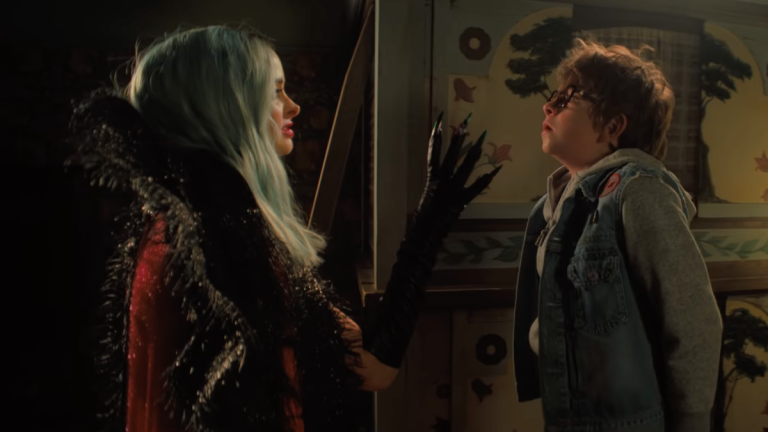
• AXE TO THE BELLY! Lost is never afraid to go gruesome on us – yet another reason to savor it. Claire kills Justin (which is a shame, as I really dig this guy) after learning the truth – Kate took Aaron, and the Others have never had him. This pretty much confirms Claire’s descent into Island-fevered, “infected” insanity.

• The “Welcome all Candidates” line on the above poster is the sort of detail that makes me smile.
• David is playing the same classical piece which we saw young Daniel Faraday attempting, but where Hawking bent Daniel’s future to her apparent will, Jack will bless his son to follow his own destiny – a very Jacobian thing to do.
• The wordless moment in which Jack fully absorbs his son’s ability, and the way in which this sequence is shot, is incredibly moving to me.

• The mysterious Dogen appears in the off-Island universe as the father of one of the other Williams Conservatory “candidates.” Given that Jack doesn’t have a son in the on-Island universe, should we assume that Dogen doesn’t either? Or will his son play a factor in how he arrives on the Island?
Dogen: “They are too young to have this kind of pressure, aren’t they? It’s hard to watch them and be unable to help.”
• I’d like to single this line out, since it seems to me to resonate with Jacob’s apparent approach to castaway orchestration. In the metaphorical sense, we’re all “young,” and dealing with the pressures of the world. As children, our parents could have attempted to step in and make things “easier” for us, but arguably that sort of direct interference doesn’t help children – it certainly didn’t do much for Jack. Instead, that kind of direct meddling tends to stunt growth. As Locke pointed out in The Moth, he could help the insect free itself by cutting open its cocoon. But doing so would only hurt the moth, despite any good intentions. Children must be free to learn how to deal with life, to make their choices, in order to grow and become strong adults. And Jacob’s actions and demeanor seem to reflect this attitude. Despite comments to the contrary, Jacob has not been running around all season solving things by being magical. He’s popped up to ask Hurley for help twice, and in both instances, does absolutely nothing else. In a sense, his nudges might be compared to a concerned, but ultimately distant parent figure who knows that these castaway “children” must fight to free themselves or be damaged irreparably.
The Man in Black has done a nice job of illustrating how Jacob has kept things from the castaways, but I’d argue that this doesn’t mean Jacob is “evil,” or that the MiB is “good” or even right. If anything, judging from the metaphors the show has already provided us, the Man in Black seems to be advocating for cutting open the cocoon, consequences be damned. And while that kind of brutal insistence is undeniably attractive, it’s also undeniably simplistic.

• With the revelation of the Lighthouse and the mirrored miracle that it contains, Lost introduces another Wheel to its mythology. Whereas the Frozen Donkey Wheel was buried deep within the earth, and had the ability to shift the Island and its castaway inhabitants through time, the Lighthouse Wheel appears to offer glimpses in time and/or space. Are we looking at different places in the same time-stream? Are we seeing possible worlds? No clue. But there’s a lot of names on that Wheel (see Lostpedia for a listing of the visible ones).
• Note that the center of the Wheel seems to contain a stone basin with ashes, suggesting that, like The Pharohs of Alexandria, fires were set to reflect the light from this place to guide ships, or to illuminate the inner visions of the mirrors at night. Is the lighthouse meant to bring people to the Island from other places? Or is it instead meant to bring people who are already on the Island to a new place within themselves?

• So, what’s with all the mirroring/reflective imagery in this episode? And how does it potentially tie in with these Existentialist ideas that seem to be directly referenced by the show? Before I answer that, take a gander at this:
“The thirty birds read through the fateful page
And there discovered, stage by detailed stage,
Their lives, their actions, set out one by one –
All that their souls had ever been or done:
And this was bad enough, but as they read
They understood that it was they who’d led
The lovely Joseph into slavery –
Who had deprived him of his liberty…
The chastened spirits of these birds became
Like crumbled powder, and they shrank with shame.
Then, as by shame their spirits were refined
Of all the world’s weight, they began to find
A new life flow towards them from that bright
Celestial and ever-living light.
Their souls rose free of all they’d been before;
The past and all its actions were no more…
They ask (but inwardly; they make no sound)
The meaning of these mysteries that confound
Their puzzled ignorance – how is it true
That ‘we’ is not distinguished here from ‘You’?
And silently their shining Lord replies:
‘I am the mirror set before your eyes,
And all who come before my splendor see
Themselves, their own unique reality…
Though you have struggled, wandered, travelled far,
It is yourselves you see and what you are.’”
– The Conference of the Birds, by Farid Ud-Din Attar
Isn’t that lovely?
The Conference of the Birds is a 12th century poem which tells the story of a flock of differing birds that undertake a journey to find “the Simorgh,” aka, The Lord, aka God the Father. Each of these birds represents some aspect of humanity – love, vanity, pride, doubt, faith, and so on. Each is flawed, and unsure about their quest. Passing through seven valleys (which represent seven stages on the path to enlightenment to the Buddhist’s eight stages), they finally arrive face-to-face with their Lord, their Father, and discover that he is them, and they are he. They arrive to find a mirror, a reflection. As in Existentialism, they are all that exists.
The poem was written by the Sufi mystic Farid Ud-Din Attar. Sufism is an “esoteric” belief system that was (and probably still is) considered heretical, in part because “it was held to be incomprehensible and dangerous if expounded to those who had not received the necessary spiritual training.”
Because Sufism was a closely-guarded doctrine, only its outlines are available to us. Those outlines, as presented through books and/or Professors of theology, present a belief system that verges on Existentialism, but a kind of “Existentialism-in-reverse.” A “Mirror image,” if you will, of the belief that there is no divine “God.” Existentialism argues for a universe in which there is no inherent meaning, in which there are no “higher Forms” to push us around, shape, inspire or judge us. Under an Existential view of the world, the “shadows” on the cave wall that Plato spoke about are all that is real. There’s nothing behind us, unseen, making those shapes in the firelight. It’s just us, huddled ‘round the flames, telling stories to keep the dark at bay.
Sufism exists as a kind of Looking Glass reversal on those ideas, in that it claims that only God truly exists, and that all other things in the universe (including you and I) are essentially his “shadow.” Under Sufism, all religions are useful in some way in that they all encourage a search for universal Truth. Under Sufism, our human notions of “good” and “evil” are meaningless to God, “who knows only unity.” Sufi mystics believed that recognizing this would help a person find the road to “enlightenment,” and to eventual “oblivion in God.” Sartre called this kind of confrontation/meeting and subsequent annihilation “Othering.”
Sartre and Attar arrive at what is basically the same conclusion through radically different means. Sartre uses the rational “scientific” approach of Philosophy. Attar uses the arational “mystic” approach of Religion.
I don’t think it’s a stretch to relate Jack’s journey in this episode with the journey of the flock in the Conference of the Birds. Like them, he’s seeking his father both literally and figuratively, in the missing body of Christian Shephard and in the bodiless apparition of Jacob, the allegorical “Simorgh” of the Island. Like them, in seeking his father he finds himself, reflected. Both literally in the mirror of the Lighthouse, and figuratively, in the face and emotions of his son, David. In fact, the journey of the birds further reflects the journey of all these castaways, who’ve passed through valleys of doubt, confusion and temptation, losing friends along the way, only to arrive and find themselves reflected in a mirror. They are all that exists, because they are God, and God is all that exists. If they had been told this information before they’d set out, would they have made the journey? Would the true meaning of that revelation actually “mean” anything other than in the academic sense? The answer is no. And that fact makes me think about the ways in which the castaways have been kept from information, while still being nudged along the journey.
• The notion of a mystic sect devoted to guarding Truths from an uncaring/hostile/unprepared world, who hide their mysteries in riddles, and reveal them only to initiates – to “candidates” – sounds a fair amount like our old friends the Others.

• Check that out – that’s not the Others’ Temple. So what exactly is it? A glimpse at Dogen’s pre-Island life?
• In the Season 6 thread, people have been pointing out that it really makes no sense for Jack to smash the mirrors and not, say, attempt to figure out what the deal is with the MAGIC MIRROR THAT SHOWS YOU YOUR CHILDHOOD HOME. I agree. But I also think logic is beside the point on at least two levels here: For one, Jack always smashes shit he doesn’t understand. It’s his go-to “I’m-so-aggravated-that-my-veins-are-a’bulgin” signature move. But on another level, it’s symbolic of something larger. Both Sartre and Attar advocate for a form of oblivion – Sartre in the meaninglessness and subsequent resulting freedom of life, and Attar in the realization that God and man are one. Both see a shattering of a “mirror” as being necessary to achieve true enlightenment. For Sartre, it’s the “mirror” of the Other. For Attar, it’s the veneer separating God from ourselves. In shattering the Lighthouse’s mirrors, Jack is shattering his “Other,” and removing that obstacle from the path to enlightenment.
Sound crazy? Note that the scene directly following this particular Jack-Attack involves Jack forcibly seizing the reins of destiny and fixing something – the relationship between him and his son.
Jack: “You know, when I was your age my father didn’t want to see me fail either. He used to say to me that – he said I didn’t have what it takes. Spent my whole life carrying that around with me, and I don’t ever want you to feel that way. I will always love you, no matter what you do. In my eyes, you can never fail. I just want to be a part of your life.”
• Cue the waterworks. Yes, I’m a sap. But that’s obvious, no? On a larger level, Jack is coming to terms with something profound inside himself through the “mirror” that is his son.
Jacob: “Jack is here because he has to do something. He can’t be told what that is – he’s got to find it himself.”
• Jacob appears to Hurley again, post-Lighthouse-breaking, and it’s heavily implied that no one is coming to the Island – that Jacob simply wanted Jack to see what was inside, and to do what he did. What was that? The obvious answer is that Jacob wanted Jack to smash the mirror. But I’m thinking it’s ultimately not that simple. I believe that Jacob simply needed Jack to make a choice – preserve what’s come before, or end the cycle. And I think that Jack’s choice pleased Jacob, because it was an assertion of free will.
• Interestingly, free will isn’t all that’s important to Jacob, and we learn that he specifically wanted Jack and Hurley as far away from the Temple as possible. Ominous, to say the least. Can we assume, then, that either Sayid will soon be “activated,” or that the Man in Black will be arriving at the Temple with his “recruits” in the next episode?
Claire: “I’m so glad to know you were lying, because if what you said was the truth – if Kate was raising Aaron? I’d kill her.”
Anti-Locke: “Am I interrupting?”
• Finally, the identity of Claire’s “friend” is revealed. It’s the Man in Black, and Claire appears to be able to see through his “John Locke” identity to someone else beneath. This is her “friend,” and it confirms that Claire has been “claimed,” though we’re still unsure what that means. Clearly she’s unhinged enough to kill indiscriminately. But is this psychological? Biological? Spiritual? Will Locke, Sawyer, Claire and Jin storm the Temple? Judging by the lack of images we’re given in the tease for next week, I honestly have no idea. But something big is coming, and I can’t wait to see what it is.
*****
If you enjoyed this column, please Digg it using the button provided below!
To view the complete Rewatch archive and related articles, please visit Back To The Island.
To talk about/join the discussion about Season Six, jump onto the Message Boards.

Lighthouse (S6, ep. 5)

“Come you lost Atoms to your centre draw,
And be the eternal mirror that you saw.” – The Conference of the Birds, by Farid Ud-Din Attar
Jack: “I came back here because I was broken. And I was stupid enough to think this place could fix me.”
Reflection. If there’s one word that sums up the overall vibe of this week’s episode, it’d be that one. Jack’s image is reflected in the Temple waters, and in the Lighthouse mirrors. We hear him reflect on why he returned to the Island. We watch as he stares out to sea, reflecting on what’s happened to him and “his people.” We see Jack reflected in his son, which causes him to reflect on the relationship between himself and his own father. Even the episode itself is a reflection, a mirror, of the Season 1 episode “White Rabbit,” in which Jack spends the entirety of the episode chasing the “ghost” of his dead father in various literal and figurative ways.
And while all of this is “cute,” I’m going to argue that it’s also more than that. Mirrors and reflection have suffused this show’s storytelling from the get-go, and as the final season slouches its way toward Bethlehem to be born, those thematic underpinnings are rising to the surface and suggesting some fascinating things. Last week I tried tackling Existentialism, which is a little like a 10 year old girl trying to tackle Adrian Peterson. Still, I hope that the essential point I was trying to make came through to you. If you’d like to refresh your memory you can re-read my ramblings here. I’d advise it. Because while “The Substitute” seemed to swim in the murky waters of “Being and Nothingness,” this week’s episode, “Lighthouse,” brings to mind what might be called Existentialism’s “mirror image,” a very fitting name in an episode where mirrors both literal and figurative cast Jack’s face back at himself.
Two things before we start this train a-rollin’:
1) I recently had the opportunity to interview Hiroyuki Sanada, who plays Dogen the Temple Master on Lost. It was a pleasure to speak with Mr. Sanada, and he shared some interesting observations and anecdotes about Lost and his (enormously impressive) career. Want to learn about Sanada’s time battling man-eating plants? His discussions with Damon Lindelof and Carlton Cuse regarding joining the show and the portrayal of his character? Interested in knowing something interesting about his character’s name? Then tune in early next week. My thanks to Devin for offering me the interview. It was kind of him, and it was much appreciated.
2) As you’ve already noticed, this week’s column is late. My apologies for that, but I’ve run something of an insane, hellish gauntlet over the past 72 hours, and I’ve had exactly zero minutes to devote to thoughts of Lost. As a result, this column may be a little more scatterbrained than most. You’ve been fairly warned. So, keep your hands and feet inside the Doombuggy at all times, hold on to your hats and glasses, and let’s do this, Brutus.
Thoughts:
• Off-Island, Jack seems uncertain about how he got his appendix scar. His mother tells him that it happened when he was “7 or 8,” that he collapsed on the playground. Christian had wanted to perform the procedure, but was denied. We all remember that Jack’s appendix came out in Season 4, just as he was coming completely unhinged by the effort to get the castaways rescued. What’s the significance of this?
Well, in the past I’ve suggested that detonating the Jughead bomb would result in the castaways’ consciousnesses traveling “back” in time to serve as kind of “past life” memories in a way similar to how Daniel’s rat learned to run her maze easily by having her future consciousness shift back into her “present” body. While Jughead doesn’t appear to have done the job of resetting the timeline, it’s still possible that this general concept is playing itself out in the “sideways” universe. Jack seems to sense that something is off about his scar, and it makes me wonder whether he’s forgotten how he received the scar (which is how it plays to me on-screen), or whether he’s begun to feel like he has two sets of memories – one that he’s always had (where he gets the appendix taken out at 8) and a new sense/memory that it was removed another way.

• So Jack’s a dad in this off-Island universe. Of all the off-Island differences we’ve seen so far, this one makes me happiest. Not only does the episode as a whole seemingly support the Second Snake Theory I’ve been raving about since the premiere, but it also throws Jack’s emotional journey/baggage into new relief, and it provides him with a window of opportunity to become the man he truly wants to be. It allows him, in the words of Aldous Huxley, to achieve “good being,” by realizing what he is not (namely, his father) and so opening the way to discovering who we truly is, or would like to be (a good father).
• Incidentally, the name David has serious Biblical significance. During the course of this episode we never learn who David’s mother is. Is it Sarah, whom Jack married, then divorced, then stalked as if his life depended on it? Is it Ana Lucia, whom Jack seemed to have a potential romantic connection to in Season 2? Is it Juliet, whom Jack might have met in Medical school in this off-Island reality? Who knows! Biblical David’s mother was similarly mysterious. Her identity is never given in the Bible (although she is named in the Talmud). Biblical David was a renowned musician, among other things, and he’s the stone-slinging dude responsible for taking down the giant, Goliath.
Jack: “Is leaving even an option?”
Dogen: “Everything is an option. But I would have to stop you.”
• Lighthouse spends a fair amount of time carefully underlining what seems to be the basic point behind Jacob’s philosophy (assuming, that is, that Jacob and his Others aren’t going to be revealed as Machievellian supervillians in the Eleventh Hour, and I’m fairly sure they won’t be). Dogen’s comment here is the first instance of this. “Everything is an option,” Dogen says. But for every action, to steal from the Scientific parlance, there is an equal and opposite reaction. Jack is free to make his own decisions, but those decisions have consequences, and the people around him are free to make the decision to stop him. I’m enjoying the subtle sense of connection that’s being formed between Dogen and Jack.
• Miles and Hurley’s makeshift game of Tic Tac Toe recalls the apparent “stalemate” status between Jacob and the MiB.
Jacob: “Someone is coming to the Island. I need you to help them find it.”
• Jacob makes another of his ghost-appearances to Hurley and persuades him to take Jack to the Lighthouse. Given what happens at the episode’s end, it seems as though no one new is actually coming to the Island at all, and that Jacob simply needed Jack to perform as expected/hoped/foretold.

“I wonder if I’ve been changed in the night? Let me think: was I the same when I got up this morning? I almost think I can remember feeling a little different. But if I’m not the same, the question is: who in the world am I? Ah, THAT’S the great puzzle!” – Alice in Wonderland
• That particular line comes from Season 4, where we watched Jack reading to Aaron. And it has a renewed significance here in the off-Island universe, where we’ve seen the characters having feelings similar to Alice’s – something has changed “overnight.” More generally, the question of who these characters really are is one that the show has been asking from the beginning.
• In addition to the overt shout-out to Alice here, we also get another occurrence of rabbit imagery in this episode, when Jack picks up a stone bunny to retrieve his ex’s house key. One of the bigger thematic questions raised this season is whether Jacob has been leading the castaways along throughout their lives, drawing them to the Island like the White Rabbit drew Alice to Wonderland. In a sense, I think that this is true, but I don’t believe that Jacob has been “pushing” them, as Anti-Locke characterized it (in a moment that seemed very personal to him). If anything, Jacob’s simply set “markers” down along the path, and the castaways have chosen for themselves whether or not to follow those “markers.”
• Jack’s comment that he set the cable up so David could watch the Red Sox illustrates, I think, the sort of blind assumption that a lot of fathers make. Jack’s a Sox fan, and so he assumes that his son will be as well. But David is his own person, making his own choices, and so he’s become a Dodgers fan. Of course, it could also be a hint that things are subtly different from when Jack got up this morning.
• Back on the Island, Jack tells Sayid about the poison pill that Dogen gave him, and I’m wondering whether that honesty – the trust that Sayid and Jack seem to genuinely share after all they’ve been through – will protect Jack once Sayid’s “infection” spreads and “claims” him.
• We cut back to Jin, who’s been severely injured by a bear trap (!) set by the Rousseau-ified Claire. Claire, as we’ve been told, has also been “infected” in a manner similar to Sayid. The effects of this infection seem to include paranoia, the ability to casually murder people, and an inability to take a bath. Claire’s seeming friendliness toward Jin confuses me. Is she still the same basic person, but is no philosophically/emotionally “infected” by the MiB’s words and beliefs? Is the infection essentially a metaphor for falling into a state of doubt and hate? Or is there some kind of physical/spiritual component to this process?
• And on another interesting note: Claire’s been on the Island for three years now – from 2004 to 2007. During that time, she apparently didn’t “skip” through time like the rest of the castaways. Is this because she was already “infected” prior to the turning of the Wheel? It seems that way, and her behavior in “Jacob’s” cabin also seems to back this up. How would Claire have been “infected”? It’s possible that it happened after she was led off into the jungle by Christian. But it’s also possible that it happened when Martin Keamy and his crew of Mercs sent a rocket straight into Claire’s Dharma bungalow. Sayid’s “infection” arose after our favorite Iraqi seemed to come back from the dead. We watched something arguably similar when Sawyer dug Claire from the wreckage. And we’ve seen that Christian’s dead body disappeared once it landed on the Island. Have all three of these characters somehow passed through death and into an “infected” state?
• Hurley uses Jacob’s instructions to locate the secret exit from the Temple. There are a number of hieroglyphs scattered through the Temple hallway, and despite my efforts, they remain untranslated. I enjoyed watching Jacob’s “ghost” instruct Hurley on how to tell Dogen off, and I enjoyed Dogen’s muttered Japanese even more. Roughly (emphasis on “roughly”) translated, it apparently means: “I have to protect you? Great. If I don’t leave now, I’ll probably separate your neck from your body.” Which is hilarious.
• So “candidates” are permitted to walk freely and go where they will? This makes perfect sense for potential Jacob replacements, emphasizing both their complete free will to choose as they want, as well as the attempted determinism of Dogen, in keeping that information from them.
• Do you want to know why I feel an inherent trust toward Jacob, despite his veiled machinations? It’s because Hurley seems to trust Jacob, and I trust Hurley.

• The symbol on the Temple wall here appears to be a modified “Omega” symbol – one with no apparent Egyptian Hieroglyph counterpart. “Omega” is a Greek letter that, Biblically-speaking, symbolizes “The End” (as in “I am the Alpha and the Omega, the beginning and the end.”). That seems appropriate, given the sense we’re getting that this is the last iteration of Jacob and the MiB’s Cosmic Backgammon Game.
• That said, for all I know, it’s actually an Egyptian hieroglyph with a completely different meaning (“Property of ABC”?). Note that, unlike the traditional “Omega” symbol, this one has a solid middle. Anyone else have ideas/information on what this baby means?
Great Hurley Line: “You ever try to get Jack to do something? It’s, like, impossible.”
• That’s the kind of chuckle-inducing insight that makes me love the Island’s resident Buddha figure. There’s an old saying: “You can lead a horse to water, but you can’t make him drink.” As applied to Jack, that saying might be “You can try to lead a horse to water, but you’ll most likely end up watching the horse stubbornly dying of thirst.”
Hurley: “You have what it takes.”
• Is it coincidence that the Island’s resident “God” figure – the “Father” of the Island – uses the mirror-reversal of Christian’s comment to Jack in Season 1’s “White Rabbit” in order to get Jack to go to the Lighthouse? I don’t believe it is. Jack’s actual father didn’t believe that Jack had “what it takes.” Jacob, apparently, does. In White Rabbit, Jack chases the “ghost” of his dead father through the jungle, but arrives at an empty coffin, which he smashes. In Lighthouse, Jack chases the “ghost” of dead Jacob, the Island’s “father,” but arrives instead at an empty Lighthouse, where he smashes the glass.
At the least, Jacob knows that hearing these words will motivate Jack. And I’m left wondering whether Jacob’s “future knowledge” (the knowledge that seems to account for the Others having constructed a runway for the Ajira flight) is involved in guiding these characters to certain places. Is he playing Daniel Faraday, and arranging things to reflect “whatever happened, happened”? I don’t think so. Rather, I think that Jacob is arranging the end-game here. He may even be consciously going against what he “knows” will happen in the future. We’ve seen that “whatever happened, happened” is the functional equivalent of the Man in Black’s comment that “it always ends the same.” Is Jacob’s goal to change time’s course? To act as Cosmic Desmond, and save “Charlie” (ie the castaways/the Island/the world) despite the universe’s determination to end them?

Claire: “If there’s one thing that’ll kill you around here, it’s infection.”
• Returning to Jin, we find that he’s come awake in a filthy tent – despite their technological advances, Dharma apparently didn’t have the equivalent of Purell/Febreeze/a vacuum – which Claire’s been living in for some time. The state of the place emphasizes that something has gone seriously wrong with her. Rousseau’s hideaway was cluttered and eerie, but I don’t remember it being this…decrepit. Also, Rousseau didn’t have freaky faux-babies made from animal bones, sticks and moss lying around.

• I mean, cripes. Lost has no shortage of eerie/creepy moments, but Claire’s bone-baby shoots to the top of that list effortlessly.
• Despite the presence of the bone-baby, and Claire’s increasing comfort with the act of homicide, I’m left thinking about how relatively “natural” much of her behavior is. She believes that the Others have taken her baby, so as a mother it’s actually understandable to see her treat Justin the Other this way. In many ways, Claire and Rousseau now echo each other, which begs the question: was Rousseau the “infected” one? It doesn’t seem that way. So what’s the deal? I’m hoping we get some answers on the infected soon, because it’s starting to bother me.
• I enjoyed this episode, and I’m more or less a Lost apologist when it comes to ignoring/excusing/creating a reason for some of the show’s decisions. But even I rolled my eyes after Jack’s mother found Christian’s will. If it’s like finding “a needle in a haystack,” then I guess the stack is about a foot high, and the needle’s about a foot long.
• Christian shares Widmore’s appreciation for MacCutcheon scotch.
• Proving that you can find meaning in anything, the law firm name on the outside of Christian’s will is an anagram for “Dad Off Horizon. Wow, rut!”
• Here in the off-Island universe, Christian appears to remain the father of Claire Littleton, and his Will gives some kind of direction regarding her. Are we going to discover that Christian’s last wishes include a union between his son and his daughter? Signs point to “yes.”
• The tension mounts back in Claire’s spooky lean-to, and we learn that “her father” and “her friend” have both told her that the Others are keeping her baby. Does this imply that the Christian we saw in Season 4 was a manifestation of the Man in Black, who manipulated Claire into joining him? I’ve been on the “Christian is the MiB” train for a while now (see the Rewatch Columns), and the revelation that both Christian and the MiB have told Claire the same thing seems to further cement the connection. But it’s also possible that Christian and the MiB are separate and distinct, but want Claire to believe the same thing for different reasons.
• Hurley and Jack return to the Caves – a location that I keep forgetting exists. Hurley’s question (“What if these skeletons are us?”) seems to kill that particular theory. It’s still possible that the skeletons are castaway-related (we haven’t seen Rose or Bernard since the Jughead Incident).
MORE LOST-Y GOODNESS AFTER THE PAGE BREAK!
28 comments
I love this column, it's a great read after each episode. Don't know if anyone else has though this, but after the last couple of episodes, I have begun to wonder if the "flash-sideways" are nothing of the sort but perhaps the actual "end" of the series. What if there was only one outcome of Juliet hitting the bomb? It didn't go off, and everyone was sent forward in time to the island. Now we are building to some huge climax between Jacob and MIB on the island. What if the end result of this climax is that everything in the characters' lives is reset, and the flash-sideways are the end result of this? Sort of like the end of season 3. We thought we were watching Jack's flashback and it turned out to be a flashforward. It strikes me as odd that a lot of good things are happening to the characters in the flash-sideways (i.e. Jack has a son he reconciles with, Locke comes to terms with his life, Claire decides to keep her baby, Hurley is lucky, etc.) Good things NEVER happen to these characters. Maybe we are seeing how their lives are supposed to be, and the confrontation/climax with Jacob and the MIB is how this all happens? Just a thought…
enjoy these more and more every week.it affirms in me a sense of knowing that i am not crazy, and other people are noticing these things. you, sir, got your shit straight.
The "Temple" Jack sees in the mirror is actually where Jin and Sun got married in Season 1
Err…Mike, what you suggest is what Ive been talking about in these columns since the season started. If you missed the Second Snake theory somehow, you can check it out on http://www.losttherewatch.blogspot.com
Thanks for the info, Brian. Clears that question right up. And thanks, all of you, for reading. Your comments are always read and always appreciated.
Thanks again for the column. I'm eager to read every week!!
One thing that is annoying me is that Claire told Jin "If one thing will kill you on this island it's infection." The island has cured paralysis, cancer, people have been shot, stabbed, had their appendix removed with out any signs of infection. I do enjoy your thoughts on Claire and Sayid being "infected." I wonder there there is a connection…
Has it crossed anyone's mind that the lighthouse could be the MiB's residence? As we are shown the House of Jack's father, and a long stated theory being he is a recruit of MiB, he could be watching his own "candidates". As in to counter Jacob's moves in the "grand game". With Jacob living beneath an egyptian statue, it would be natural to assume the MiB living in a similar location.
You missed a chance to play with numbers. Jacob asked Hurley to spin the dial to 108. 108 is the total sum of the Numbers. On an interesting note, the name Wallace was the name listed at 108.
Yep, I agree with #2. It looks just like the place they got married in. And the next episode is entitled "Sundown" I believe, which would effectively mirror season 1.6 "House of the Rising Sun." This season is awesome.
I also really enjoy reading your musings. I've lately been rewatching the entire series on DVD, so everything is fresh in my mind. That as well as reading this particular column has deepened my enjoyment, involvement and understanding of the current season. And it helps make a case for Lost being the great achievement I believe it to be. I doubt there will ever be a better television series. I love The Wire, Deadwood, Twin Peaks, etc. But while Lost hasn't been necessarily as consistent as some of those shows (handicapped by network structure and restrictions, I'm sure), Lost has a built in advantage of drawing from so many different genres and engage viewers on so many levels. I guess it doesn't have to be "the best ever." I can just say I love it. That's enough.
This is probably way off and even I think it's a totally retarded stretch but here goes. I think that despite seeing the name Wallace at 108 degrees that it's still Desmond who is coming to the island. I think that Desmond is an off-island reincarnating entity in a way similar to how Jacob and the MiB are on-island reincarnating entities. It's too much of a coincidence to me that the name Wallace is Scottish, plus I'm sure we all remember that the rules don't apply to him.
I figured the lighthouse not being seen before this week had something to do with what alpert wrote in the truce about "not disturb(ing) any *PREEXISTING* ruins"
ANother nice episode breakdown, Morse. <p> Doombuggies. "Hats and glasses." Good to see another DL fan out there, too.
I was kind of disturbed by Jack telling Sayid that the Temple Others just tried to poison him and that they are looking at him funny because they think he's evil, and then just disappearing with Hugo. Poor Sayid. He must be freaking out.
You are a Lost apologist but were annoyed that they conveniently found Christian's will so easily, but what about the damned light house that was like a half hour's walk away from the caves that existed for so long without them knowing about it?
Good job as always.
I think Sayid is already crossed to the dark side, he was playing Jack like Clair was Jin. I think Sayid is not Sayid anymore, and he was pumping Jack for information. That whole scene just didn't sit well with me for some reason, seemed, uncomfortable. My belief is that Claire, Sayid, Christian, etc. have been taken over by spirits that MiB controls. Thus becoming his followers.
Was happy to see the column up, figured it might not be coming this week. While I think some of your inferences this week may be kind of a stretch, I highly enjoy reading them. Keep up the great work, best column on CHUD!
Good Episode. The moment with Hurley and Dogen, classic. In regards to the number of 108 on the lighthouse dial, I would totally assume that that would refer to Desmond, as he has been associated with those numbers before (the hatch) and he needs to loop his ass back into this narrative, pronto. I love me some Des, brother! I didn't see the dial go to 108, and I didn't see the name Wallace, either. Anyone know where a screen cap might be? AND, did anyone else notice the name Roussou on the dial? It was scratched off, but I swear that's what one of them said. Also, my random guess as to the identity of Jack's son's mother: Penelope Widmore. Just sayin'…….
"all religions are useful in some way in that they all encourage a search for universal Truth"
I really… really wish that were true. Don't they just offer one version of the truth, which you must believe?
Anyone notice Claire's weird baby looked like the original statute where Jacob hid out? For people wondering about Aaron being the new Jacob, that was interesting to me. Also, it was unsettling the way she covered its face. There was something deliberate there for us to catch and I don't hear much about it.
Another fine column! Some comments:
1) I begrudgingly have to give up my "Christian is not the MiB" theory. Although I still don't think the more elusive Christian Jack has seen is the MiB.
2) Someone is definitely coming to the Island. When Hurley bemoans that Jacob's mission is 'unaccomplished', Jacob says that the person will get to the Island another way.
3) I suspect that the Lighthouse, like the Cabin, is not actually where it appears to be. Rather that both move through time and space (like we've seen the Cabin and the Island itself do), making them visible only if you follow the right path – hence Hurley's detailed instructions.
4) Claire killing Justin doesn't indicate 'infection' – Justin had just told Jin that if released, he would snap Claire's neck. So far, 'infected' just seems to be Other-speak for, "doesn't like it when we hunt and torture them".
Great column! That temple in the mirror is from a place called Valley of the Temples in Hawaii. It was the same location they used for Jin and Sun's wedding, so I just assumed that it was a reflection of their homeland of Korea. See a picture of this place here:
http://www.hawaiigaga.com/Images/attractions/valley-of-the-temples-s1.jpg
#17, you can see some screenshots and a list of the the visible names on the dial in the lighthouse here: http://lostpedia.wikia.com/wiki/The_Lighthouse
great column!
You remember the original Legend of Zelda? There was a path you couldn't get through unless you went in the right direction. That is my theory on why they never found the lighthouse before. That and the never looked up.
Wow, it was a long wait, this one, but as ussual, it was great.
What's notable about Claire's ability to recognize MiB as her "friend" and not as Locke is that he's only been in that form for what, a few days? So it seems she's able to see his essence despite his appearance. And yet, she makes a distinction between her friend and her father… This tells me Christian is not MiB, but someone different, even if he also wants Claire to think the Others took Aaron.
Note that Claire and Sayid were put through DIFFERENT tests. Yes, both were branded or marked by the Others, but Claire said she had needles poked in her. Sayid was electrocuted. Why the different tests?
Really enjoy your column. Catching up on the archived ones kept me sane during the haitus.
Wanted to mention that the glyph Hurley was looking for is actually ancient egyptian and call a 'shen ring'.
#26 – I would think Claire was more referring to the needles that Ethan poked her with, not this new group of others.
P.S. Chud, please please please address the captcha situation. It is utterly ridiculous.
Comments are shown as archived from the original site; new comments are closed.