
Thoughts on Double Play:
A solid director seems to make all the difference on this show. Overall, Double Play is far more tolerable as an episode than Checkmate is, and much of that comes down to the way the actors are directed, the way the scenes are shot. Props to Uli Edel, who scrapes most of the egregious cheese from the proceedings despite having to work with some just-plain-awful written material; additional hatred toward Todd Holland, whose work in the last episode seems downright inexcusable when held up next to Edel’s efforts. Checkmate was an exercise in directorial banality – one part Skinemax seduction flick, one part mid-80’s primetime soap opera, almost all terrible – while Double Play rescues some of the much-needed visual atmosphere of the show and regains some ground overall. This is not to say that the episode is great, or that Edel’s skills are anymore near Lynch’s, but Double Play simply plays much, much better for me than Checkmate. It helps that this episode finally introduces us to the psychotic Chess master, Cooper’s former mentor and partner, Windom Earle. Some of you have warned me that Earle will essentially reveal himself to be “a Batman villain” – overly campy and disappointing in execution. I hope that’s not the case. The show has done a terrific job of building up Earle’s mystery and malevolence over the course of the season, and his initial appearance here is anything but campy. It’s creepy in the good way. As I’ve said before, I’m in the dark with the rest of you first-time watchers until the final episode, so I’ll be hoping that Earle makes for a compelling/fun adversary.
Truman: “You’ve seen this before.”
We rejoin the show and its characters back in Truman’s office, where Doc Hayward is examining the dead body of the man that Windom Earle has left for Agent Cooper. The dead man’s finger is oriented to point at the chess board in front of him, and a pawn piece has been stuffed into his mouth. Cooper informs the men that Earle has taken his first pawn, which makes me wonder whether Earle intends to kill 16 people – the same number as on one side of a chess board. Cooper’s description of Earle’s methods, his description of the man himself (“Everything he does has its own rationale, precision and intelligence”) paints Earle as the Moriarty to Cooper’s Holmes. I kind of love this.

I also kinda love the way that Leo Johnson’s been reintroduced to the narrative. He comes “back to life” during a power outage, with the imagery serving as a warped homage to Frankenstein. This episode continues that weird-yet-fun allusion, having him stumble around in a stupefied rage, muttering monosyllabically (yet also, somehow, capable of locking all the doors of the house from the inside while no one’s looking…Yeah, I don’t get it either). His menacing of Shelly is, as was the case previously, pretty legitimately scary stuff. Eric Da Re may have a goofy last name but he makes a decent heavy.
It makes no sense to me that Bobby would tell Shelly he’s never coming back, only to have him show up on her doorstep again one episode later. Still, I’m glad he dropped by if only for the nicely effective jump-scare that results from Leo’s arm suddenly shattering the glass of a window in an effort to grab Bobby and drag him inside.
Uli Edel gets it. It’s the arresting imagery, and the painterly, often-obtuse approach to capturing that imagery, that makes up a large portion of Twin Peaks’ appeal. A shot of an Olde Tyme-y camera’s flashbulb popping as the camera captures the image of Earle’s vagrant victim doesn’t make a lick of difference to the narrative here, but the image nonetheless enhances the scene it precedes, and it’s of a piece with Peaks’ overall obsession with the filming of somehow-ominous inanimate objects. This is a lesson that Todd Holland could stand to learn.
How many times does James threaten to leave Evelyn and her overwrought, Dynasty-lite life behind over the course of this episode? Maybe it’s just the ceaseless boredom, beating down on me like a vast ocean of meh, but it seems like he does this approximately one thousand times in a 40-something minute span. Luckily for all of us, it looks as though this episode marks the end of the James/Evelyn boreathon. I refuse to devote any more verbiage to something so painfully inconsequential.
In other “Nothing To See Here” News, Ben Horne is still crazy as a loon. Dr. Jacoby’s idea of therapy seems to be cheering Ben on as he chases empty victory. It’s great to see Jerry Horne back in the mix, and I always enjoy watching these three work, but there’s nothing of consequence going on here that I can tell. Goofy, over the top, and largely meaningless – that describes more than a few of Peaks’ subplots at the moment.

Cooper: “Harry, I’ve brought some baggage to town with me I haven’t told you about.”
After some serious foreplay, we finally get some in-show background on Cooper’s past, his relationship with Windom Earle, and the woman he loved and lost. If you’ve chosen to read Cooper’s “Autobiography” then all of what we learn here is stuff you already know. If you haven’t read it, I suggest that you try to skim through the sections on Earle, Cooper and Caroline. They give some much-appreciated color to the story that Cooper relates here. My impression after reading the account in Cooper’s book is that Windom Earle essentially set Caroline and Cooper up to fall in love so that he could then murder Caroline and destroy his partner. Cooper’s words regarding his former mentor do a great job of creating fear and tension around Earle’s still largely-unknown capabilities. Here’s hoping that the show doesn’t squander all of its hard work by having Earle be too campy (I’ll gladly accept some camp, since an “Evil” version of Cooper would reflect his quirks as much as his competence).
Another detail Uli Edel (and the writers) gets right: the offbeat scene opener in which the Major, Cooper and Truman sit around gulping water like men just in from the desert. No explanation, no context, and no hamminess. It’s just short and strange and then it’s gone.

Can someone please explain the point of the Lana Milford subplot to me? Is she supposed to have some magical man-bewitching powers that will somehow have some kind of possible degree of potential relevance to the show?
Speaking of subplots whose relevance I’m currently questioning: What’s going to happen now that Andrew Packard has been revealed as very much Not Dead? We’re getting a lot of tease here, but very little else. It is nice to see David Warner show up as the mysterious and apparently-dangerous Thomas Eckhardt. Andrew Packard resembles Jack Palance enough so that I expect him to summon a fat corrupt policeman by that name in order to betray Jack Nicholson.

(This Newspaper is really, really excited about Asian men being murdered)
Most boring, pointless moment of the episode? I’d have nominated any scene featuring James and Evelyn, but to my surprise the Top Honors (so to speak) should probably go to Doc Hayward’s lengthy (I mean, Jeebus) speech about how hard Little Nicky has had it, how tough his life is, etc etc et al ad nauseum on ad infinitum. Painfully dull. I’m assuming that Nicky will turn around to actually be Evil after all? Otherwise, this is one of the worst narrative dead ends I’ve seen in some time. Still liking the Andy/Dick interplay though.
I love that there are multiple police cars surrounding the Marsh residence, and yet no one sees James clumsily sneak off, or sees Donna meet up with him in what seems like plain view, or sees them both clumsily sneak off some more.
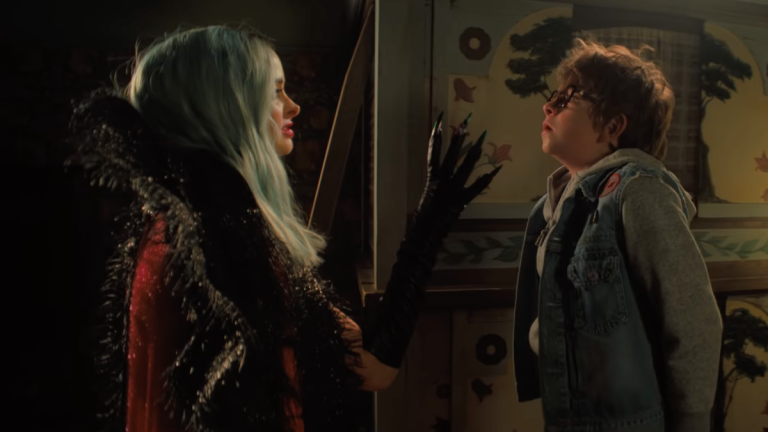
The episode concludes with the sight of Leo Johnson stumbling through the Ghostwood forest and happening upon a dilapidated old cabin that could be straight out of Lost. The inexplicable Frankenstein homage continues as Leo goes inside, lured by what seems to be music, and we see that a shadowed figure has laid out several flutes/whistles, in what’s basically a riff on Frankenstein’s encounter with a blind dude (here’s a truly weird recreation of that moment, featuring some kid in a parka and some girl in a cowboy hat with a guitar – come for the awkwardly read soliloquies, stay for the ramshackle “fight” scene!).

Only, this isn’t some friendly blind man essayed by a clumsy Gene Hackman – this is Windom Earle revealed at last. It’s a nice, effective introduction to him – creepy and quiet and atmospheric. At first meeting him he’s exactly what I’d pictured – a grimy, unkempt, wild-eyed mirror of Dale Cooper. Let the games begin, Mr. Earle. Try not to camp the place up too much, mmmkay?
That’s it for this week – what did you think? Let me know in the comments or in the Lost & Found thread on Chud’s message board. We’re closing in on the end of the show. Eight episodes left to go, then Fire Walk With Me, then the next round of voting where you’ll decide what I/we watch next. Taste the excitement!

Checkmate & Double Play (Twin Peaks S2, eps. 13 & 14)

Major Briggs: “Oh God…Is this meant for the soul? My soul?
Thoughts on Checkmate:
Ah…so THIS is what “fallow period” means. This week’s episodes illustrate, near-perfectly, the sorts of elements required to make Twin Peaks “work,” and what happens when those elements aren’t present: we end up with an episode like Checkmate; as godawful an episode of Twin Peaks as I’ve seen, yet still not without some intriguing/redeeming qualities. I don’t think it’s any coincidence that Todd Holland directed both this episode and the previous Season 2 episode, Laura’s Secret Diary. Both Holland installments are solidly, woefully mediocre additions to Twin Peaks’ narrative; the equivalent of a Happy Meal when we’re used to being served Televisual steak.
But it ain’t all a travesty. Like, how about that opening scene, huh? Cheesy, pre-CGI graphic aside, I thought it worked well. The conflation of UFO and mystic imagery on this show is pretty unique – typically, our entertainments don’t choose to mix the general realms of “Fantasy” and “Science Fiction,” since (in my humble opinion) they don’t typically mix very well. That said, they’re mixing well for me here. Many ancient cultures portrayed their gods as riding in “sky chariots,” a detail that lines up nicely with modern day tales of UFO visitations/abductions. The triangular shape of the object that appears in this sequence is consistent with claimed UFO sightings, and recalls real-world unexplained phenomena such as “Pag’s Triangle,” a location in Croatia that some UFO-theorists believe was the sight of a long-ago alien visit. Drawing an even closer association between the show’s previous mysticism and these hints of alien involvement is the “brand” of scar tissue that Major Briggs now displays behind his ear – a branding of three triangles joined at one point, and an echo of the shape that we saw come down from the sky. Finally, Major Briggs comes somewhat cleaner about his classified work, and reveals that he’s involved in a still-functional, “unofficial” Project Blue Book – an Air Force investigation into UFOs.

What’s unclear to me is whether the addition of potential “alien” elements is meant as a distracter (meaning that they’ll turn out not to be extraterrestrial in nature), or whether they’re meant to be a straightforward addition to the show’s unique cosmology. Either way, there’s no denying the cool/spooky vibe of the scene – in which we witness what appears to be a UFO crash, then glimpse Major Briggs seated on a carved stone throne in the midst of a forest primeval. It’s my impression that we’re witnessing a glimpse of the White Lodge, or an aspect of it, and that Briggs appears to hold a place of some importance within it/to it. We learn that this unofficial Project Bluebook has been searching for the White Lodge, but not how, or why. How do aliens tie in to concerns about the human soul, if at all? How does the apparent mysticism of Mike, Bob and the Giant fit with Little Green Men? Answer me, Twin Peaks!!
Owls again prove their importance to the narrative of the show as the Major reports remembering the image of a “giant owl” from the time of his disappearance, and nothing else. Briggs claims that the image of the owl has somehow clouded his “mind and memory,” and this again ties the mystic and the extraterrestrial together.
And hey – did you notice that ghostly voice moaning “Coooooper” just as the deep-space communications revealed Cooper’s name being transmitted from the Ghostwood forest? Or the way that the water from the Station’s sprinkler system falls on the photograph of the Major’s new neck tattoo, and the way in which Cooper & Co. draw our attention to this seemingly-innocuous detail? Is Water symbolically important on this show in the same way that Fire is symbolically important? I’m going to go out on a limb here and say “yes.” With Fire so strongly associated with Mike, Bob and the “negative” forces that presumably inhabit the Black Lodge (and perhaps Earth as well – remember the mounds of earth that Bob/Leland created at the scenes of his crimes), it makes thematic sense that there would be a counterbalancing elemental force at play, and Water counterbalances Fire nicely, as Air (an element now associated with the Major’s abduction thanks to the UFO stuff and the Major’s mentioning of “the heavens”) counterbalances Earth.
The problem with a plot as compelling as the Major’s is the same problem that we encountered when Laura’s murder remained unsolved – most of the show’s other subplots pale in comparison. There’s inherent intrigue in the sting operation that Cooper and Denise are setting up in order to clear Cooper’s good name with the bureau, and my deep affection for, and interest in, Cooper’s character makes any scene he’s in good if not great. The Windom Earle subplot has been running under the surface of the show for some time now, and I’m a big fan of the way that the show’s writers have teased it out for us. But the same can’t be said for some of these other subplots and, as amusing/entertaining as some of them might be, they don’t have the same strength or magnetism. As a result, this episode (and the next) often feels disjointed and unsteady – a car with three working tires and a flat.
It doesn’t help that this installment’s director – Todd Holland – shoots the entire thing like he’s helming an episode of Falcon Crest. There is none of the usual visual magnificence that Twin Peaks so regularly displays, the acting is pancake-flat when it’s not oddly off and off-putting (Cooper isn’t Cooper for most of this episode, and for the first time I understand Lynch’s comment that not all of the directors knew how to bring the “true” Cooper out of MacLachlan).
Dick: “Where have you been Andrew?”
Andy: “There was a cat in a tree.”
Despite the overall shrugworthiness of the Lucy/Andy/Dick storyline I’m still finding myself enjoying the strange interplay between Andy and Ian Buchanan as Dick Tremayne. The “Is Little Nicky the devil?” subplot will likely fizzle out and/or end up disappointing me, but I’ll continue to enjoy these two actors playing off of one another for the time being. I got a good laugh out of them being mistaken for employees of the Helping Hands agency, and by Dick telling a couple of eager, prospective adoptees that the boy they were interested in is dead – then amending himself and telling them that the boy is “dead-tired.”
We finally (FINALLY!) get some forward movement on the dead-in-the-water-like-a-homecoming-queen Bobby/Leo/Shelly storyline, which is a huge relief, since I was beginning to wince every time the show cut back to them. Bobby’s momentary success in impressing Ben Horne and his flirtations with Audrey seem to have severed his sense of responsibility to Shelly and their previous “master plan.” He leaves and says he’s not coming back. By the end of the episode we’ve witnessed the resurrection of Leo Johnson in an admirably-creepy scene involving a toy clown, a deflated balloon, and some effectively flickering electric lights. I welcome Leo’s return to non-vegetable-hood, if only to stop the ceaseless procession of images in which Eric Da Re (I still can’t believe the actor credits himself that way – it’s so very, very affected) sits there staring/drooling/doing NOTHING.

(Evelyn Marsh was terrified of losing control over her Optic Blasts)
James: “I need you to get all the money out of my savings account.”
Big Ed: “That’s only twelve dollars James.”
I find this inexplicably funny. I find James’ storyline just plain inexplicable. Was this kid some kind of heartthrob back in ’91? Why are they keeping this barely-animated block of wood around? And why are they saddling him/us with this moldy, musty storyline fit for Skinemax, but sans Skin? Does Twin Peaks want to make me suffer? From the evidence submitted, I’d say that the answer is “Oh yes – you have not yet BEGUN to suffer.” But that said, I am enjoying the James storyline in the ‘dear God, can it get any worse?’ sense. Did you catch those ENORMOUS blind-lady sunglasses Evelyn Marsh was wearing? And what about James and Evelyn’s cork-popping, car fender-mounting shenanigans? Funny as anything, though not intentionally.
I’m not as annoyed by the Mad Pirate High Schooler Nadine subplot, but that’s because Wendy Robie – who plays Nadine on the show – is so admirably committed to selling me on her character’s drunk-on-the-blood-of-the-dark-god-Kali insanity. Do I care whether Mike Nelson submits to Nadine’s Hulk-ian “charms”? Nope. Do I care if she and Big Ed stay married, or if he’ll end up pairing off with Norma after all? Not really, although I think Peggy Lipton and Everett McGill do consistently solid work together. But I do enjoy Robie’s performance, and as long as the show continues to insist on foisting this subplot on us I’ll continue not caring about it and enjoying her performance in relatively equal measure. I’ll admit that I got a kick out of seeing Nadine beat the holy hell out of Hank after Hank assaults Big Ed for the crime of surreptitious snugglebunnies with Norma.
But at the top of the ‘never cared, never will’ pile is the Josie Packard storyline. A wash, a waste, a wankfest…pick your favorite W-word, it all ends up at the same place: Josie is a TERRIBLY uninteresting character, and her storyline has been consistently, terribly uninteresting from inception. If awards were given for “least interesting character on a television show, dramatic” Josie would win each and every year – including those years in which no one bothered nominating her out of lack of interest.

Truman: “Consider yourself deputized. The bureau’s loss is my gain.”
In one of those ‘so obvious I should’ve seen it coming a country-mile away’ moments, Truman deputizes Cooper as they work to ready themselves for the sting operation they’ve set up. It’s a great little moment and Cooper’s heartfelt response (“I hope I can live up to this”) is funny and poignant. An FBI agent hoping to “live up” to the standards of a two-bit Podunk town Sherriff’s Department? Albert would laugh. And yet, as we’ve seen, the Twin Peaks Sheriff’s Department is staffed – seemingly exclusively – with the most honorable and stalwart men that the town has to offer. It’s fitting that Cooper becomes Deputy 13 – that number suits him in a few ways.
I continue to like the character of Denise/Dennis (David Duchovony in drag!) and the change “she” makes back to Dennis for the sting operation is a nicely funny moment.
Ben Horne’s insanity continues apace – he’s apparently convinced that he’s fighting in the Civil War on the Confederate side of things. And, well, that’s about it. I mean, we discover that Catherine is still creepy and still attracted to Ben despite the whole tried-to-kill-her-in-a-Mill-fire thing, but that’s really it. Nothing more to see here, people. Besides, we’re about to get back to some of the good stuff – the sting is going down.
Cooper and Denise have put a wire on Ernie Niles and they’re using him to set up Jean Renault and his Evil Mountie Henchman at Dead Dog Farm. There’s a solid sense of suspense throughout the transaction, as we listen in on it via Ernie’s wire and look in on it via Coop’s binoculars. Of course, something goes horribly wrong: the wire Ernie’s wearing starts to smoke, and Jean and the Evil Mountie take Denise and Ernie as hostages. Cooper – ever-heroic and (seemingly) fearless, offers himself in exchange for Jean’s hostages and Jean – still beholden to his need for revenge – takes Cooper up on this. Bad move, Jean. This is Dale Cooper you’re dealing with, and things aren’t going to work out for you in the….wait…what is Twin Peaks doing? Why is it….No! Stop!
….Annnnnnd we’re back to the James/Evelyn Lame-a-thon. Why, Twin Peaks? Why the sadistic urge/need to undercut moments of genuine dramatic intensity with limptastic nonsense? Turns out that Evelyn and Malcolm are in secret cahoots, are duping poor ol’ James, for reasons that –
Wait, nevermind…because we almost immediately rejoin the proceedings at Dead Dog Farm and leave the James/Evelyn/Who-gives-a-flying-f*ck business behind. For now. And in rejoining the Dead Dog shenanigans, we get this juicy-and-interesting bit of dialogue from Jean Renault, who is holding Cooper hostage at the Farm as deputies and sharp shooters surround their location:
Jean: “Before you came here, Twin Peak was a simple place. My brothers deal dope to the teenagers and the truck drivers. One-Eyed Jack welcome the businessman and the tourist. Quiet people live a quiet life. Then a pretty girl die and you arrive and everything change. My brother Bernardo shot and left to die in the … the woods. A grieving father smother my remaining brother with a … a pillow. Kidnapping, dead. Suddenly the quiet people they’re quiet no more. Suddenly the … the simple dream become the nightmare. So, if you die maybe you will be the last to die. Maybe you brought the … the nightmare with you and maybe the nightmare will die with you.”
Jean genuinely seems to believe what he’s saying here, which tells us quite a lot about his sense of morality (this was a “quiet little town” where the homecoming queen was a secret coke-whore and where young impressionable girls were farmed out to a brothel on a regular basis). Jean speaks for the sort of quietly corrupted and corruptible men and women who’d rather have their dark secrets remain buried than have them unearthed and brought into the light. He’s the sort of fellow who protests the violent pulling of an infected tooth because of the immediate pain that action causes.
But above and beyond the personal morality of Jean Renault, there’s the larger question of whether he’s right about Cooper. Did Cooper bring “the nightmare” with him? In a sense, it seems he did – or that the nightmare and Cooper are somehow intimately connected. Bob tells Cooper (through Leland) that Bob knows about what happened in Philadelphia, and now Cooper’s past has pursued him to Twin Peaks. Cooper’s a force for good, but Evil seems to stalk him. I’ve enjoyed Jean Renault as a villain but I’m also glad to see him go. He’s served his purpose. To keep him around further would be too much of a good thing.
I love that Denise smuggles a gun to Cooper by pretending to be a waitress from the Double R, and I love that Denise punches out the Evil Mountie Henchman, then slams him against a wall. In Twin Peaks, the heroes are always unlikely.

Denise decides to show her Mountie where the wild goose goes)

Cooper: “It’s a chess game. Windom Earle’s next move.”
The episode ends with an explanation for the electrical problems at the Johnson household – someone has set off explosives which have blacked out areas of the town, including the Sherriff’s Department. That someone? The still-unseen Windom Earle, who leaves Cooper and Truman a “present” in the form of a murdered man. I’m looking forward to meeting Mr. Earle, and to Todd Holland never going near a camera in Twin Peaks again.
DOUBLE YOUR PLEASURE AFTER THE PAGE BREAK!

6 comments
Great write-up, as usual! Keep 'em coming. I've been watching the series, too, and I'm about at the same spot you are. I'm really enjoying it, even post-Bob. Post-Bob isn't nearly as good as Bob-Bob, but it's still better than most of the stuff that was on back then, or now for that matter. It certainly suffered a decline in quality, but nevertheless I wish they hadn't canceled it. I'd love to have seen where it was going. (Just so long as it wasn't more of the James/Marsh stuff!) I'm missing Lynch as a director, though. Did he direct any after the midway point of this season? Maybe he lost interest at the same time the audience did.
lynch directed the very last episode, which actually has some pretty mindblowing parts
Yes, these eps are some of the worst (Malcom has the best forehead this side of Larry Fessenden). But the full out entrance of Windom Earle is great if for no other reason than the beginning of the great Lynch directed end.
For me, Josie's story was the second most compelling plot line (second to Laura's death). It's a shame you haven't found interest in her story.
Windom Earle does get campy at times, but he's deliciously insane, and his tormenting of Cooper have made him one of my favorite villains on TV.
"Still liking the Andy/Dick interplay though." Its certainly better than Andy Dick interplay
Comments are shown as archived from the original site; new comments are closed.