The River: Carnivale, S1, ep. 7
“He was now in full possession of his physical senses. They were, indeed, preternaturally keen and alert. Something in the awful disturbance of his organic system had so exalted and refined them they made record of things never before perceived.” – Ambrose Bierce, An Occurrence at Owl Creek Bridge
Brother Justin: “I am a man of God.”
Irina: “You lie.”
Welcome back, folks. I know that the columns for Carnivale have been a little spotty in terms of their appearing on Chud every Friday, and I apologize. Life in general and the Day Job have ramped up to insane levels and I’m afraid that it’s not going to let up for a month or so. As such, there’ll be this column today, a new column next Friday, and then Lost & Found will go on temporary hiatus for three weeks, at which point I’ll be in the clear and will be able to resume my traditional weekly pace. I’d like to thank you for your patience and assure you that this column won’t be disappearing into the ether. I enjoy it far too much to abandon it. If you want to be notified when next week’s column drops and when the column returns from hiatus in March, sign yourself up for my handy-dandy Twitter feed. You’ll receive a minimum of mundanity (no “Hey! I brushed my teeth!” updates) and you’ll be able to jump right back on board with me when the good times start to roll again, so to speak.
I’ll remind everyone again next week, but now lets get crack-a-lackin’ and talk about this week’s dose of dusty weirdness courtesy of Daniel Knauf n’ friends. I started out feeling wildly indifferent about The River – there’s something stilted and less atmospheric about its opening half, at least from my perspective – but midway through Carnivale‘s seventh episode something clicked, and (for me) The River went from being a mediocre installment to a solid, character-building one. Characters who’ve so far been fairly two-dimensional acquired interesting new aspects. One of Chud’s venerable message board commenters noted that Carnivale makes a nice contrast to Twin Peaks, because Carnivale is obviously headed somewhere specific and pre-planned. But a major problem with both series lies in their assumption that an audience will willingly sit through vast chunks of television in which not a hell of a lot actually happens in terms of the overarching plot. The danger of peddling in mood and atmosphere is that these things can only take an audience so far. Sooner than later a show needs to start heading firmly in a direction, and it needs to give its general audience a reason to follow along.
I’ve talked about this before, and I don’t want to sound like a broken record, but I think this bears repeating especially because this column is dedicated to shows that failed in the commercial sense of the word. With the advent of DVD mainlining a TV show like Twin Peaks or Carnivale in back-to-back-to-back episode marathons helps to smooth out the sensation of frustration that shows like these can engender. But that quality is lost on the show’s initial audience, who must wait patiently as the show in question doles out its installments one…slow….week….at….a…..time. And Carnivale doesn’t go out of its way to provide effective cliffhangers in each episode that would spur the viewer to eagerly await the next week’s episode. You’re either in or you’re out and Carnivale does not seem to care one way or the other. While I genuinely admire this approach from a creative POV its pretty much commercial suicide (Lost, which strung us all along mercilessly over entire seasons, is the exception that proves the rule; masterful as it was at crafting the sort of cliffhangers and character moments that made its audience near-ravenous for the next installment).
That said there’s a lot to like about The River once you get past the surprisingly-pedestrian feeling of the episode’s beginning. The actors and actresses on the show do a fine job, and the script gives them some interesting moments to play. Now give us some indication of what all this mystical signifying is leading up to, Carnivale. We don’t need any handholding, just some more substantive-seeming hints at the larger mythology behind the scenes.
So what happens in The River? Well, this week swings the show’s focus back toward the center. The past two weeks have mostly focused on Ben Hawkins and the carnival he’s traveling with, only providing us with occasional asides that show Justin Crowe struggling with his faith in the aftermath of the Dignity Ministry fire. This week we follow Justin on a weirdo-journey into his past and watch the start of what promises to be the revelation of Ben’s true abilities to his fellow carnival-ians. We also get a touching, extended look at the aftermath of Dora Mae’s “death,” and what it’s done to the Cooch clan. Finally, we get more hints that what we’re watching here isn’t chance, or choice, but Fate – bearing down on these characters like an inescapable force; a dust storm they can’t evade. As for the details….let’s make like Brother Justin and dive in.
Iris: “I feel decadent.”
Tommy Dolan: “That’s not a bad feeling, is it?”
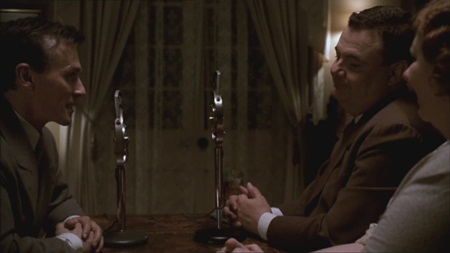
One aspect of The River that I found particularly satisfying involves the continually muddied morality on display. In this episode we spend some time getting to know Tommy Dolan, a radio personality and unlikely ally(?) of Justin Crowe. Dolan’s clearly and openly a “lowly sinner” (his words) – the sort of man who’d use the plight of the Dignity Ministry to further his own career and make a lot of money off of that; the sort of man who’d openly hit on the sister of the Minister he’s ostensibly trying to help, trying to get her drunk on wine. That’s all mighty questionable stuff, and it paints Dolan as a snake in the grass (how fitting then, that Ruthie and Ben go snake-hunting in this episode, and that Ruthie warns Ben about snakes that look harmless, but are in fact deadly) but what’s truly interesting (to me at any rate) is how open he is about his self-serving interests, along with the way in which those interests appear to genuinely help the cause of the needful migrant community. His blindsiding of Val Templeton (a returning Glenn Shadix who thankfully wasn’t killed by Justin’s Spooky Mind Powers, and who is welcome to stick around on this show for a long time as far as this viewer is concerned) is fascinating and satisfying because, while we know we cannot trust Tommy Dolan further than we can throw him, we see him force a loathsomely bigoted politician into publicly promising to help the poor. This shades-o’-gray approach lends Carnivale’s more outrageous aspects a sense of being grounded in the lives of real, complicated people. In real life people do bad things for good reasons and good things for bad reasons. The emphasis on this continues to be one of Carnivale’s strengths.
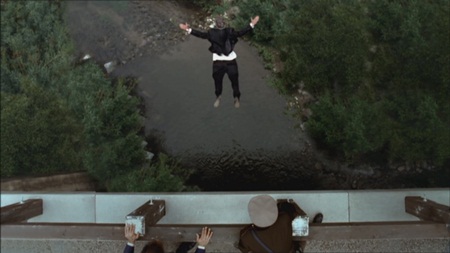
Brother Justin’s bizarre vision in this episode plays as a reversal of the cheerful and uplifting story An Occurance at Owl Creek Bridge by Ambrose Bierce. Bierce’s tale concerns a soldier about to be hung who finds that the rope snaps, allowing him to escape and try to find his way back to his lady. Only, just as he reaches her the story reveals that all of this has happened in the soldier’s mind. He’s still got that noose around his neck, and all of what we’ve read has occurred in the space between the moment that the trap door opens and the moment when the soldier’s neck snaps.
There are some nifty reverse-parallels to be drawn here. For one, the structure of Bierce’s story is reversed in The River. Brother Justin’s vision ends not in his death but in his rescue. For another, in Bierce’s story the snapping of the soldier’s neck signifies both the end of his vision and the end of his life. In The River, Justin’s neck is also snapped (by himself! As a boy! Which is totally trippy, dude!) but that act functions to return him from the vision and back to reality, where he still lives. As with Carnivale’s previous references to Tolstoy, this stuff is buried in the narrative and not alluded to in any obvious way.
Sofie: “My dreams are none of your business.”
In The River we learn that the day Apollonia gave birth to Sofie was also the day she became catatonic. Sofie tells Libby that because of this she doesn’t know her birthday. This has to be significant, and it makes me wonder (1) who Sofie’s dad is (was it Scudder? If so, that guy was a regular slut given what else is implied over the course of this episode), (2) if Sofie is also an avatar of some sort, or connected to the avatars in some way and (3) just how much Apollonia really knows about what’s happening. During The River Apollonia informs Sofie that her new friend Libby will dance the cooch for the rest of her life, which Sofie shrugs off as she does most of her mother’s advice. She tells her mother that Apollonia doesn’t know everything, but is that so? A strong sense of fatalism continues to hang over everything and there’s a nice visual representation of that theme in the scene where Sofie reads Libby’s Tarot cards. Sofie changes the meaning of the cards to give Libby happier news than what the cards actually tell her (“I dealt it wrong”) but Sofie’s actions, and her support of Libby in leaving the carnival for California, don’t add up to a hill of beans. Libby stays, and Apollonia’s seeming “prophecy” comes true. By episode’s end we can see Libby take another step toward consigning herself to that very fate (and who’s to say how long her life will be?). You can argue that Libby’s choice to stay with the carnival is her own, but the idea of foretelling the future implies that the future is already set. If Apollonian KNOWS that Libby will shake her tailfeather forever then how much real “choice” does Libby have in the matter, really? Pretty much none, from the look of things.
But maybe that’s me reading way too much into things. It’s been known to happen. Maybe Apollonia was simply giving her daughter her (cranky) opinion on Sofie’s new friend. After all, we don’t actually know what Sofie’s mom says to her daughter – we only hear Sofie’s answers.
What do you think? Do you think that free will plays a part in Carnivale’s universe? Do you agree that Fatalism suffuses the show and its characters? Do you believe that Knauf and his fellow writers intended to imply the dominance of one over the other? I’d love to hear your thoughts, and your reasons as to why (but no spoilers, por favor). Be bold, be crazy, be overly-wordy.
Samson: “You can only know a man so much.”
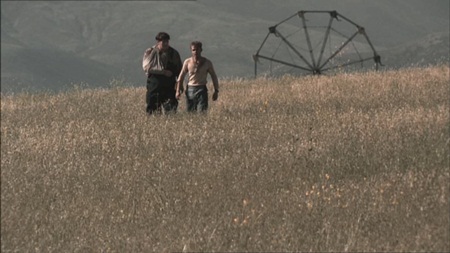
Moving on to Ben and the rest of the carnival-ians: Are Gabriel and Ben half-brothers? The look that Ruthie gives to Gabriel after Ben confronts her about sleeping with Scudder (who is, again, kind of a slut from the evidence that’s accumulating) would seem to suggest so. Like a good brother, Ben heals Gabriel’s arm while standing in a lake, as dead fish rise to the surface of the water. It’s a nicely haunting image and it promises to help bring Ben’s gift to the attention of the rest of the carnival, something which should help accelerate the plot in general. We see this happening already as Lila the Bearded Lady brings news to Lodz that Gabriel’s arm is healed. Why does Lodz beat the holy hell outta Lila with his cane? Because Ben has figured out how to use his abilities without Lodz’s assistance, something that throws a serious monkey wrench into the blind man’s plans; plans which include manipulating Ben’s cluelessness in order to gain access to Ben’s power. At least I assume that’s the reason. If there were any doubt that Lodz is a bad dude this little scenelet dispels that notion for me. In entertainment as in real life only absolute @$$holes hit women.
In addition to these shenanigans, we also learn that, back when he was traveling with the carnival, Hack Scudder healed Ruthie of snake venom poisoning, confirming that Scudder and Ben shared the same “gift.” I won’t lie – it’s creepy to watch as Ruthie and Ben engage in some trans-generational flirtation. She looks old enough to be his grandmother, and the idea that Ben’s father has already slept with her makes the whole thing that much creepier. Yes, Adrienne Barbeau is a beautiful woman. No, that fact does not negate the icky-squicky sight of her aged hand caressing Ben’s much-much-younger face.
Stumpy: “You know, every which way I turn…I see my little girl. Every which way.”
Maybe the most moving portion of the episode revolves around the cooch family, and their efforts to move forward following the death (or something) of Dora Mae. Ma is a fascinating character, all vampy eyes and pouty lips and domineering willfulness combined with a sultry insouciance. She and Stumpy make perfect sense as a couple, and Stumpy’s decision to stay with her at the end of the episode feels true. Their interplay throughout the episode is varied and never uninteresting, and I appreciated the scene between Stumpy and Jonesy as the two of them get their drink on together and race each other to the bottom of the bottle. Random observation: Stumpy offers Jonesy a bottle of something called “coon dick.” I don’t know what “coon dick” is, but it sounds godawful. I considered researching it but I’m genuinely frightened to see what search results those words would generate.
Brother Justin: “This is not visited upon me. This is my birthright.”
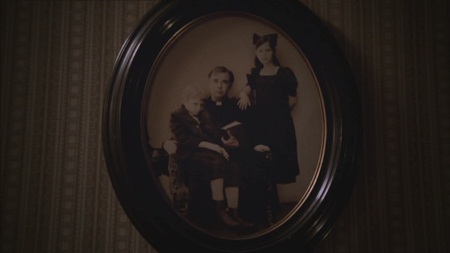
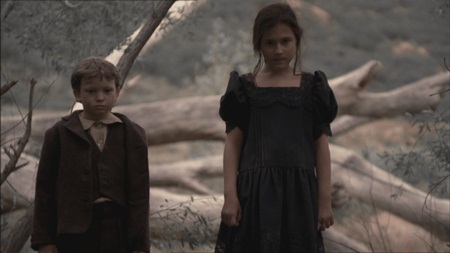
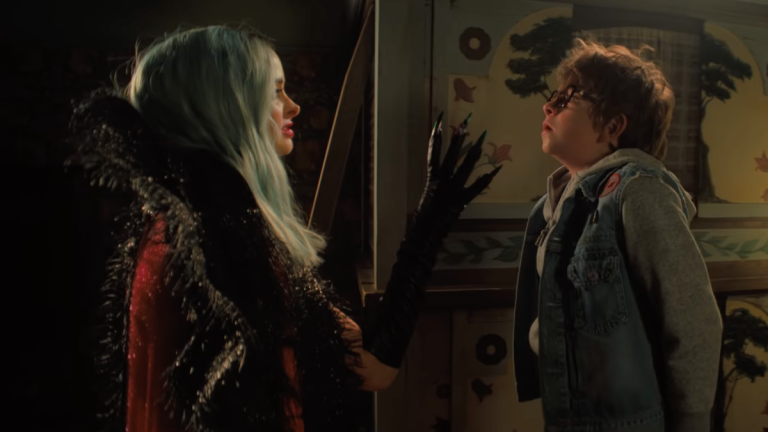
By the end of The River we’ve discovered a whole hidden history behind the seemingly-vanilla lives of Justin and Iris Crowe. They’re Russian immigrants, presumably taken in and raised by the kindly-seeming old Pastor that we met a few episodes back if the photo which ends the episode is any indication. It’s revealed that the children who’ve been haunting Justin throughout this episode are actually spectral memories/visions/ghosts of young Iris and Justin, then named Alexei and Irina. For some reason young Iris and Justin/Irina and Alexei were pursued by assassins, hunted down and almost killed. Throughout Justin’s vision it is HE who assumes the role of the assassin, experiencing his own past through the eyes of a man who once tried to kill him. This is an interesting, bizarre, and frankly-confusing twist. It’s also pretty neat, and it goes a long way toward further shoring up the sort of thematic and narrative mirroring that’s been present throughout the show thus far. When young Iris tells Justin “You lie,” it has a dual effect. In hindsight we know that this was a conversation she probably had with the man who actually did chase the two young siblings and try to kill them. Yet at the same time, this is also a conversation that she is having with Justin in the moment.
Given what we’ve learned overall I’d say that it’s a safe bet to assume that they were hunted because of Justin and his ooky-spooky superpowers – superpowers that, as Justin finally realizes here, have been with him for his entire life. Notice that as a young boy Justin had the power to END life, whereas Ben has the power to GIVE life. Notice also that the ability to snap a neck with your mind is not consistent with adult Justin’s displayed abilities (i.e.: creating illusions/visions). At some point Justin was able to make physical changes in the world, just as Ben has been able to do. Do all avatars have the same abilities? Are they able to access different aspects of those abilities depending on whether they are avatars of “light” or “darkness”? And as with Sofie I’m left wondering who Justin’s father was. We’re told that he was “an evil man.” Was he perhaps the previous avatar of darkness?
Brother Justin: “You always knew what was inside of me.”
And it seems Iris has always known. This revelation begins to paint Justin and Iris’ relationship in a brand new light. Suddenly it’s Iris who appears the strong one; the sister who has protected her brother for all of her life. Suddenly their co-dependence seems less the result of Iris’s seeming-timidity and more the result of a childhood trauma and Iris’s continuing need to keep her brother safe – from others and, perhaps, from himself. The look on Iris/Irina’s face as The River ends is one of unmistakable fear.
Join me next week for the last Lost & Found until March. Until then be good to one another and thanks, as always, for reading.


7 comments
Coon dick is just another colorful term for moonshine.
Gracias, sir. I’ve never tried moonshine. I should attempt to rectify that.
Awesome article for an awesome episode of an awesome series. Not sure I like having to wait until March though! I can’t wait for you to get to season 2.
Hi! I was waiting for this episode review to express some of my thought without spoiling the events.
What I love about Carnivale is that it doesn’t portrait Russians in grotesque and stereotypical way. They may be unpleasant or even evil people but not simply dumb or cartoonish.
From little things here and there I came to a conclusion that Knauf knows and (what’s more important) understands a deal about Russian culture. I’m not sure how much it inspired the show, but Carnivale definitely has some concepts and ideas similar to ones of Russian art and philosophy.
First, Russian writers and artists were never afraid of portraying the most ugly and disturbing aspects of life and human nature. The best example (in my opinion) in Kuprin’s novel “Yama” or “The Hole” which describes the life of the whorehouse and is probably the only work of fiction that does justice to this business while managing to be poetic all the way.
Second, the aforementioned fatalism. Russian culture is EXTREMELY fatalistic. Starting from Pushkin and Turgenev to Pasternak’s “Doctor Zhivago”. You can find some pragmatic, common-sense, self made characters but – guess what? – they are usually villains or have foreign background. Interesting, the only two Carnivale characters who do not simply go with the flow and successfully shape events and reality at their own will are Russians. Wink-wink. (You should pay attention to Iris’ “Faith and action” motto – you’re gonna see it’s importance).
And third, suffering. Suffering is a crucial thing for (at least fictional) Russians. It’s not a light-hearted Buddhist conception, but a dark medieval idea. Russians in fiction often bring a misfortune and suffering on themselves, they masochistically scratch their inner wounds and sink into obscurity and self-deprecation. In suffering and humiliation they achieve a very intense state of mind and soul and come to possess a deep insight into God’s and human nature. Take every Dostoevsky’s, Tolstoy’s , Chekhov’s book. Even Soviet writers like that.
And last, the Big Idea. Russians are very fond of it. They desperately need the overwhelming Cause to fight for. And it’s not plain survival or prosperity or happy family, it is usually very abstract. They can do unbelievably heroic or cruel things because of it. Here again Knauf makes a brilliant guess (who knows, how intentional the writing was). Unfortunately, I can’t discuss it now without spoiling, but this is gonna be hilarious.
Well, sorry for my long rant and please continue!
Thank you so much for your in depth coverage of Carnivale, Twin Peaks and Lost. All of which I loved. Please keep it up. I often feel after reading your coverage that I am seeing the series in a new and deeper light and that is quite an accomplishment on your part.
Now as for A93Trojan’s definition of “Coon Dick” as colorful description of moonshine, it is technically true, but deeply simplified. To quote from Cassel’s Dictionary of Slang, coon dick is “an illicitly distilled spirit compounded of ‘grapefruit juice, cornmeal mash, beef bones and a few mo’ things (Zora Neale Hurston, Mules & Men, 1935).”
There ya go, another useless piece of trivia to help shade the details in this brilliant series.
I’ve never seen anything objectionable in the attraction between Ben and Ruthie, or in the idea that Ben might–if he has sex with her–be having it with a woman who’d also, years before, been intimate with his father. So what? Ruthie is right in saying her past sex life is none of Ben’s business; and he, to his credit, quickly comes around to acknowledging it. (While I’m on the topic of the characters’ sex lives…is every man who’s intimate with more than one woman in his lifetime, in your opinion, a “slut”?) One minor problem I do have is that in this episode, Ben’s relationship with Ruthie seems to have advanced–in a “leap”–beyond where we’d previously seen it.
More things I’ve wanted to say, now that I’ve managed to register and can post more: There was a never-aired first pilot, parts of which were used in the Episode One we saw. Oddly, as one looks back, it seemed in Episode One that a man other than Stumpy was pimping Rita Sue. The explanation: It was a bit from the first pilot, in which the prostitute was meant to be Lila. The characters of the Dreifuss family–and Iris!–were only created for the second pilot. (The other main difference: In the first pilot, Justin was already a famous preacher.)
Maybe I’m incorrigibly low-brow, but I care less about whether Daniel Knauf was channeling Tolstoy and Bierce than about mundane script problems. Why did we never hear the carnies question how the Tipton townfolk had gotten the idea Ben was a healer? Why was there no explanation, when the carnival was way off its normal circuit, of how Samson knew Jolene? In either of those cases, one or two lines of dialogue would have sufficed?
And I care less about the exact meaning of “coon dick” (we know there’s some slang the writers simply made up) than about their calling a five-dollar bill a “sawbuck,” which is downright wrong. (In a much later episode, they will get it right: a “sawbuck” is ten dollars.)
Comments are shown as archived from the original site; new comments are closed.