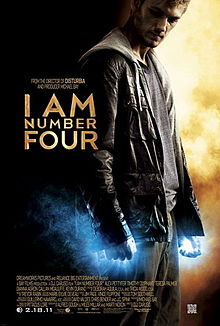
 Talking to Marti Noxon – as I did about I Am Number Four – certain things have come into more focus about the state of cinema. As a film lover, we’re at a point now where the studio system is less likely to take chances on character-driven material like television will. And we’ve also seen a class of comedies (Arrested Development, Community, Cougar Town, Parks and Rec) and dramas (Justified, Mad Men, The Shield, The Wire) that have season-long and show-long arcs that are on par with anything the big-screen produces. It should be a different storytelling art, but the shorthand of yesteryear – the economy that can only comes from visual storytelling – is not a priority in the studio system. With many television writers (and television developed out of radio) working for the big screen, you’re seeing the influence of a more aural medium. When was the last time you were in a theater and had a moment like the chill and realization that came from William H. Macy seeing a body, and then the pan over to his trunk popping like in Fargo? That’s a shot that tells a story without dialogue, something you rarely get from the modern B movie.
I have gotten into fights for calling Star Trek – the entertaining ’09 reboot – a pilot, but as a narrative that’s all it is. It’s about getting characters in place for their next adventure, giving you the broad outline of their characters until they settle into the roles that were made famous by other actors. I’ve never seen someone successfully argue that there are themes at work there that aren’t “destiny” as cribbed loosely from Lucas. Regardless, it works, and J. J. Abrams has developed enough flair to make it a good-enough popcorn ride, but these sorts of films that don’t have anything going on under the surface – while also not being a complete narrative unto themselves – are growing tiresome (Robin Hood, The A-Team, The Losers, and on and on). It seems if a studio spends a certain amount of money on a title they want to make sure it can be franchised, and it’s leaving me with blue balls. Arguably, romantic comedies break this trend, but those films are usually about making a brand of their stars (Kate Hudson, Katherine Heigl), so they can do more of the same.
The cart is now so in front of the horse that films rarely feel like a meal as much as an advertisement for future adventures, unless the film has some form of Oscar aspirations. It’s also why Inception was such a breath of fresh air. This serialized nature is slightly more palatable in comic books, as it reflects their origins, but those tend to – at least – have a big baddie who is soundly defeated at the end. It’s no less formulaic, but it tends to give a great sense of closure to the narrative. The other problem is that the grammar of the cinema of these films is often similar to television, just done on a grander scale – it’s coverage-based. You have more types than characters – you don’t have the time to grow to love the characters who are sketchily defined – there’s the people you theoretically care about, but whatever empathy you have generally comes because of the performers involved (and the performers being good looking), but generally there’s no sense of a finished journey. If you did, then you couldn’t have sequels. Now there are more endings where it’s not just that there could be sequels, but a sense there has to be a sequel. As a filmgoer, you’re getting fucked. With the Lord of the Rings it was understood, with The Losers, it’s a spit in the eye.
So much of cinema comes directly from television these days. It used to be that it was just music video and commercial directors – and it still is to some extent (David Fincher, Mark Romanek, Joseph Kahn Spike Jonze, etc.) – but now more than ever we’re seeing the talents behind TV go back and forth from big screen to small. This goes both ways (as I’ve noted in the past) with people like Frank Darabont and Todd Haynes, but also last year saw Eat, Pray Love directed by the creator of Glee. DreamWorks executive Steven Spielberg began his career in television, and some of the best directors going these days (from Michael Mann to Edgar Wright) cut their teeth on television so it’s not necessarily a cross to bear, but you also get directors like Mimi Leder, Clark Johnson, and D.J. Caruso.
These are filmmaker without much personal style or perceptible storytelling interests. Not every director is an auteur – nor should directors be harshly judged for simply delivering something that’s just entertaining (entertaining is hard enough) – but Caruso and his ilk seem to do what they’re told. And when you partner him with three writers who have specialized in television, and with the open-ended storytelling that comes from adapting a series of books, you get a non-film like I Am Number Four. It’s not terrible, but it feels more like a pilot than a movie. In some ways it makes you long for the cinematic thinking of someone like Christopher Columbus. How sad is that?
In I Am Number Four Alex Pettyfer stars as John Smith, an alien who is the number four of the title. He has a guardian Henri (Timothy Olyphant), and any time he does anything remotely alien, they leave town and destroy all evidence of their past behind them. They are called Loriens (from the planet Loreal?) and are being hunted by the Mogodorians, who killed off the rest of their race, excepting the (nine?) remaining children who can supposedly stop the bad guys from completing their genocide through their magical, mystical, undefined powers. This though is awkward because we don’t really know how many there are (there are at least six in total, as Teresa Palmer plays number six – the interviews I did told me there were nine), or why they have to be killed in order. This chase is the inciting incident of the story, which sets up some of the film’s problems (there’s no sense of the rules of the universe), but that isn’t so problematic in the scheme of things, or at least wouldn’t be if the film was more compelling. The film opens with Number Three dying in a sequence that is shot exceptionally dark and muddled, and the death of three makes John’s leg light up like a firework. This is also happening as it looks like he might score with a woman, so it seems to connect his alien outbursts with his sexuality, though it’ s never a plot point (so much as his emotions sometimes make him use his powers, so it’s got that Spider-Man thing). This forces him to move from Florida to Paradise, Ohio, where he plans on going to school against Olyphant’s objections. Already you’ve got a little superhero, a little Potter, and a little Twilight, which likely has everything to do with its source – a young adult novel, and most of those have been modeled on what’s successful of late.
At school John meets the bullied Sam (Callan McAuliffe), and hottie Sarah (Dianna Argon), the cute girl who doesn’t quite fit in after she left her boyfriend – and cock of the walk – Mark (Jake Abel). Mark and his friends pick on Sam and John gets in the middle, showing himself proficient physically, while also coming to realize his otherworldly powers. Sam unintentionally puts himself in the middle of an ongoing feud between Sarah and Mark, which must eventually escalate to violence. John’s supposed to be invisible, which is hard when Sarah likes taking pictures that Henri must erase from her website. Henri wants constant updates on his location, and threatens to revoke some of John’s privileges if he doesn’t comply, but John never seems to comply, so that threat never amounts to much.
The film hits what can be called its groove when Sarah and John start to date. Yes, their love is modeled partly on Twilight (John’s alien race mate for life), but the two have a believable chemistry and neither is exactly hard on the eyes. This will – of course – be interrupted by the evil Mogodorians (headed by Kevin Durand in a fun, aware performance) who are eventually going to catch up with him, because they’re good at stalking and have one goal. But then also Number Six (Palmer) – a total bad ass – is looking to help Four, and she’s learned in the arts of Badassery.
The love story is what makes the movie palatable, and it’s the core of the film, so that helps keep this film slightly above terrible, though again, it’s toeing its foot in the franchise pool. There’s such small-minded thinking going on across the board. The actors wouldn’t be out of place on network shows (nothing against Argon and Olyphant, who are TV stars), and when the film finally unleashes the big end fight sequence, it’s slightly larger than most things put on the small screen -perhaps because the source material isn’t all that great (though I can’t be sure because I haven’t read it). Sadly, Olyphant – as much of a TV actor as he is, and as much as both Deadwood and Justified make him look like a movie star – has nothing to do here but be concerned. I loved what Olyphant did with his supporting character in The Girl Next Door, this has none of those dimensions. While Teresa Palmer’s character hits exactly one note. Palmer looks good doing it, but that’s all there is. And dimension is exactly what this film is lacking. As a February release, I’m sure everyone involved knows this isn’t a masterpiece, but worse than it not being a great movie, it doesn’t feel much like a film, period. I’m not the sort to pull a Dirty Harry and throw my badge to the ground, but the more cinema we get like this, the harder it is to defend my favorite art form. What’s on television tonight? Community? I have no doubt tonight’s episode smokes this in terms of visual storytelling, and anything else you’d want to throw at it.
Rating: 

Out of a Possible 5 Stars

12 comments
While what you’re saying in the bulk of the article is important and valid, I don’t think it should be part of the review of the film. It needs to be addressed separately, since it’s a big problem in the industry, and is slowly killing storytelling in film. Regardless, I love your articles. Nothing about this film excited me, especially since this is from the first book of a planned six-novel series, of which only the first has been published. I just don’t see it as anything but a Twilight derivative. But on one level, it would have made a decent TV series in the 80s. Come to think of it, isn’t it a knock off of “The Powers Of Matthew Starr”?
If The A-Team wasn’t intended to serve as a complete narrative, I guess it failed for me. Because I thought I saw everything I needed to know about those characters and their adventures in that film. I guess you could have them do another adventure as “soldiers of fortune,” but there’d be no personal stakes, so why would I care? I enjoyed the movie as a one-off.
You’ve hit the nail on the head with this current era of filmmaking.
It was bad enough 20 years ago when producers stopped being film lovers and become accountants and lawyers who only saw the industry in terms of investment and product.
These days producers don’t even consider their films to be investments – there is no interest in developing a film that has to be discovered and find an audience. Now it is all about getting the film out as quickly and widely as possible before people realize how bad it is. The first weekend’s gross is all that matters because once word of mouth gets out the film’s dead.
I’m seeing too many sentences starting with “But” right after the other. And it takes too long to get to the beginning of the review.
Carnotaur3, I don’t write normal reviews. I thought that was evident before. I did check my “but” count, though. I love buts (can not lie).
Excellent review Damon. Movie looked like crap and you pretty much confirmed it for me. Won’t be seeing.
Great review!
I have to say if you can’t deliver a normal review, maybe you should examine your desire to review movies. While you may present some valid ideas about the state of film making today, these are big picture views that don’t have much to offer regarding my decision to go see THIS movie. So keep your film student dissertations to yourself until you’re writing articles about the state of film, and give me your take on the film at hand. If this is beyond you, than I would recommend that film review is beyond you, as the average reader, or even the not-so-average reader here at CHUD, isn’t looking for four+ paragraphs of film student spew before the FILM YOU ARE REVIEWING is even mentioned. You have valid points but they could easily show up behind “don’t go see this film” with circles and arrows and footnotes presenting the downfall of modern studio cinema. BTW, this film is not representative of much at all. Nor were a lot of your examples. And if I want to examine the shocking intrusion of TV on cinema, I’ll look at the 50s and 60s. No offense. You’re a good writer, but focus and purpose seem to be a problem you might want to examine.
Sorry… p.s. or just file your “reviews” under another heading so they are not so misleading.
http://www.aintitcool.com/node/48543 covers the “evolution” of the source material. Teen/Young Adult Fiction is slightly more honest in conception than this sort of shit.
QuintProQuo Everything I wrote is a review of the movie. I thought that was obvious. Every complaint I have about TV cinema is building up to talk about I AM NUMBER FOUR as it is guilty of the things I’m complaining about. I don’t understand why reviews have to be of a certain format. Why did I give a big picture view of this film and cinema as a whole? Because I think this film – like most things – are important to view in context. Is it more interesting to talk about the trends of cinema than this movie? If yes, doesn’t that say something about the film itself, which I gave a middlng review to? That you don’t like how I approached writing about, I, I’m sorry, I guess, maybe – like the last time I did something like this – I could also call it a column, but defining it as less than a review is weird, because – again – everything I was writing was actually about the movie I was reviewing.
As per “And if I want to examine the shocking intrusion of TV on cinema, I’ll look at the 50s and 60s. No offense.” This suggests you have no idea what you’re talking about. No offense.
I love that you give the reader a deeper analysis of the film being reviewed by providing the context in which it is made. Keep it up, Dre! It’s compelling stuff.
Comments are shown as archived from the original site; new comments are closed.