
New Canaan, CA (Carnivale, S2 ep. 12)
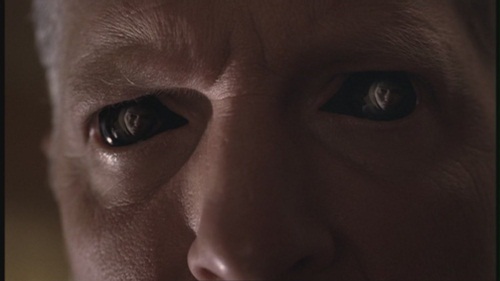
“What is in opposition is in concert and from what differs comes the most beautiful harmony.” – Heraclitus
Sofie: “This is your House.”
This is the way the world of Carnivale ends: not with a bang, but a wither(ing). The final moments of the final episode function like a warped Möbius Strip, connecting the show’s last episode with the show’s first episode elegantly and relatively subtly. Both Milfay, OK and New Canaan, CA end with the sight of crops wilting away as a result of supernatural healing, and both episodes end with the sight of an exhausted Ben Hawkins being carried away to a new, as-yet-unknown destination. Carnivale completes itself through a final act of reflection – fitting for a show that’s spent so much time reflecting events, themes and main characters back at each other.
Brother Justin: Pain is an unavoidable side effect.
See what I mean? This is the case throughout New Canaan, CA, as characters repeat phrases heard much earlier in the show and remember events that function to more-or-less bring the narrative full-circle. It’s a neat trick that the show pulls off well.
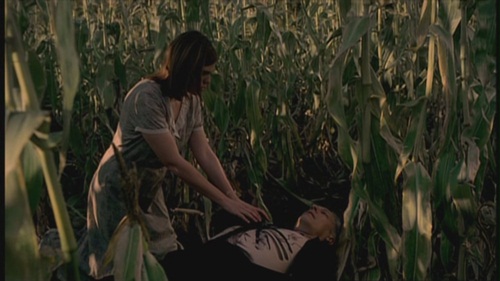
Most of Carnivale’s running time has been devoted to stories of grim desolation and desperation, which is only fitting for a show set firmly during the Great Depression. The unrelentingly bleak atmosphere, however, began to take its toll on me as a viewer; it was only with the healing of Jonesy and the acceleration of Ben’s quest to destroy Brother Justin that something like Hope began to enter into the show’s dusty, dim-lit world. For all the darkness Carnivale wields so deftly, New Canaan, CA finally opens the figurative doors to let in the Light at last, at least temporarily. I’m grateful for that, since the glimpses of honor, sacrifice and righteous purpose we’re shown in this final hour serve the show magnificently. I can’t help but regret that these characters didn’t find common ground earlier in the season(s), if only for a little while, because watching them work together toward a common Good is exciting, interesting, occasionally laugh-out-loud funny stuff. Who among us didn’t feel a sense of excitement as Samson and Stumpy coordinated a final performance from Benjamin St. John? It’s one thing to watch this troupe fleece innocent, Depression-ravaged people. It’s quite another to watch them pool their collective talents to put one over on the man who proposes to create hell on earth. It’s pretty darned satisfying – like watching Robin Hood and his Merry Men stick it to a satanic Prince John. When is that not worth watching?
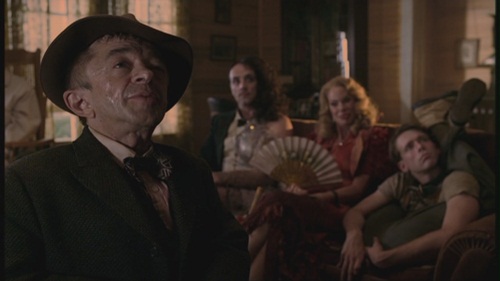
While New Canaan, CA is not a perfect episode of television (what is?), it succeeds handily where it matters. It gives us the confrontation we’ve been waiting for this entire time, it gives us (again, at least temporarily) definitive endings for many of the characters’ individual storylines, and it does these things with style and a kind of dark grace. I have absolutely no idea whether or not Knauf and Co. knew that this would be the last episode; if not, it’s remarkable how well New Canaan functions as a premature coda for the show. Sure, many questions are left up in the air (Why is Ben a wanted man? What are Lodz’ motivations? Why is Ruthie seeing dead people? Has her resurrection left her open to possession from any spirit that happens to wander by? Why? Sofie’s Eeeeeevil now?! WTF!?), and there are moments here that feel unnecessarily rushed and/or questionable (see below), but New Canaan, CA still manages to be an effective and moving episode. I especially enjoyed the way that Sofie’s healing of Brother Justin in the episode’s closing moments serves as a potent metaphor for the endless struggle between “Light” and “Dark,” with neither side ever truly winning, so much as momentarily gaining an upper hand.
Let’s talk semi-briefly about what didn’t work for me in this episode, because frankly most of it did:
In the column for Carnivale‘s first episode I wrote: “My hope is that Carnivale will delve into the backgrounds and emotional lives of these people. My fear is that the show will use them simply for window-dressing and/or plot advancement, or will take the easy road of melodrama over the harder, more rewarding road of believable character development in an unreal setting.”
On one level, my hopes for the show were realized. Carnivale delved into the lives of a few of its supporting characters and painted affecting, intimate portraits. On another level, my hopes in this regard were also dashed, as many of those storylines ended up feeling far less interesting and consequential than they might have been, or as some of the people featured in the first season either disappeared completely (I’m looking at you, Lizard Man and the Siamese Twins) or faded further into the background. I cannot begin to fathom the degree of difficulty inherent in juggling a multitude of supporting characters while attempting to service both their stories and the larger, show-defining stories of Carnivale’s main characters. That said, I have to admit to some disappointment over, say, the disappearance of the Daily Brothers carnies (who reappear again in this episode) after the show devoted an entire episode to their joining Carnivale. These supporting characters were never quite as three-dimensional as I wanted them to be, but they were also never as two-dimensional as they could have been, and each and every actor/actress involved gave wonderfully well-realized performances in which they fully inhabited these contradictory, charismatic characters.
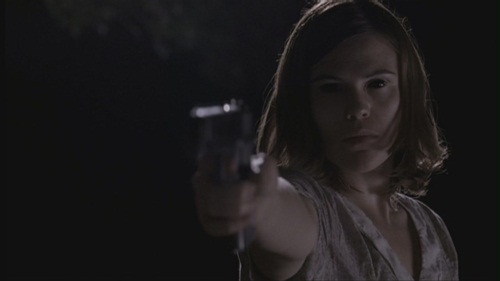
I had also had issues with the way that Sofie’s storyline resolved here. For one, it’s abrupt to say the least. Sofie’s sudden transformation into what seems like another Creature of Darkness is swift enough that it doesn’t quite make logical sense to me – unless her fate/dark heritage has overwhelmed her free will and/or driven her mad. Sofie goes from telling Justin off to shooting Jonesy in cold blood over the course of one (admittedly and admirably superfreakincreepy) hallucinatory encounter. This only makes sense if we give free will the boot more or less completely and accept profound fatalism as this fictional universe’s driving force. The Sofie that Jonesy knew and that we knew just a little earlier in this episode wasn’t capable of this. Yes, she’d hurt both Jonesy and Libby rather cruelly, but that doesn’t mean she’s a murderer.
All of which makes me wonder why the writers had Sofie reject Justin at all to begin with. It’s far more believable that she’d shoot a guy like Jonesy if she’d truly drunk Justin’s Kool-Aid – if her power began to manifest because she was drawing closer to the darkness itself. As it stands, Sofie is essentially attacked by her mother (who is most likely just a manifestation of “Dark Sofie,” since Apollonia seemed sincere in wanting to take protect her daughter and/or take her out) and that attack/confrontation seems to basically rewire Sofie’s brain so that now she’s Eeeeeeeevil.
That’s less interesting to me than, say, Justin’s path – in which he found himself becoming a harder, darker man even as he struggled with that part of himself.
I do like the misdirection that Carnivale has apparently employed all along. We’ve assumed that The Usher would be the person directly responsible for destroying the world/bringing hell to earth/otherwise f*cking sh*t up in a major way. As it turns out, though, The Usher’s role may end up being literal father to the End Times. Justin Crowe “ushers in” the end of the world not through his own (in retrospect rather petty) machinations, but through conceiving a daughter destined to be “The Omega” – Greek for “The End.” Crowe “ushers” Sofie into the world, into her fated role. I’ve no idea if this is the intended interpretation, but it’s a nifty one nonetheless.
Iris: “When I die, I’m going to Hell. And if I’m very, very fortunate, my brother will be waiting for me with an embrace.”
I’ve enjoyed Amy Madigan’s performance throughout the show, but by turning Iris into a secret opponent to her brother the show’s writers muddled her character and made it difficult to believe that the same woman who willingly sacrificed innocent children for her brother’s sake would have a change of heart the way that she has. I suppose you can argue that once she realized Justin had a sinister agenda she turned away from him, but a God who’d welcome a sacrifice of children seems like a pretty sinister God, no? I suppose you could rationalize this by saying that even homicidal fanatics can grow frightened of un-distilled evil, but her regrets here still don’t make any real emotional sense. given how religious she claims to be, she had to know that for her, hell’s gate was open for her the moment she set that fire.
Amy Madigan deserves a lot of credit for making this feel emotionally believable anyway. She sells her change of heart well. I may not understand why Iris is in this place, but I buy it because Madigan is achingly sincere.
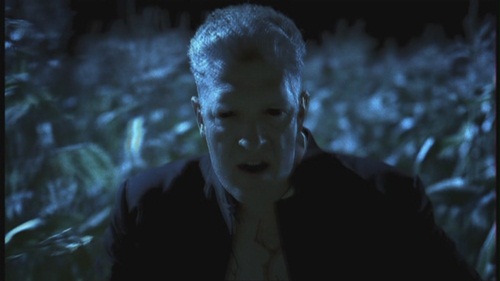
Lastly: New Canaan is very satisfying, given that it’s all we’re gonna get, and I’m grateful for a quasi/pseudo/sorta “ending” that the episode provides. But I can’t help thinking that the show lost some strong storytelling possibilities by choosing to stretch out the mysteries, favoring them over what could have and probably should have been a more extended, unnerving encounter between the tent city and the Carnivale; between Justin and Ben. There’s something semi-anticlimactic to the sight of these two avatars stabbing each other in a cornfield with barely a word spoken between them. Those moments don’t hold a dramatic candle to the scenes of Justin interacting with the Carnivale. The show devoted more airtime to the town of Babylon than it did to Ben and Justin’s confrontation. Does that seem right to you?
Me either.
All of that said, I kind of loved what we did get – from the pensive scenes of Ben, Jonesy and Samson powwowing in Management’s trailer to the funky/creepy hallucinations in Sofie’s shack, to the plan to drain Justin of his lifeforce by sticking him on a Ferris Wheel (Clancy Brown’s acting in these scenes is wonderfully BIG and BROAD and straddles the line between blackly funny and frightening in just the right way), to the sight of Ben Hawkins healing men, women and children in rapturous succession, pulling life in seemingly-endless supply from Justin’s writhing, tattooed body, to the shock of seeing Jonesy shot so callously….this episode is chock-a-block with excellence. I’ve genuinely enjoyed the way that Knauf has more-or-less naturalistically let the “mythology” dribble out over the course of the show, never spoonfeeding the audience. It feels like he was consciously trying to make a show where both the characters and the viewers have to work at the meaning behind things, as opposed to having answers dropped into their laps. I really respect that approach. I also respect the show’s firm refusal to cater to simple/simplistic notions of Black & White, capital-G Good and capital-E Evil by illustrating for us that good men can be cruel and petty, and that evil men can be kind and compassionate.
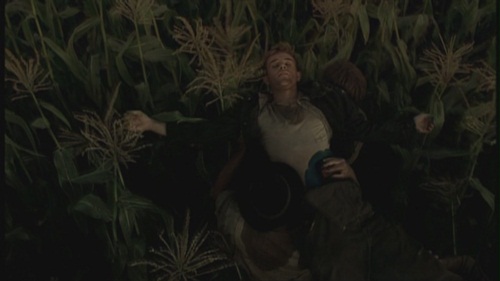
And as always, I loved the references to religious practice and spiritual figures. At this point the sight of a hero being carried in a Christ-like pose is a total cliché, but Carnivale really pulls this particular cliché off with panache. It helps that Ben really is a Christ-like figure outside of this particular moment. Even better, for this particular viewer, was the final scene between Justin and Ben in which Justin, the Reverse Christ, mangles the words of the Bible a final time as he gets ready to do hisself some slaughterin’: “My will be done,” he says, not “Thy will be done.” I’ve really loved the ways in which Carnivale’s writers fashioned Justin into the negative image of Jesus, and I love the consistency with which they’ve done so.
So here we are, at the end of the road. It’s been six years since Carnivale was cancelled, and it doesn’t appear as though we’re going to get any more of the story anytime soon. In the wake of the cancellation, Knauf apparently approached Marvel Comics about continuing his saga with them, but HBO has held fast to the rights, and there’s been no indication that they’re willing to let Knauf take his odd opus elsewhere so that he can complete it.
Knauf set out to craft a televisual novel – a sprawling, idiosyncratic opus. Instead Carnivale became a novella, and an unfinished one at that. It’s strange and imperfect and incomplete, but those things aren’t as important as the fact of its existence. It is a marvelous thing to have a show like Carnivale out in the world, offering up its thick, partially obscured mysteries and gasping, sunbleached landscapes to unsuspecting viewers. Saying that Carnivale isn’t for everyone is something of a massive understatement. But since when do we care whether art/entertainment is for everyone? I prefer art that doesn’t attempt to appeal to the greatest possible demographic. I like my entertainment idiosyncratic; crafted with undeniable heart and irrepressible quirk.
I shouldn’t have to say that there’s a vast difference between commercial success and artistic failure, but there is, and that distinction matters. Carnivale may not have succeeded as product, but it does succeed artistically, on its own terms.
As I was writing this column I reached out to Daniel Knauf to request an email interview. There are a lot of fans of Carnivale out there, and I suspect they’d love to hear his thoughts on the show he’s created – not about the future plans for the show, but about the care and effort and thought that went into creating the episodes that exist. Knauf declined, preferring not to look back, and I fully respect that position even as I regret the loss of an opportunity to ask him whether, for instance, Tolstoy’s “After the Ball” was an actual influence on the episode of the same name, or whether that’s an instance where an overzealous interpreter (me) sees things that aren’t really there. In the course of responding to me, Knauf added this, for which I am very, very grateful:
“Read your stuff, as have a # of cast-members. We all think you’re the beez-knees. Thx for ‘getting it.’”
That more-or-less blew my mind.
I have a lot of respect for men and women who can create something as imaginative and intricate as Carnivale and whatever the show’s flaws, it is owed attention and intelligent analysis. I can’t claim to have provided the latter, but I have certainly given it my full attention, and I’m glad that was noticed and appreciated. In return I feel the need to congratulate all the people responsible for bringing this show to life – from the writers to the actors to the composer to the location scouts, set designers, lighting technicians, best boys and key grips and on and on anon. Carnivale is undeniably imperfect, but to expect otherwise is to profoundly misunderstand the creative process. You don’t make omelets without breaking a few eggs, and you don’t construct dreamy/nightmarish dark fantasy without making some missteps. Do I wish Carnivale had made some different decisions? Yes. Does that wish in any way negate the beauty, the strangeness, the ambition and the craft that Carnivale brought to the table, week after week? No, it does not.
Carnivale is a ride well worth taking. I’m glad that you good folks chose it, and I’m glad to have had a chance to think and write about it. I’ve little doubt that this show will live on for a long time to come in the hearts and in the media collections of folks like you and me – folks who love it when a show shoots for the moon, regardless of whether it hits that target. It deserves the cult it’s acquired.
Join me here next week as I examine Daniel Knauf’s initial “pitch document” and delve into his comments on what the future of Carnivale might have entailed. Then join me here in two weeks’ time to cast your vote and determine which show I’ll resurrect and reappraise next.
‘til then…? Let’s shake some dust, children.



6 comments
Guess I’m the first fan to check in, unless someone else is busily typing a Comment at the same time! I’m delighted that you enjoyed the finale as much as you did–disappointed (and somewhat surprised) that Daniel Knauf didn’t agree to that e-mail interview. I hope the reason is that he’s super-busy with a new project.
One “parallel” you mentioned in the finale’s ending was unintentional! Knauf wanted the episode to end with the shot of Iris looking at the dying corn. HBO insisted it couldn’t end with a shot of a supporting character. And…I think I have this right. If not, someone will correct me. They’d wrapped, Nick Stahl was no longer available. So for that last shot of “him,” they actually had to use the actor who’d played Rollo the Rubber Boy.
Personally, I think it should have been spelled out a little more clearly that the closer Ben got to Justin, the more his use of his powers affected Justin–and when they were as close as they were in this episode, his use of his healing power would draw life-force from Justin before taking it from any other source. I would have liked to hear Ben say he’d gradually come to understand that.
And there was a lot of debate about what Sofie does in the final scene. Justin was dead. Supposedly, a drawing of life-force from plants can only heal; the restoration of a human life requires taking another human life. Knauf assured fans he hadn’t violated his own rules. So we have to guess at who was killed, and how. My theory is that Sofie first reached out with her mind to kill an already injured, unconscious Varlyn Stroud, then used the corn to perform some degree of healing.
I tried to pull together, at one point, all we subsequently learned about what would have followed. I’ll submit this post, then copy that–if I can–into another. Don’t read it if you don’t want to be “spoiled”!
I recently pulled together (to keep it straight for myself) a summary of
important “new canon” that’s been established, mostly since the show
went off the air. This includes most of what we’ve been told about the
show’s planned future direction:
In Season 3, Sofie and Justin would have been married, and there would
be a three-year-old boy who’d be publicly identified as Justin’s son.
(“But whose son is he?”) Justin would still not know Sofie was his
daughter. Both Sofie and Iris know about that relationship, but in
Season 3, neither of them would be aware that the other knows.
Virtually all fans are in agreement that the child is meant to be
Sofie’s son by Ben. But we’ve been given no clue as to whether Justin
knows the truth about the boy, or believes him to be his. Similarly, we
haven’t been told whether the Sofie/Justin marriage is a legal fiction
meant to deceive the world about the paternity of the child, or a real,
consummated union (incestuous, without Justin’s knowledge). Nor do we
know whether the child is an Avatar. Fans tend to have very strong
opinions on these questions.
Wounds made by an anointed blade will never completely heal. So both
Justin and Ben will have serious, continuing medical problems. And the
blade of Ben’s dagger will still be imbedded in Justin’s chest. DK has
gone so far as to say that in Season 3, the weakened Justin would be a
“hollow figurehead” at the head of his movement, with Sofie and Iris
vying to wield the real power.
Justin has “warred against” his Dark nature in the past, and will do so
again. His yielding to it at the climax of Season 2 was a temporary
thing. DK has even said Justin may be the “most heroic” character. He’s
also said there would have been so many twists in future seasons that
viewers would seriously question who was good and who evil. Ben would
presumably go through a stage of being bitter and ruthless. But still,
it’s not at all certain what Justin’s final role was meant to be.
We’ve been told that both Ben and Justin were mere “adolescents” as
Avatars in the first two seasons, and we would later have seen Avatars
wield much more spectacular powers (despite the men’s medical
problems).
Whatever it may be taken to mean, DK has told fans Ben and Sofie love
each other “more than life itself.”
Viewers have already seen what was meant to be the final frame of the
six-season series: the glimpse Sofie and Ben had in a Tarot reading of
the two of them kissing, with the Trinity test blast in the background.
Some fans believe they’re letting themselves be killed by the blast;
others think one scene is being superimposed on the other for symbolic
reasons. By now we’ve seen screen-caps that give us a better look at
the couple. They seem oddly well-dressed for participants in a suicide
pact. Some fans think Ben is wearing military-uniform pants…but how
could he not be 4F, with his never fully healed abdominal wound? And
Sofie isn’t wearing a wedding ring; so she’s no longer married to
Justin, but not married to Ben either.
It is canon that even an Avatar loyal to the Dark cause would have
opposed the development of the atom bomb, because humans’ making that
breakthrough effectively put the Avatars out of a job.
It’s also canon that Ben possesses the power to heal other individuals’
spirits–which is said to be a more valuable power than mere physical
healing, and not to require drawing life-force from anywhere (because
it depends on love, which is limitless). This is said to be very
important. DK tried to show it in Ben’s scene with the dead baby’s
mother in the pilot, and the later scene in which he makes the old man
see that it was wrong to pimp his retarded granddaughter. This power
may well have been meant to figure in the show’s conclusion.
And it’s also canon that Jonesy survives being shot at the end of
Season 2. No miracle required–the wound simply wasn’t fatal. At the
beginning of Season 3 he would have been back in the majors, pitching
for the Yankees…and still married to Libby.
Finally, we’ve been told Seasons 3 and 4 would have taken place in
1939-1940, Seasons 5 and 6 in 1944-1945.
One more thing! As you might guess from my “wordiness,” I’m a fan fiction writer. In the unlikely event anyone’s interested, I have my version of an “ending” at fanfiction.net (definitely not what the real thing might have been, too much talk and not enough action, but one fan’s way of tying up loose ends). My pen name is the same there as here. The “ending” story is called “Trinity,” and there’s a short, necessary followup called “The Little Man With the Tall Tale.”
well done, this is a show that I had forgotten about but truly enjoyed while it was on. With network television suffering an odious death at the hands of the lowest common denominator, it is good to know that a show like Carnivale existed and that at least on cable there is still a chance of getting a quality product.
I probably should have mentioned this in a previous edition, but since this is the last, I guess it’s now or never…while I agree with you that many supporting characters were not given very much time/development, I have to say that I really loved the side stories that were chosen to be a focus because they seemed to tie so much into the overall concept of the show as a whole. Take the Stumpy/Rita Sue/Libby clan. I think that the show was really able to play with the stereotypes of good and evil with these characters. They took a father who makes money off his daughter and wife, and a wife who cheats and pushes her daughters into the family business, and they show there human side. These guys are the opitome of what is sterotypically “bad”, but yet we can see that they really do love eachother. The more the story unfolds, however, the more I realized that despite there love for eachother, the bad choices that they have made only lead to more bad choices no matter how many opportunities they have to act differently (stumpy’s chance to leave rita sue to go to cali, stumpy’s choice continue gambling when his wife forgives the past and gives him a fresh start, etc), and at some point bad choice after bad choice adds up to a “bad person” (I kinda hated this couple by the end of the season and hoped that Libby would be able to choose a better life for herself). I liked that while the main storyline of the show was following a metaphysical good vs bad saga along with an overarching determinism vs free will theme, the side stories followed a real world good vs bad story as well and showing how a person’s choices make up the type of person that they become. This made the show much more fulfilling for me.
This was a little while ago, but I want to add that Tim Dekay said in an interview, that Jonesey would’ve returned to baseball and he and Libby would’ve moved out of the Carnivale, only for Samson to call him towards rejoining the Carnivale and the fight against evil.
As a side note, if anyone reads this:
Knauf has a new webseries project that he’s gathering money for called Backbox: Haunted. He’s asking for donations, so if there are any fans here who don’t know about the project and are willing to pledge a little cash, please visit:
http://www.kickstarter.com/projects/fboffo/blackbxx-haunted
There are some cool rewards in tow for anyone who pledges and if you won’t be charged unless the project is fully pledged by the end of November.
Comments are shown as archived from the original site; new comments are closed.