
The Film: Harry Potter and the Goblet of Fire (2005)
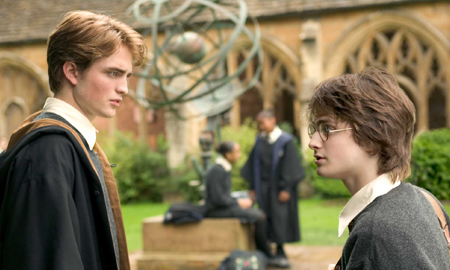
The Principles: Mike Newell (Director). Hell you already know the main folks. With this film we’re introduced to David Tennant, Brendan Gleeson, Robert Pattinson and Ralph Fiennes as Lord Voldemort, among others.
The Premise: Hogwarts is host to the (annual?) Tri-Wizard Tournament in which Mr. Potter ends up mysteriously competing (he’s just a boy!). In the meantime, the Death Eaters have made a mess of the Quidditch World Cup, our young Wizards are hitting puberty and the Dark Lord himself is reborn.
Is It Good: Ya know – I don’t know. I really don’t. Taken as a whole? No. I suppose it isn’t. It’s soooo long and a lot of it is tedious and Emma Watson is such a pain in the ass for almost every scene she’s in (which I only mention because she was quite delightful in Azkaban) and the ending is BULLSHIT. BUT – when it works? Goddamn it works. The question is – does it work because of or in spite of new franchise helmer Mike Newell?
Up to this point, Goblet of Fire was the single most important entry in the series (and, in a lot of ways, it still is). It’s a fact recognizable from the very beginning in that this is the first film in which we do NOT open with Harry at the Dursleys. Not only is this great in the whole symbolic sense of having finally moved Harry into permanent residency within the Wizarding World, the added bonus is that, in terms of the films, the opening segments in Little Winging were becoming incredibly grating (even in Azkaban with the emotion that Cuaron was able to wrangle out of Radcliffe and the tiny but wonderfully sinister performance he got out of Pam Ferris as Aunt Marge). They had sort of gotten to the point of being better served with their own title card and being played as a standalone short in front of the films (and welcome back to another episode of “Those Crazy Dursleys!”). At any rate, that’s gone, thankfully.
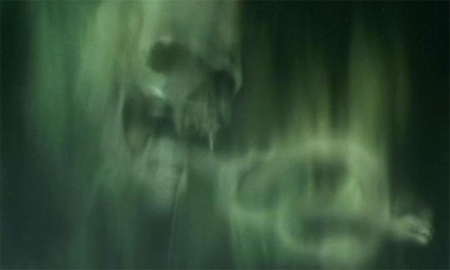
Instead, removed from Little Winging, we open with a really slick little pre-title graveyard tracking shot following a nicely rendered snake and it turns out that Harry isn’t even the first character we see – it’s an elderly old Muggle. Who ends up murdered by Voldemort himself (it‘s also the first time we see the Avada Kedavra curse fully performed – Lucius Malfoy’s foiled attempt at the end of Chamber of Secrets excluded). No, there’s no Muggle buffoonery here – we open with a straight-up murder. And this is all before we even see Harry’s face. It’s a drastic turn in overall tone from the previous three films (though it can be argued that Cuaron – largely due to his execution in bringing the Dementors to life – established a wonderful, palpable sense of danger in the previous film) and it states with sinister authority that of all the stakes have indeed been raised. It’s a tone that’s carried over as the Weasleys (along with Harry and Hermione and the Diggorys) take a trip to watch the Quidditch World Cup Match…which gets subsequently raided and ransacked by the Death Eaters. The who? Yeah – the Death Eaters. He-Who-Must-Not-Be-Named’s Loyal Subjects. This is the first time we’re introduced to them and the blow isn’t softened with a whispered legend or a forbidden name. No, the first time we meet the Death Eaters we actually see them – assembled in full regalia, goose-stepping through the magical shanty-town set up at the Stadium grounds, doing their work. It‘s chillingly effective to see all that fire reflected and shimmering in their metallic masks as they march through crowds of screaming, terrified, desperate people. And it’s all punctuated by our first-ever glimpse at the Dark Mark – Lord Voldemort’s logo, if you will – the sickly green image twirling and writhing about in the clouds.
The first fifteen minutes of Goblet of Fire are fucking intense.
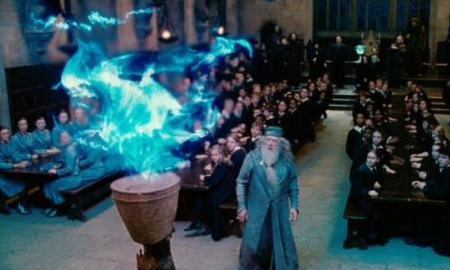
But, then the kids go off to school and, aside from a brief exchange between Harry and Hermione on the train, everything that’s just happened is all but forgotten. Now, granted, nobody but us knows what happened to the old Muggle (well, us and Harry, but he thinks it’s just a dream), but there’s no secret about what happened at the World Cup and when school starts again it might as well have not happened at all. From the moment the students are assembled in The Great Hall everything becomes centered around the Tri-Wizard Tournament. There are moments, sure, when the sinister tone bubbles back up to the top – mainly in the aftermath of Harry’s name flying out of the Goblet – but these things are just disembodied moments that are mentioned as they happen, but not brought up again. As angry as Dumbledore was when he interrogated Harry, as serious and dour as McGonagall was when discussing it – it was never investigated or even mentioned again. At that point it just becomes accepted that Potter’s in the competition and everybody seems to be okay with it. We see Barty Crouch (who was at the World Cup and even accused Harry of setting off the Dark Mark) several times but he never makes any mention of what happened before the school year started. Instead we jump from scene to scene, beat to beat in a very punctuated plot progression that makes the film – again, what is supposed to be the most important in the series – feel very jagged.
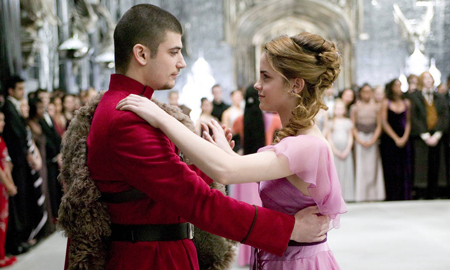
And it’s not just the Dursleys and the Death Eaters that mark a departure. Goblet is where we first start to get a glimpse of the jealousy that’s hiding deep within Ron and his fight with Harry (in the book) is fleshed out and given some real weight and sets up a powerful callback in the first half of Deathly Hallows. Here it just sort of happens and ends almost as soon as it begins. Which is a real shame because Grint shows some early promise with nothing more than a look that betrays a simmering darkness and had Newell really known what he was doing he would have pulled more of that out, especially as it leads to the another Big Establishment; namely, the fact that our kids are turning into adults. Romance (and puberty) is in the air as the kids get ready for the Yule Ball – Hogwarts’ version of the prom – and while there are some wonderfully charming moments with the boys working up the nerve to ask the girls out, there’s another nice establishing moment (and one of Watson’s only good scenes in the film) in the about-to-blossom romance between Ron and Hermione in which Ron’s jealousy over Hermione’s date with Viktor Krum could have been wonderfully tied back into his jealously of Harry. Instead, everything that happens is treated as mutually exclusive from everything else.
So yeah, there’s a LOT going on in Goblet of Fire and practically every single moment of it sets the wheels in motion for every single thing that comes after, going all the way to the very, very end of Deathly Hallows. And Newell does a decent job of handling each of these things on their own (though there is a teency bit of…flatness to his direction), but he has no idea how to weave in any connective tissue and, as such, the entire thing becomes extremely and distractingly compartmentalized.
And then the end happens. (FYI – spoilers below, if that’s a concern)
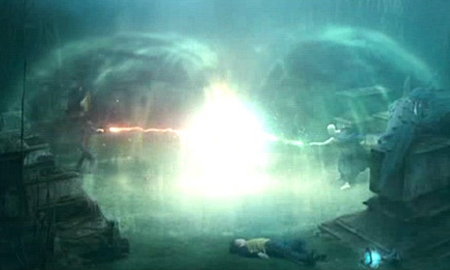
For all the Big Establishing Moments that came before, the single most important moment in Goblet of Fire comes at the end of the Tri-Wizard Tournament. After Harry and Cedric fight their way to the Cup, they discover that it’s actually a portkey and get transported to that graveyard from the beginning of the film. Once there, Cedric is almost immediately struck dead for his troubles and Peter Pettigrew uses Harry to bring Lord Voldemort back to life. It‘s a resurrection that sometimes threatens to look silly (Pettigrew dropping the rubber Voldemort fetus cat thing in the cauldron was kinda laughable), but when he fully forms it’s rather spectacular. Made even more so by the fact that it’s not only our first look, but also Harry’s first look at the Dark Lord in the flesh, in person, as a whole being. This is a tremendous moment for Harry – Voldemort is the reason for every single thing that’s happened in his life and it’s here that he finally gets to look those stories and legends and secrets in the eye. It’s something that we get to share with him and even though the execution is sometimes flat and spotty, it’s only helped by the scenery-chewing delight that Ralph Fiennes turns in with his performance. And the ensuing showdown is somewhat of a visual feast – the red and green spells battling each other and giving us a taste of the great things Yates would go on to do in the emerald halls of the Ministry at the end of Order of the Phoenix – but it’s also given a thematic weight, with Harry being aided by the souls of those who had been killed by Voldemort. It sets up the idea that Harry isn’t just fighting for himself or his parents – he’s fighting for everyone who’s suffered a loss at the hands of Voldemort. It‘s a poignant, rather powerful moment. And as he transports back to the playing field with Cedric’s corpse in tow and the crowd slowly realizes what’s happened and Amos Diggory breaks down into sobs of “My boy…my boy…” there’s so much going on and Newell pulls those few moments off so well that you want to forgive every stumble that came before it because HOLY SHIT everything’s changed.
The problem is that we slowly pull away from that and start to tie up all the expositional angles – we still have to find out how Harry’s name got put in the Goblet, after all – and after a touching eulogy from Dumbledore, the movie gradually shoves its head up its own ass and ends with a humorous, even whimsical tone.
Really, Mike Newell? Lord Voldemort is back, his followers have reassembled, he’s murdered two people (one of them a CHILD) and we end on a happy note? Bullshit. And it’s at this point that you realize how much of a failure Goblet of Fire is as a film. And just to add insult to injury, there are moments where Newell did in fact know what he was doing and there are glimmers of what could have been. And when you’re tasked with directing one of the most important films in the series and you’re following up the artistic success that was (and is) Cuaron’s Prisoner of Azkaban, you need to bring your A-Game. Newell didn’t. At all.
So no…all things considered, it’s not good.
Is It Worth A Look: If you’re just a casual fan of the series and you haven’t seen it yet then no – probably not, as the main story beats can be easily gathered elsewhere and you’re probably not invested enough to let the thematic weight outshine the filmmaking. And if you’re a more hardcore fan of the series, then chances are you’ve already seen it. I suppose a more fitting way to answer it would be that if I were going to marathon the series I wouldn’t skip it, but I doubt it would be one that would make it’s way into the comfort food/background noise/go-to-sleep-to rotation. So take that for what it’s worth.
Random Anecdotes: Ya know, if the world hadn’t had to deal with Twilight ever happening and didn‘t have to endure his overly-rosy-cheeked face being sold as the “most beautiful thing in the world,” I think Robert Pattinson might have ended up as a dude we all liked, as I liked him a lot here. Also – and this isn’t anything to do with Goblet specifically – but since nobody seems to have mentioned it yet I do wanna give some hi-fives to Julie Walters as Ms. Molly Weasley. The warmth and motherly nature that comes out of that performance in all of the films is palpable. I want her to knit me a sweater. Definitely one of my most absolute favorite supporting characters.
Also, I got so busy ranting above that I didn’t even mention Mad-Eye Moody, played wonderfully by Brendan Gleeson. Brought in as the requisite new Defense Against the Dark Arts Teacher, Moody has some great moments but the problems I had with the character lie at Rowling’s feet (though someone should have told Newell no when he wanted to shoot in Moody-Vision) – namely that we spend so much time with him but it all turns out to be fake, which makes it really hard to care when he’s reintroduced and meets his fate in Deathly Hallows. Also – since when does polyjuice potion change your voice, Jo?
Cinematc Soulmates: The other 7 Harry Potter Films. Any other movie that should have been great but was poorly executed.
7 comments
There are even more problems with this film than what you mentioned – namely that it relies on foreknowledge of the books (or, possibly, relies on the viewer to rewatch the movie) to make sense at times. The scene with Snape in the closet – “you know what it means as well as I!” – makes no sense upon initial viewing to anyone who only knows this franchise from the movies. (For my part, it was clearer when I watched it a second time, at least, no matter how rushed and awkward the scene is anyway.)
And then at the end, the whole thing with the Potters’ ghosts talking to Harry with FULL KNOWLEDGE and sentience of what they’re seeing happens, and the only justification we hear is Dumbledore muttering “Priori Incantatum” to himself. Is this ever explained, maybe in a later movie? No. No it’s not.
This same issue would finally re-emerge in Deathly Hallows Part 1, but for now it’s an early instance of some epic fail. You have to be able to function as a MOVIE, and you have to make sense from start to finish for the newbies.
Jesus, I’ve seen these movies countless times and didn’t pick up on the polyjuice error. How could I have missed that?
eh, I still like the film. It has a lot of problems, but there are so many great moments in the film, from the first fifteen minutes (as mentioned) to Rita Skeeter, to the Dragon test, to Mad Eye’s demonstration of the three unforgivable curses, to Voldemort… I think it’s a mistake to encourage anyone to skip it, specially considering it shows us the resurrection of Tom Riddle… I mean, that is very important.
Good analysis–I may like the movie a little more than you, but I absolutely agree on Mad Eye Moody. We get introduced to this wonderful new character, brought to life by a great actor, and then we get the rug pulled out from under us. This might have worked better if we’d already known Moody before he was impersonated, or if the impostor only took over halfway through the story. But as it is, by the end of the film, we realize we know nothing about the real character. He needed to be reintroduced somehow–but never was. Pity.
As someone with no forknowledge of the books I read your comment hoping to glean a better understanding of both the film and this article, but unfortunately am unable to as I have no forknowledge of the books. Trying to get into the Harry Potter series of films is like trying to get into playing World of Warcraft the like.
After Cuaron’s film showed how you could streamline things and make it work as a film, Mike Newell takes it back to the territory of a meandering episodic mess… When this movie drags, boy does it ever drag.
The plot, as it were, is about the Tri-Wizard tournament. And those are the most thrilling moments in the film. Everything else just feels like padding. Fine for a book that you take a few days to read and get involved in. But not appropriate for what should really just be an adventure story. I’ve been getting on Columbus’s case from the start, but Chamber Of Secrets (which is longer) feels tighter than this movie.
Also… How can it feel like such a chore to sit through, while also feeling too rushed? Isn’t that weird?
Am I really the only one who counts this one as my favorite of the series? Interesting. As someone who has not read the novels, here is my ranking of the Harry Potter films:
1. Goblet of Fire
2. Half-Blood Prince
3. Prisoner of Azkaban
4. Order of the Phoenix
5. The Deathly Hallows Part 1
6. The Chamber of Secrets
7. The Sorcerer’s Stone
Keep in mind that I pretty much love the first six on the list.
Comments are shown as archived from the original site; new comments are closed.