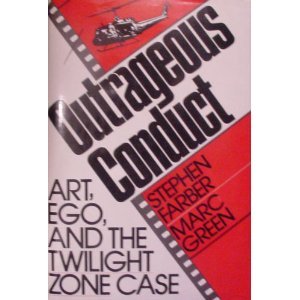
About a year ago when I was home visiting Chicago Mr. Brown bestowed upon me a copy of Stephen Farber and Marc Green’s 1989 book Outrageous Conduct. The book is an accounting of/reaction to the infamous Twilight Zone Movie accident in 1982 that killed actor Vic Morrow and two very young Filipino children (6 and 8 years of age). The authors (or at least one of them – the book has a tone that suggests Farber may be the ‘author’ and Green the researcher/fact checker) comes off as overly biased – of course how couldn’t you be, it’s not as though Director John Landis, under whose healm the disaster took place, isn’t guilty of the (at least near-)criminal neglience that lead to the loss of three lives. However, even in the face of irrefutable facts there is a certain tone that is expected in a project like this, and Farber and Green come off so strong that one wonders if it was all outrage or perhaps something personal snuck in there too…
Anyway, we’ll stick to the outrage, because it’s pretty dire. The book chronicles the events leading up to the disaster, including the climate of Hollywood at the time in regards to stunts, stunt persons, stunt protocol and, of course, the legal guidelines of having children involved in a shoot. As it pertains to our situation here in 1982, children quite simply were not allowed to work on set after 8 PM and Landis and/or his people purposely ignored that fact. They also apparently purposely ignored standard (and seemingly common sense) stunt guidelines, hence a helicopter flying too close to a set populated with actors surrounded by explosions.
Sounds grim, eh?
It’s pretty clear that the outrage that Farber and Green feel about this tragedy had not alleviated one iota by the time of the book’s publishing some seven years later, and maybe that’s good. Although, it must be said, when people argue in such a way as to very clearly have cross hairs on their query’s forehead parts of their argument may become suspect (I’m looking at you, Michael ‘I-used-to-be-relevant’ Moore) and despite my own much quieter outrage some thirty-odd years later I must say that the authors here do indeed come off a bit biased – although I don’t know what could change perhaps other than a more even-keel in the presentation of the facts, instead of the sensationalism I feel sneaks around most of the books pages.
That being said, so far great read, it just has a little bit of the Hard Copy element, and that’s scary.


2 comments
How is it biased?? Examples are helpful
I’ve thought about how exactly to answer your question Kate without expressly sounding biased meself. The bias I’m describing is the Hard Copy element in the delivery – ie slightly overly dramatic and sensational, and the point of the book is to infect the reader with the author’s outrage. And yeah, as I stated above, it is an outrageous event borne of neglect. However, none of us, including the authors, were there, so everything is based on research. Research conducted – obviously – after the fact. Farber and Green, in telling everybody involved (esp. Landis’) history up to the event, seek to crucify the director. Maybe that’s fine. However, their description of the making of his other movies, esp. The Blues Brothers, contains examples cited by others that worked with him about his predilection for a dangerous and neglectful MO that seems to casually and with almost maniacal glee (as it is presented by the authors) put his actors in jeopardy to obtain difficult, dangerous but photographic or ‘groundbreaking’ shots/effects (ie the detonation of an entire mall in The Blues Brothers). While the tallying of these events does indeed help to make the authors’ case against Landis, again, some of this stuff is twice or thrice removed, source wise, and laid out with a similar maniacal glee – a glee where they (authors) seem to want to quickly and completely build a mob of hatred toward the director.
My original thoughts upon starting the book was that perhaps one of the authors lost a family member or friend in the debacle – they didn’t – or that they were previously screenwriters, crew members or even directors whose actual outrage at the Twilight Zone Event was actually under-coated with jealous envy at the Landis success. That however, does not seem to be the case.
In the end I think Farber and Green’s argument and, let’s say, ah, joie de vivre for the subject are genuine, I just wish they’d been a little bit more careful with how they made it. In a similar example of reporting facts ruined by MO Michael Moore once felt like a good guy interested in exposing some of the evils of the political/financial world. Then Bush came along and within a few years his frustrated sensationalism began to interfere with the presentation of his facts and he nearly ruined the argument for everybody else.
I hope that helps.
Comments are shown as archived from the original site; new comments are closed.