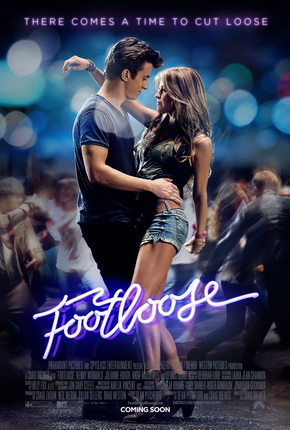
 Craig Brewer loves him a southern girl with baggage, almost as much as he loves photographing the south, compiling great soundtracks, and elevating music and dance to sacrosanct rituals that serve as outlets for our basic humanity. It’s for these reasons that the director of Hustle & Flow and Black Snake Moan was a perfect choice to take on a remake of a beloved 80s classic that is loved as much for its ridiculous conceit as it is for the catchy songs or for launching Kevin Bacon. What would seem like a fools errand though, modernizing and adding a dash of realism to a decidedly archaic concept, actually results in a good movie that solidly earns its existence and finds a place, albeit a lighter family-friendly place, among the films of a still-developing southern-baked auteur.
The story of Footloose is simple and familiar: the rebellious new boy discovers that this isolated little town he’s moving into has outlawed dancing. He rocks and rolls his way into the town’s heart, bucking authority at ever turn, and ultimately gets the girl. Little has changed with Brewer’s Footloose, except a new entry-point and sense of perspective is brought to the proceedings from the very start. A familiar opening of dancing feet at a keggar dovetails into a scene in which five kids in a car are pulverized (like, way dead) by an eighteen-wheeler. It’s a sharp start to the film that contrasts the exuberance of the youth’s dancing with the sudden impact of tragedy. Dennis Quaid enters as Reverend Moore with a stirringly emotional entreaty for the parents of Bomont to take a more active role in their children’s lives, translating that into an active step to disban public dances. While it shouldn’t matter (this is a musical after all), the film does take care to frame the law in such a way that it toes the line of plausibility: the town doesn’t outlaw dancing, but rather unsupervised dances at unchaperoned locations.
So really when the (exceedingly chaste) Ren* comes to town and starts to rebel, he is ostensibly fighting for the right of Bomont’s youth to publicly dry hump each other. Again, the laws do not ban dancing outright, just doing so outside of unchaperoned locations as well as movements considered “loud.” Of course in the Brewerverse, where the sweaty, mind-blowing release of all-or-nothing dancing is akin to pure humanity, this is a state of unbearable purgatory. In Black Snake Moan one of the most cathartic moments of the entire film is a scene in which Christina Ricci’s Rae dances her heart out, but in a way that makes it a healthy outlet for the dark, destructive sexual overdrive she carries with her. To an outside observer (say, a Bomont parent) such a dance would seem like a prelude to a night of regrets, but we know in fact that this is a far healthier expression of her physical needs than the alternative. Brewer’s Bomont under the anti-dancing statutes must have a sky-high pregnancy rate.
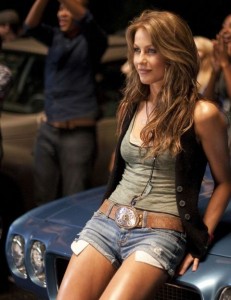 Once we skip forward a few years, we see that the inherent teenagerdom of the town’s youth has not been suppressed, and Brewer captures the pent-up frustration of the Bomont kids very well. Of course we’re also introduced to Ariel, the Reverend’s daughter and an amped up southern wild child that isn’t quite on the x-rated path of self-destruction that Christina Ricci’s Rae is in Black Snake Moan, but she’s still demonstrating a decided lack of judgement for someone who is clearly sharp. It’s a familiar archetype, but one Brewer excels at capturing, and he works with the electric Julianne Hough to create a complicated Southern Belle worthy of the big screen. Her highs and lows are obviously toned down from Rae (implied sex, rather than debaucherous public screwing, and a single smack rather than a life-threatening beating), but she stands as another well-rendered, multidimensional basketcase for Brewer to heal. Of course, she’s the result of a complicated environment: a post-9/11 subtext is definitely present in to the film, without being overwrought or exploitative. It very naturally and confidently tackles the general tone of modern America. The struggle between freedom and safety, and the perhaps well-intentioned but ultimately dangerous use of authority in Footloose reflects, in very broad strokes, something that will feel familiar to Americans old enough to remember how things felt before and after the country was so abruptly scarred.
Subtext or not, you can’t pull off a film like this with a lead worth building a fun dance flick around. Fortunately, Kenny Wormald is a very worthy big screen presence who fills Bacon’s shoes with confidence and charm. His Bostonian accent clashes perfectly with the twang that surrounds him, and its to his credit that the seemingly contradictory personality traits of being a smartass punk and a chaste charmer are balanced so well in his character. What you soon realize is that Ren and Ariel are both carrying the weight of tragedy on their shoulders, and where Ariel’s frustration with small town life and overbearing adults has manifested in unhealthy relationships and bad choices, Ren’s story has forced him to grow up faster than most kids. Wormald, under Brewer’s keen eye for personal drama, is able to bring out that damaged anti-authoritarian while totally selling a maturity that keeps him from banging Ariel at the first whiff of sexual tension. In fact, the story of Footloose has that romance drawn out across most of the film, and these days that decades old story is suddenly fresh in an environment where every film romance is about getting together immediately, breaking up, and getting back together again.
As fascinated by the broken southern girl as the film may be though, the bulk of the development is aimed at Ren and it unfolds very naturally. A lot of what we learn about him is brought out by friendships he makes with characters like his new pal Willard, joyfully played by Miles Teller. The soul and good intentions of the small town are centered around an engaged Dennis Quaid, who bounces well of the kids and other adult character actors like Andie MacDowell and Ray McKinnon.
Brewer has not merely tweaked the story and characters to sell the film to a modern audience though, nor has he simply accentuated a few themes that he’s shown interest in before. 2011’s Footloose feels made from the same ingredients, but re-baked in an entirely different oven. Partly this is accomplished by transplanting the story to Georgia, where Brewer can go nuts with a southern aesthetic, and that open up his musical choices. The South is a region that accepts every genre of music as long as it can be filtered through a working class lens, and is perhaps the only setting in which country, hip hop, rock and roll, and pop music could be brought together to form such a cohesive rhythmic tapestry. The film has a great soundtrack that represents the complicated social ecosystem of the modern south, in which the reddest-necked hillbillies look as natural bobbing their heads to dirty south rap next to a black guy in a cowboy hat as they would square dancing. The great construction of the soundtrack is mirrored by how well choreographed and filmed the dancing sequences are. The film really comes alive during these scenes, but they’re not always show-stopping distinct DANCE SEQUENCES. Rather, dancing is integrated into the story and the drama, and people dance as a backdrop to unfolding character drama. It makes the film feel more natural, and less like a overwrought cliche in which everyone spontaneously breaks into synchronization, and more like a decidedly messy collection of cool-looking movement. There is some mass choreography of course, but it’s more scattered and interestingly blocked so that it’s much less unbelievable than you’re used to from a musical. Specific characters stick to a style throughout the film as well: Ren’s background as a gymnast justifies his more elaborate moves, whereas Ariel spends most of the film pulling off a mix of writhing and line dancing.
 Naturally everything from the town of Bomont to the skyline of Atlanta is beautifully shot, and while Brewer may have had to dilute the potency of some of his themes and images, a bigger budget has empowered him to really cut loose (I’m sorry) visually. The camera in Footloose always feels perfectly placed and as energetic as whatever it’s capturing. I mentioned before that the dancing sequences have a more expansive, complex layout than you might expect, and its such confident camera work that makes that possible. Even a more intimate scene like the famous “angry dance” is filled with a tightly-shot intertia that makes the frame expressive along with the dancer, doubling the impact. It strongly suggests that as the scale of Brewer’s productions increase, so will his ability to visually manage them.
The intentions of the Footloose of 2011 do not read as having been designed to subvert the idea of a dance film or a teen romance movie. Instead it’s respectful of the charm and purity of the classic 80s teen fables, but it’s not afraid to amp up the potent big people drama. Brewer will certainly be better served working in his edgier, more adult wheelhouse as often as possible, but he’s definitively proven that his skills hold up in the mainstream. Beautifully shot and thematically resonant, Footloose is a remake that earns its place as a classic teen movie for a new generation.
Rating: 

Out of a Possible 5 Stars
*This is a weird review to write. I’m not at all used to sharing my name.

10 comments
Jesus.
And that’s not a slight on Renn or anything. This is a well-written, credible piece of film criticism.
But still… Jesus.
Yeah this is a nice review, as usual, but I can’t help but wonder if this is a Fast Five/Warrior situation where the movie gets a ton of good reviews in the movie geek press but is nevertheless an obvious piece of shit. I guess it’s just the stigma involved in a Footloose remake that makes me think that. And of course, Brewer is more of an auteur than the directors of either of those two aforementioned films — although not a fully-fledged one yet, but that would indicate potential I suppose.
But I just don’t think I can bring myself to see this.
All well and good, but if this film provides even one additional nickel of royalties to that smarmy Kenny Loggins, it needs to be taken out and shot.
Thematically resonant? This movie’s central conceit has been thematically resonant since the 1950s. Beautifully shot? What movie today isn’t beautifully shot?
Ebert gave it 1 and a half stars. His opening is pretty hilarious:
“There’s one thing to be said for a remake of a 1984 movie that uses the original’s screenplay. This 2011 version is so similar — sometimes song for song and line for line — that I was wickedly tempted to reprint my 1984 review, word for word. But That Would be Wrong. I think I could have gotten away with it, though. The movies differ in such tiny details (the hero now moves to Tennessee from Massachusetts, not Chicago) that few would have noticed. “
I notice he made his usual screw up of a plot/setting/character detail right there in the first paragraph on that one, naturally amidst the willfully obtuse, out-of-touch groaning he’s so effective at these days.
Way to take a shit on an old guy without a jaw, Renn. Classy.
I loved the original but I like what I’m reading about this film’s difference. I’ll check it out.
Straight up, I’d take Renn over Ebert any day. And it’s not just because of the missing mandibles on the latter.
Really? I’m waiting with anticipation to learn why you’d take Renn over Ebert any day… or did you just write that for the missing mandibles line?
Okay went to see it and thoroughly enjoyed it. Yes, Kenny is no Kevin Bacon (seriously could anyone every be as cool as Kevin Bacon?) but I thought he gave a sincere performance as Renn. I also think that seeing the accident after that rousing open dance scene drives home the reasoning of why a town might resort to such extreme after such a loss. I think Renn the reviewer is right in saying that there’s some believable like post 911 hysteria at work.
And the soundtrack was terrific. It won me over and I own cassettes and vinyls of the original.
All in all, a pretty good effort not perfect but then let’s not kid ourselves either, the original wasn’t Citizen Kane.
Comments are shown as archived from the original site; new comments are closed.