Hollywood loves a good franchise. The movie-going public does too. Horror, action, comedy, sci-fi, western, no genre is safe. And any film, no matter how seemingly stand-alone, conclusive, or inappropriate to sequel, could generate an expansive franchise. They are legion. We are surrounded. But a champion has risen from the rabble to defend us. Me. I have donned my sweats and taken up cinema’s gauntlet. Don’t try this at home. I am a professional.
Let’s be buddies on the Facebookz!
Buy my newest book!
The Franchise: Back to the Future: following the time-traveling adventures of teenager Marty McFly, eccentric inventor Dr. Emmett “Doc” Brown, and Brown’s creation, a 1981 DeLorean DMC-12 that has been modified into a time-machine. From 1985 to 1992, the franchise spanned three films and an animated television series.
previous installments
Back to the Future
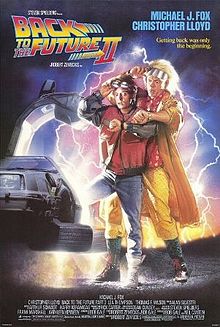
The Installment: Back to the Future II (1989)
The Story:
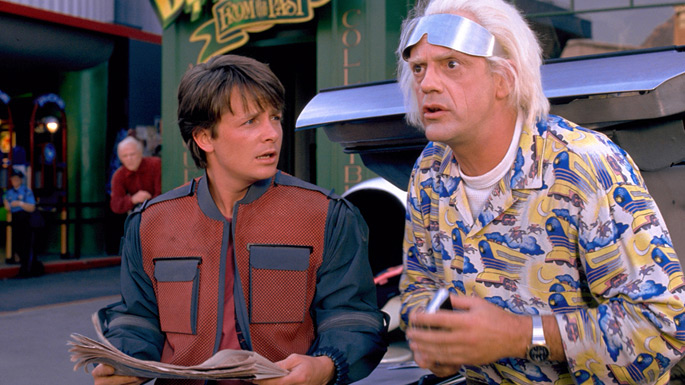
We pick up right where we left off, with Doc Brown showing up in Marty’s driveway in a flying DeLorean — though Marty’s girlfriend Jennifer looks a little different for some reason. Doc Brown takes Marty and Jennifer to the year 2015, even though Jennifer doesn’t really need to be there, so that Marty can tamper with history and prevent his son from going to jail. Then Doc yells at Marty for trying to tamper with history when Marty purchases a sports almanac listing statistics from 1950-2000. After Doc throws the almanac in the trash, an elderly Biff Tannen takes the almanac and steals the DeLorean so that he can give himself the paper-bound gambling goldmine back in 1955. This creates an alternate timeline in which Biff is rich and life sucks for the McFly clan and Doc Brown. So Marty and Doc go back to 1955 again to make sure Biff can’t get rich and stuff. Hoverboards happen somewhere in here.
What Works:
Because Back to the Future II and Back to the Future III were shot simultaneously, and make up two halves of one larger narrative arc, talking about either as stand-alone films is a little unfair to the intentions of the filmmakers, but the sequels are nonetheless individual installments released as two distinct films, trying to do two distinct things. I’ll touch on the two-part thing with BTTF III, but for now let’s just act like this film is a standalone sequel.
The fact that BTTF II is made by the same creative team who gave us the first film is interesting, because it feels like a shake-up; like James Cameron swooping in after Alien with an entirely different brazen attitude. Fittingly to BTTF II‘s themes, the sequel is something of a paradox — consumed with a fanboy-like revelry for the original film, yet also jettisoning pretty much every structural and aesthetic success that made the original such a hit. This is the film’s charm and its repulsion, depending on how you look at it. It is hard to label the film a success or a failure, because though Robert Zemeckis and Bob Gale were apparently completely bored by the prospect of crafting a truly respectful and thoughtful sequel, their excitement for what they did come up with is at times exhilarating and inspired — this is no lazy sequel. BTTF II is a crazy film. And though it is extremely disappointing in many ways, I personally find it relevant to remind myself that there was a time when my friends and I found the film superior to the original. It isn’t. At all. Where the original film felt effortless, II feels spastic, like it is trying too hard and overcompensating for its lack of story by having a lot of story artifice and machinations. But my childhood delusion speaks to the fact that Zemeckis did something unique here. He may have created his own pile of lemons in the concepting phase, but he still made lemonade out of it.
It is easy, from our side of the filmmaking process, to view the two Bobs’ decision to go “silly” with the sequel as an odd or even disrespectful choice. But that is also ignoring the uncertain path BTTF left for a follow-up film. Creating a sequel to Back to the Future seems like a no-brainer. We have a lovable pair of characters with great chemistry (Marty and Doc) and a sky’s-the-limit high-concept (time-traveling car) that allows for an endless number of story possibilities. But that is an illusion. Despite the fact that the film ends with Marty and Doc going off on another adventure, the ending is actually a closed off finale. The films that are most easily franchised, in any genre, are films that serve as an origin story. You’d think that a film in which a teen has a time-traveling car introduced into his life is indeed an origin story, but it isn’t. BTTF is a movie centered around a time machine, but the movie isn’t really about time travel. It is about the relationship between a teen and his two parents. That is why the film didn’t end with Doc and Marty going off on an adventure to see Vikings or dinosaurs, or going off to save the world or fix a time anomaly. Instead the cliffhanger is that Marty now needs to resolve something in the future with his own children. Also, Marty traveled through time by accident last time, so the plot hinged on the fact that he was stuck in 1955. If you were accurately describing the film you would most likely say it was about a teen who “gets stuck” in the past, versus saying it is about a teen who “travels” to the past. And I think that minor wording difference adds up to a much bigger implication than it might seem.
The problem the Bobs faced was similar to the problem that faced the filmmakers behind Bill & Ted’s Excellent Adventure (the other big time-travel comedy of the ’80s). Do you sequel the schtick of the first film, or do you sequel the elements? For BTTF, do you once again tell a story about the DeLorean immediately becoming non-functional and trapping Marty in the past/future? As Ghostbusters 2 demonstrated this same year, just doing the same old shit again doesn’t feel very magical the second time around. Yet there is the risk of alienating fans by deviating from the path, and essentially giving them a whole new kind of movie that simply features the same characters. Similarly, we don’t really want/need another story about Marty trying to save his family, but having a story that has nothing to do with his family will be a very sudden change. It is a lose-lose situation, and the Bobs clearly felt that deviating from the path was the lesser of two evils. The other big dilemma facing the Bobs from the get-go was more a case of bad luck. Do they ignore BTTF‘s cliffhanger, or pick up right where it left off? BTTF‘s cliffhanger is a clever reversal on the film’s parent/child dynamics, and a perfect way to end the film. But continuing with the cliffhanger doesn’t exactly leave you with many options (the Bobs never planned to make a sequel, so they didn’t even know what exactly Doc Brown needed Marty and Jennifer to see in 2015). From a writing perspective ignoring the cliffhanger would be the smart thing to do, because it frees up story options. But fans would be pissed. We squirmed with anticipation for a few years waiting to find out what Marty’s future looks like. I think the Bobs made the right call regarding the cliffhanger — erring on the side of pleasing the fanbase is never a bad move, even though it caused some problems for the film (which we will discuss in the next section).
I referred to this movie as having a “fanboy-like revelry” for BTTF. Almost all sequels pay tribute to their predecessor with callbacks and repeated bits and whatnot, but rarely are sequels consumed by such things. Like pretty much every aspect of BTTF II, this cuts both ways and you’re either going to enjoy it or find it off-putting. By and large, I find it entertaining. It makes the entire film feel incredibly frivolous, but as I already said, Zemeckis is making lemonade here. He does not seem at all concerned with establishing a true franchise. He’s revisiting his surprise hit with a carnival funhouse approach. Everything is a gag, and almost all of it is a direct reference or riff on BTTF. While the sheer silliness of some of the gags changes the film’s tone a bit, in most cases the Bobs are actually just expanding upon two gimmicks they had employed in the first film: 1) actors playing two different versions of the same character in different time periods, and 2) the repeat of the Libyan terrorist scene.
Let’s start with #1. A key component to the humor in BTTF was the juxtaposition between 1985 Hill Valley and 1955 Hill Valley, which rested heavily on seeing all the characters from 1985 now in their younger 1955 forms. The love it or hate it bomb for BTTF II was the decision to have Michael J. Fox and Thomas F. Wilson not only play Marty and Biff at multiple ages, but to play completely different characters as well — namely the decision to have Michael J. Fox play Marty’s son and daughter. It is a cute idea, but it does introduce an Eddie Murphy shtick to the film that feels out of place; which isn’t helped by the jinky quality of the make-up FX. Here we’re seeing the first ramifications of the visual FX bug that Zemeckis caught while shooting Roger Rabbit, because there isn’t a reason to do any of these gags, other than it is “fun.” But, it is pretty fun (though Fox makes a somewhat unsettlingly pretty female) and adds a further bit of novelty to the already frenzied madhouse of gags in 2015. And adding even more age-variations for the existing characters is a natural sequel expansion. The scene between Old Biff and Young Biff is particularly enjoyable, and the huge-breasted Lorraine from the alternate 1985 is a nice way to relive the awkward sexuality from the BTTF scene in which Marty awakens (after being knocked out), disoriented and thinking the whole movie had been a crazy dream — “I’m fine, I’m fine. It’s just that you’re so – you’re so – big.”
#2. One can suspect that, like us, the Bobs also really liked the bit at the end of BTTF with Marty watching himself run away from the Libyans. It is a fantastic moment, and from a franchising perspective it establishes that Marty can travel back into his own movie. All sequels try to find ways to recycle the first film. In BTTF II, the Bobs found the most genius way imaginable — just have Marty go back to Back to the Future. It is thrilling seeing Marty sneak around in the shadows of the first film, and Zemeckis nicely utilizes outtakes and unused camera angles from the original film to give us a fresh look at things. The excitement of this section can best be summed up in the moment when BTTF Marty accidentally hits BTTF II Marty in the face with a door. Even aside from the (then) groundbreaking compositting technology being used here, it is a smart bit. A whole movie of Marty back in 1955 again would have been awful, but having Marty hustle through the climax of BTTF is just so, well, fun. I’m going to be using the word “fun” too much, I can already tell.
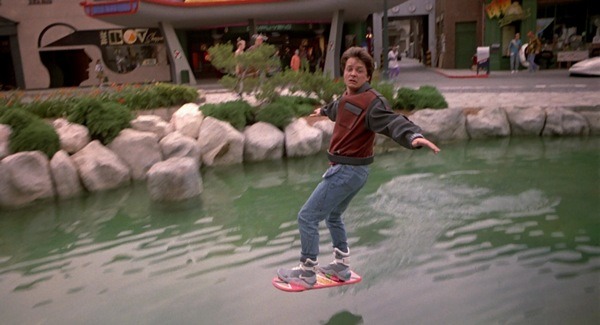
Speaking of the frenzied madhouse of gags in 2015, this first section of the film features a Futurama-esque onslaught of sci-fi jokes, generating some of the film’s most indelible moments with what are actually just throwaway gags. Marty’s self-drying jacket. The auto-lacing shoes. To-the-second accurate weather predictions. Doc de-aging himself. Jaws 19. The Max Headroom-esque waiters of Cafe 80s. The Black & Decker food hydrator. Fingerprint door locks. Griff’s bionic legs. The robot dog-walking leash. And of course we can’t forget the hoverboard — the most iconic thing from the whole film is that hoverboard. The attention to small details here is dizzying. Everything is a joke. I’m sure I’m stilling missing some background jokes.
The film doesn’t quite click until we reach alternate 1985, but from that point forward the film starts hitting its marks. I’m a sucker for dystopian jokes, like the scene with the gun-toting Mr. Strickland. And the scene in which Marty accidentally stumbles into a little girl’s bedroom at night, only to be attacked by her very angry father, while kind of politically incorrect I suppose, is hilarious. I also love all the stuff with asshole Rich Biff. I like Thomas F. Wilson, so it is great seeing him given so much to do and so many characters to play.
Because BTTF II is meant to lead directly into BTTF III, the film doesn’t have a real ending. But it does have a great “oh shit!” cliffhanger, with the DeLorean being struck by lightning and a Western Union employee (played by the always welcome Joe Flaherty) mysteriously showing up with a seventy-year-old letter addressed to Marty — revealing that the Doc is in the ‘Old West.’ It is an ending of enormous promise.
What Doesn’t Work:
As we talked about last time, BTTF is a film with a lot of on-paper problems that got magically plastered over by its lightning-in-a-bottle execution. BTTF II doesn’t really have that many more on-paper problems than its predecessor, but the bottled lightning feeling is now gone. This leaves its many problems more conspicuously exposed. Much of this was no one’s fault (it is hard to blame a movie for not being perfect), but there are some problems that seem very fixable.
It is unfortunate that the Bobs saddled themselves with Jennifer (now being played by Elizabeth Shue) at the end of BTTF. Having her jump in the DeLorean with Marty and Doc worked just dandy as the epilogue to the first film, but what the hell do they do with her now? Adding her to the team would be too much. Things are already going to be different even just with Doc becoming a more important character. Marty was on his own in the first film, needing to convince 1955 Doc to help him. It feels natural to turn them into a full duo for the sequel (that’s what most of us wanted), but suddenly a trio? With an under-developed character we don’t care about? No one wants that. But there had to be something better to do with Jennifer than what we get. Doc just knocks her out immediately once they land the DeLorean in 2015, cause she’s freaking out. Why bring her at all though? He says he had to because she saw the DeLorean in 1985. So he had to take her. So…why did he let her see the damn car then? Oh, he was in a hurry. Wait. In a hurry? He has a time machine! Even if he waited two weeks (or two years) for Marty to finally be alone in 1985, they could still have traveled to the same moment in time in 2015. I realize this is just a silly movie, but that’s still stupid. And then after being briefly awake, Jennifer gets knocked out again and dumped on a porch in alternate 1985 (with further flimsy logic; “The disorientation will help convince her it was all a dream?”; huh?), and is never seen again. All this is symptomatic of the film’s biggest flaw…
The 2015 section feels pointless and carelessly conceived. It seems like the Bobs put all their formidable creative powers to use in coming up with hilarious sci-fi gags, because the story we’re given in 2015 is a head-scratcher. 2015 is just set-up for the real story, which is Old Biff giving Young Biff the sports almanac. That’s fine. And using our time in the future to have a series of silly gags and to see Old Marty is great. Not to mention that this is the Bobs trying their best to have Marty solve a family problem without that being the entire plot of the film. But I have to believe there was a better way to handle things. Once again, why is Doc Brown in a hurry?!?! The dude has a fucking time-machine! And this isn’t one of those “Because then the movie wouldn’t exist” questions that you just need to accept to enjoy the film. There are a million other ways 2015 could have gone down, considering that the only plot point that needed to happen was Old Biff stealing the almanac and the DeLorean. Doc and Marty didn’t need to be in a hurry. But whatever. It is nice to have a stakes. What I find less excusable is why Doc Brown is being such a hypocrite. In BTTF II the major conflict is directly Marty’s fault — he buys the almanac. Doc Brown gets mad at Marty for buying said almanac and trying to alter the future to make his life better. This is a standard set-up for our hero to learn a lesson, but hold the phone, let’s break this down. Why did Doc bring Marty and Jennifer to 2015? To prevent their son from getting arrested, which would send the McFly family into the toilet. So…Doc wants to alter Marty’s future to make Marty’s life better. How is that any different than Marty wanting to make his own life better?! And future Marty’s life already sucks because of a car accident he gets into between 1985 and 2015. Wouldn’t it have made more sense for Doc to tamper with that part of the timeline? But, regardless, why is it cool for Doc to mess with the timeline but not Marty or anyone else? Doc is kind of a dick.
Once we’re out of 2015, these problems are behind us. The problem the overall film has is that there is no ticking clock this time. Part of the reason the 1955 section of the film is as thrilling as it is, is because it is the only part of BTTF II that develops genuine (and not artificial) stakes. It comes when Marty is in danger of screwing up the series of events we already saw in BTTF — risking trapping the original him in 1955 and thus fucking up the time continuum. But other than that relatively brief series of scenes, the movie is just amped up faux-urgency most of the time. Doc and Marty have a time-machine. They never need to hurry. Ever. This may not be immediately apparent to all people while watching the film, but it is felt nonetheless. We don’t have anything equivalent to the disappearing family photo from the first film, and thus the sequel feels less desperate and thus more aimless.
While I enjoy seeing Wilson get such a major acting showcase, BTTF II makes the questionable call that Biff was really important to BTTF. He was a great character and indeed an antagonist, but he was also more of a “complication” than the “bad guy.” Now he’s definitely the bad guy. Promoting in-house, elevating an existing character in a franchise, isn’t a bad idea. In fact, it is usually a good idea, but the upped presence of Biff (as funny as Biff is) makes it feel like George and Lorraine have been sidelined. I know that the real reason George plays such a small role in the film is because Crispin Glover was fired due to a contract dispute, and Zemeckis and Gale covered it all up quite cleverly (most people don’t even realize Glover isn’t in the film), but as has been noted many times, BTTF was a film about a teen’s relationship with his parents. Now it is about a teen’s relationship with the asshole his parents know. It is an organic move, but something about it doesn’t feel quite right as a follow up to the first film.
I think the film might have benefited from having either less or more of Doc Brown. Less would have brought us to something closer to the dynamics of the first film. Maybe more wouldn’t have worked, but there is something about the way Doc just keeps flitting in and out of scenes like a sci-fi Gandalf, offering only partially helpful info and swooping in at the end of scenes to rescue Marty, that feels like a waste of their chemistry. BTTF II keeps Marty and Doc’s relationship at a hurried pace, lacking a lot of the slower and more intimate moments they shared in 1955 in the first film.
Then we finally come to the chicken thing. In BTTF Marty had zero character flaws. Nothing to learn, no arc. Despite the fact that BTTF is basically a perfect film, it seems like the Bobs felt they had missed something. Not only does Marty incite the film’s conflict, but now he’s suddenly got a big flaw. As we learn through some on-the-nose exposition delivered by 2015 Lorraine, apparently Marty’s life-long curse is that he loses all control when someone calls him “chicken.” It is a pretty lame character trait as it is, but it doesn’t match the Marty we’ve already come to know and love. And it feels wholly unnecessary.
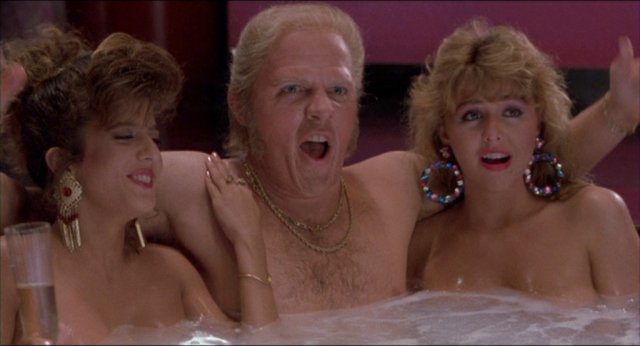
Best Biffism: “That’s about as funny as a screen door on a battleship.”
Marty’s Best Contribution to History: He doesn’t really contribute anything this time.
Marty’s Best Use of Future Superiority: Using the hoverboard to sneak alongside Biff’s moving car in 1955.
Time Travel Murkiness: Why is Old Biff able to travel from 1955 back to the same unaltered 2015 after giving Young Biff the sports almanac? Shouldn’t he too have been transported to an alternate reality 2015?
Most Rosy View of the Future: That people actually wanted more Jaws films after Jaws: The Revenge.
How the Characters Could Have Better Used Time Travel: Old Biff could have stayed in 1955. For one thing, that would ensure Marty and Doc were trapped in a 2015 that would be wiped out by the new Rich Biff timeline. Plus, as an old man, it seems like it would be rewarding to close out your final years during a period you had a lot of nostalgia for.
Should There Be a Sequel: Well, they show us a trailer for the sequel at the end of the film, so yeah. That’d be pretty weird if the film was never released.
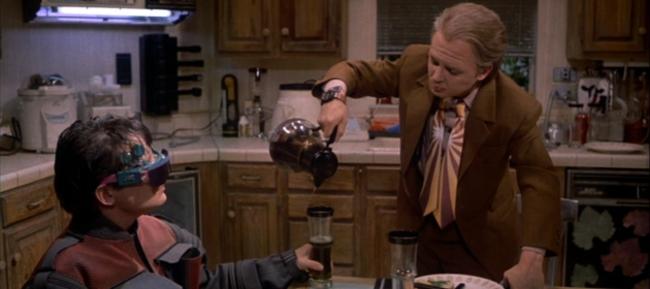
Up Next: Back to the Future III
previous franchises battled
Alien
Critters
Death Wish
Hellraiser
Home Alone
Jurassic Park
Lethal Weapon
Leprechaun
Meatballs
The Muppets
Phantasm
Planet of the Apes
Police Academy
Predator
Psycho
Rambo
Tremors
20 comments
I always thought it bizarre how Marty would fly off the deep end whenever someone called him chicken, as if such a tame insult was some kind of mysterious trigger word. Maybe Marty’s parents accidentally left him inside a crowded hen-house when he was five, and the experience resulted in a repressed fear/hatred of poultry.
Nice job. I never liked II much. It just feels off.
Also History of the World had a trailer for a sequel that sadly never got made.
I’m still waiting.
😛
Describing Doc as a “sci-fi Gandalf” is exactly right. Marty is the hapless Bilbo Baggins of the film, getting whisked off on an unexpected adventure, picking up something he shouldn’t have (the One Ring, sorry almanac) and getting his ass saved by Doc Gandalf every so often. The warmth and tightness of the first film is replaced by a string of cheap gags, and unnecessary flab. You can picture the Bobs slurping coffee and saying “Gee wouldn’t it be clever if we…” Too much exposition, very little inspiration.
My biggest problem with II stemmed from the end of I…why in the hell would they need to go to the future to fix anything? It hasn’t happened yet, so who gives a crap. At the end of I, Marty should have said “Doc, I just got back, and I’m about to spend a week spelunking Jennifer by the lake, in my new Toyota. Piss off.” I like III way more than II for that reason. II just never made any sense to me.
Yeah, 2 was a real disappointment. It’s been forever since I watched it, but I just remember the tone being so terribly different than the first. It was darker, and just not fun. Fortunately #3, while no great, was enjoyable.
Later when Marty says about leaving Jennifer and Einstein, Doc tells us leaving them will be fine as time will be transformed around them. That’s what happens to them 2015. Time transforms around them. Biff likely died (there was a deleted part where he did go behind a dumpster and get erased from existence) before 2015 in the new future. Dead or not, it doesn’t mean that Hilldale wouldn’t still exist.
In regard to your comment about Old Biff being able to return to an unaltered 2015: There is a deleted scene which shows Old Biff (who has just returned from 1955) stumbling out of the DeLorean in obvious pain, collapsing to the ground, and then vanishing from existence. It’s a deleted scene, so I guess it can’t be considered canon, but at least it shows the filmmakers were at least trying somewhat to adhere to their own rules. Great article! Looking forward to the next installment!
Oops, MikeShaynePI beat me to it. Wish I had a time machine so I could go back and stop myself from posting.
Part 3 could have been avoided if Marty looked at Doc… who was 30 years away from getting struck by lightning at the end of Part Two, and said, “Hey, don’t fly the DeLorean in a thunderstorm”. Ta-Da… never zapped. Never shot by Mad Dog. Sucks to be Clara, though.
This movie has a ton of problems, but it was mostly fun and had some of the CLEVEREST special effects I’ve ever seen… back when special effects artists needed to be clever.
Great Review. I just enjoy all three movies as a whole! It’s just a crazy trilogy,…and sure, it probably sidelines more often than not, but it’s still entertaining. Your diagnosis of the films so far has been great,…and I can’t wait to read the third part. Franchise Me is one of my favorite features of the site! So thank you for your hard work.
I love Franchise Me and this review is one of your best. So please forgive me but …
Revelry. You keep using that word. I do not think it means what you think it means.
What a great analysis, Joshua. So fun to read. It pretty much covers everything I’ve ever felt or noticed about Part II. When I saw this in ’89 (I was 10) I was torn between loving it and feeling like something was way off. I was a massive fan of the original and longed for a sequel. Even at such a young age there was stuff about the sequel that just didn’t add up. I just couldn’t articulate it at the time. In the following years I grew to outright dislike and dismiss it. I found Part III to have so much more heart and project the qualities of the original.
But a funny thing happened in my late teen years and into my twenties where I re-visited II and just found it to be so damn watchable–even if imperfect. This is the one out of the three now that I can throw on at any time or catch on cable and just… watch. It’s endlessly quotable. The wife and I throw around faux-George McFly’s, “You’re right! You’re right!” and old Marty’s “Mom, you sure can hydrate a pizza” on an almost daily basis. I look forward to your writeup on III.
i used to love part 2 as a kid as well; but it’s been years since I’ve re-watched it. I never could get into 3, just because it felt so completely different to suddenly be in the wild west…
WHO THE HELL IS CLARA????
Ok. So hear me out before you scream at me. Does ANYONE else feel that this should be “remade”. WAIT! STOP SCREAMING. I don’t mean remake BTTF I,II,III. I mean a story in the same world, that maybe touches on the first 3. Find the Time Machine (would need to work on THAT plot point), more adventures.
BAM! INSTANT MONEY.
No.
Too late! A studio executive has already seen bcoaks’s comment, and plans are now in motion…
Fun fact: the original/initial script to BTTF2 had a bit more of a typical/ derivative sequel nature to it. That is, the first half was basically the same but in the future Old Biff goes back to 1967 instead of 1955, so they all end up there. And of course, in fairly short order, Marty unintentionally prevents his parents weekend rendezvous and his actual conception. So! Yet again, they are running around trying to fix things so Marty isn’t erased from existence. At the same time, Mr Fusion is destroyed on the trip to 1967, so they have to find another power source to get up to 1.21 Gigawatts. Again.
I love this retrospective analysis series almost as much as I love the BTTF franchise. But reading through your excellent insights, I’m reminded of a couple of things that always bothered me about Part 2.
1) For all Doc Brown’s insistence that it would be unethical to take anything back in time (either for monetary gain or to make one’s life better), he has no qualms about giving the Delorean a hovercar make-over, or integrating Mr Fusion technology into its hardware – both somewhat visible examples of future technologies that would not go unnoticed by any bystanders.
2) Who is the guy handing out the leaflets about the clock-tower in 2015? Like you mentioned, the trip to the future enabled cast-members to play older versions of themselves, complete with unconvincing make-up. Since clock-tower guy is buried under a ton of shitty old-age prosthetics, I figure he’s supposed to be someone we recognise, but I’ve no idea who.
BTW – I always got a kick out of the Roger Rabbit doll in the antique store window.
Comments are shown as archived from the original site; new comments are closed.