• And now, before The End comes to an end…I give you Final Jackface (All instances culled from The End). We’ll miss you, Jackface. Thanks, for the memories.


Ahhhhh. That’s cleansing.

Christian: “Well, there is no “now” here.”
• Still-more evidence for “Limbo” as a plane of reality that’s at the “center” of the Island – a place that already seems to sit at the “center” of space/time, like the hub of a giant Dharma Wheel. There is no “now” because Limbo is an instance of pure, literalized Minkowsky space – where past, present and future are erased as meaningful concepts.
As mentioned earlier, Limbo seems to be a realm that’s contained in/accessible from/powered by the Light. It’s arguably another “plane” of reality – and that, along with the ways in which it mirrors the “real” reality of the past seasons, is similar in concept to the idea of Quantum worlds. Those of you looking for a “science-based” rationale for Limbo can find it in these ideas. Yes, you need to do some work to connect these dots – whether you want to make the effort is up to you. But it’s a mistake, I believe, to claim that Lost has abandoned science totally in favor of faith. Its past seasons and the way in which what we learned in terms of scientific theories colors what we see here are arguments against that stance.
This Limbo and its levels aren’t specific to any one religion, or arguably to “religion” in general insofar as the “religions” that some of these characters subscribe to emphatically condemn men like Ben Linus and Sayid Jarrah. Despite their series-long willingness to break Commandments, both of them end up having the choice to “move on” and join the rest of the Castaways in Light-Brite-Land. If there’s “Cosmic Justice” in Lost’s world, it plays by very subtle, Jacob-esque Rules. It’s either that, or we accept that there is no “Divine Judge” assigning these people Afterlife Dharma Duties; we accept that these people ultimately judge themselves. They are the causes of their own suffering, and they are the causes of their own salvation.
• It seems to me that there are different levels to “Limbo” – that these levels seem to be roughly correspondent to the spirit’s proximity to the Island’s heart – an afterlife mirror of Dante’s 7 circles, of the Gnostic notion of “projections of the divine.” We have othe living, most of whom never find the Island (and if that’s not a big, stinking metaphor that I’ll explore in depth in the upcoming Back to the Island book I don’t know what is), we have off/on Island apparitions, and we have those spirits which appear to reside inside the Island’s heart.
• I find the argument that having the Castaways reunite in the afterlife diminishes the drama of past episodes to be bizarre at best, frankly – and the very picture of Nihilism at worst. It isn’t as though the pain, struggle and confusion that the Castaways dealt with in their lives didn’t exist, or that many of them aren’t re-living the same sorts of traumas and self-imposed set-backs in the world of “Limbo.” It’s as though those folks arguing this point feel that the very existence of any “heaven”/”purgatory”/“afterlife”/”quantum world”/”plane of existence” renders our lives meaningless – as if receiving new life means that your old life would no longer matter. To make that kind of an argument would seem to dismiss the idea of second chances entirely, in this world and/or in any other. It suggests a worldview in which there is no forgiveness, a world in which there is no learning or growth or Grace, since that growth would apparently render the past actions of people “meaningless.” That’s a kind of high-octane nihilism. To take that tact is to essentially argue that Locke gaining the use of his legs in Walkabout renders all of his flashback suffering moot. It’s to argue that all pain is meaningless unless its unending pain. You can go ahead and ride that particular pony all day, but I’ve got no interest in watching you.
Above and beyond that, the notion that the sideways world is simply a “do over” without consequence blatantly ignores the reality of what we’ve seen in the show itself. Sayid is profoundly unhappy and disconnected in Limbo, despite having all of the tools to change that fact. Jack has achieved a kind of happiness and contentedness, but only by confronting his previous, still-unresolved issues – something we see him do in the off-Island universe. Where they are apparently allows them the chance to choose connection and evolution, growth and change. It also allows them stagnation, isolation. That’s Karma, in a nutshell, not some version concocted specifically for the show. That’s the process described in the Tibetan Book of the Dead. It’s the Catholic conception of Limbo, and etc. et al. ad infinitum.
And yet despite the fantastical names, in essence, it’s no different from their “real” lives at all. It might as well be another “quantum world” instead of a proper “purgatory.”
The choices made here matter as much as the choices made prior and in both cases they allow the characters to let go of what has haunted them, to make peace with what unsettles them, to learn from their upbringing and hopefully improve on it. Conversely, these characters have the choice to stay, with the knowledge they’ve connected to, in order to try and work through their “issues.” In the confrontation with his Other, Ben Linus makes a choice to effect his own salvation, by staying and working on himself, aware of who he was, of who he is.
Are there plot problems with this ending that I can point to? Yes, of course. Are there confusing aspects to the meet-up at the church that I wish were more firmly defined? Yup. Do I think that the overarching idea here, and its overall execution over six seasons trumps those problems?
Yes. Very much so. Selfishly, the finale firmly affirmed a lot of what I’ve been saying about the show’s themes and interests. I’ve genuinely loved what the show seemed to be saying all this time, am glad to find that much of it wasn’t entirely the ravings of an insane person, and have found it rewarding and edifying to think about these things for a few hours a week with all of you.
• My final word on Lost’s intelligence-level, or lack thereof, at least until I take up work on the Book again: One can snark about Lost’s “philosophy 101”-level themes and its simple New Agey spiritualism, but its sorta intellectually dishonest to do so. Too much of the show itself actively refutes such a dismissive interpretation. There’s nothing simple about Lost’s critical eye toward religion and religious hierarchy, nor about the ways in which that sometimes-vicious criticism coexists, largely successfully, with a seemingly-genuine reverence for the kind of unaffiliated Oceanic “spirituality” that’s bound up in recognition of mankind’s essential Existential state and our kind’s endless capacity for violence and grace, sometimes all at once.

• More than anything, that’s what the final minutes of this show evoke for me: Grace. You don’t need to be religious or even spiritual to appreciate the importance of Grace, or to understand how difficult it is to perceive and achieve.
As theologian, Pastor and Righteous Hero of World War II Dietrich Bonhoeffer noted, true Grace is costly. It is not the cheap grace of once-a-week gathering in the spaces consecrated to various faiths. Costly Grace – real, true Grace – demands sacrifice. It requires the willingness to lay down one’s life for one’s fellow man. Bonhoeffer ought to have known. He was, after all, a man who put his money where his mouth was. His was a Grace that cost more than I can honestly imagine giving. Unlike far too many of his fellow “men of the cloth” in germany during World War II, he passionately opposed the Nazi party, helped found the Anti-Nazi Confessing Church, and was hung as a traitor shortly before the war ended.
You don’t have to be religious at all to find profundity in Bonhoeffer’s story.
I would never seriously compare Bonhoeffer’s life or works with a fictional television show – it would be inherently disrespectful toward a man that I have enormous respect for. But the idea of costly Grace is certainly applicable to the saga of these Castaways. We’ve been watching them struggle toward it for six seasons – moths wrenching free of their cocoons.
• Can you make a spiritual show that’s also caustically critical of and suspicious of religion? I believe that you can, and that Lost can be seen as just such a show. I’ve talked about this extensively throughout these columns, and I’ll be summing this aspect up in Back to the Island: The Book, since it’s one of the areas that I think Lost has succeeded most brilliantly in exploring. John Locke’s exploitation, the MiB’s manipulations, Jacob’s removed-and-detached approach to leadership, the Others and their interpretations of Jacob’s orders, whether false or true….all of this operates as a pointed and powerful commentary on the dangers of blind belief, while also, simultaneously, operating to explore the necessity (at least as far as Lost is concerned) of faith. As Aldus Huxley wrote in Island – a book that Lost name checked back in Season 2:
“Faith is something very different from belief. Belief is the systematic taking of unanalyzed words much too seriously. Paul’s words, Mohammed’s words, Marx’s words, Hitler’s words—people take them too seriously, and what happens? What happens is the senseless ambivalence of history—sadism versus duty, or (incomparably worse) sadism as duty; devotion counterbalanced by organized paranoia; sisters of charity selflessly tending the victims of their own church’s inquisitors and crusaders. Faith, on the contrary, can never be taken too seriously. For Faith is the empirically justified confidence in our capacity to know who in fact we are, to forget the belief-intoxicated Manichee in Good Being. Give us this day our daily Faith, but deliver us, dear God, from Belief.”
As Huxley and, so it seems, Lost’s writers appear to believe, Faith is an exercise in hope. Belief is an exercise in certainty where there is no certainty. Lost is a show, ultimately, about Faith and belief. It’s about the perils and the power, the blindness and the awakening.
It’s about two sides: one black, one white.
It’s about a journey to find The Answers, arriving at the end to find yourself before a giant mirror. In the column for Lighthouse, I talked about The Conference of the Birds – a Sufi poem wherein a group of birds go looking for God and discover themselves instead. Their community is divinity. It is through their connections that they will be saved. In an Existential universe, where meaning can be endlessly debated, we can choose to create our own meaning through the communion we share with one another, the community we build with one another, the communication we forge between one another.
That’s Lost’s final message to us, and it’s one that never fails to move me deeply.

• The final shots of Jack, returned to the place where the story began – passing a rotting, dangling white tennis shoe – are sad and uplifting all at once. There’s something beatific about the sight of the plane arcing overhead as Jack lays there, chuckling, and finally lets go.
That’s all, folks. You know the drill – you don’t have to go home but you can’t stay here. Thank you, sincerely, for reading my ramblings and for your thoughts, comments and inexplicably-flattering compliments. It’s been a blessing to write for you. I’ll hope to see some of you back here in a weeks’ time for “Lost and Found.” In the meantime, take care of each other.
…and Namaste.
-MMorse
*****
If you enjoyed this column, please Digg it using the button provided below!
To view the complete Rewatch archive and related articles, please visit Back To The Island.
To talk about/join the discussion about Season Six, jump onto the Message Boards.

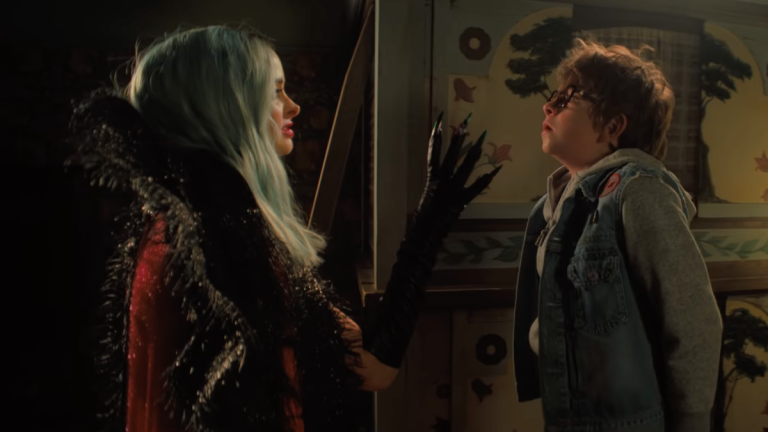
Anti-Locke: “I want you to know, Jack – you died for NOTHING.”
• Jack’s flying Hawaiian-punch is appropriately epic. Jack Bender’s work throughout this episode is fantastic stuff – shots like this one amp the energy up significantly. It’s telling, I think, that the episodes that have most underwhelmed me this season are the ones that are the most indifferently-shot.
• Yet another fun, potentially-intentional piece of subtext (mmmmm…subtext): Jack’s battle with Anti-Locke mirrors Jack’s struggle with Locke throughout the earlier seasons. In a sense, Jack is fighting his previous self – not the man of science, not the idea of rationality, but the stubborn nihilism. Matthew Fox played his Season 2 Swan stuff with Locke to a hysterical note, adding weirdly funny grins in the midst of his anger, a phenomenon associated with Jackface, one of the best and strangest sources of unintentional humor on Lost. That hysteria reflected not rationalism but mania.
• Jack’s wounding here can be seen as an explicit Christ-allusion (Jesus’ side was pierced by a Roman spear), and a few writers/critics/bloggers have taken this and other symbolism from the final hours of the show (like Jacob’s Cup O’ Communion) t mean that Lost becomes an explicit Christian allegory in its final hours, with Jack transparently embodying Christ.
That’s not particularly fair. First, Lost has always been an explicit Christian allegory – just as it’s always been an explicit Jewish allegory, an explicit Hindu allegory, an explicit Buddhist and Urdu and Flying Spaghetti Monster allegory. This isn’t new. Second, Lost has consistently favored a pan-religious/pan-mythic approach in its narrative, in its references and allusions. Granted, the writers have also consistently drawn from what appear to be their own religious leanings/interests, which means that much of the show’s overt symbolism (Charlie’s dream, the Dharma symbol and philosophy, Eko’s “Jesus Stick,” the Eastern Temple of the Others, episode titles like Exodus, etc. et al.) refers most readily to Catholicism/Christianity and Buddhism, but to infer from this that the show functions as an overall-Christian allegory is to miss the forest for the trees. Jack’s being stabbed and subsequently sacrificing himself to save the Island/the Castaways/ the state of pop music/the world is certainly a mirror of the Christ story, but it’s also a mirror that serves to reflect a host of other dying/wounded sacrificial gods/mythic figures.
• Anti-Locke’s knife enters Jack’s body in the area of the appendix, which Jack attempted to remove (by himself! via mirror! Jack is a badass/completely bugnuts!) back in Season 4. Recall that Jack’s Appendix scar appears in the off-Island Limbo, and that it seems to come to his attention and/or spring into existence when his past and “present” consciousness begin to literally and figuratively “bleed” together.
This wounding niftily echoes the wounding of John Locke by Ben Linus, back in Season 3. Both Jack and Locke are, respectively, stabbed or shot in a place where traumatic surgery has removed an organ that would ordinarily have ruptured instantly and killed them more-or-less immediately.
Instead, both Jack and Locke are able to keep going as a direct result of their missing appendix/kidney. Their ability to do this, in both instances, serves the purpose of protecting the Island. They quite literally “needed their pain to get to where they are today,” to quote Classic Locke from Season 5.

Maybe Kate’s Best Line In The Series: “I saved you a bullet.”
Locke: “You don’t have a son, Jack.”
• For me this confirms that David is a construct of Limbo, and not a “real” person – at least, not to the Jack we know. It’s also really, really jarring. Which is, I think, very much the point. Locke was always honest to the point of pain with Jack.
• I love Jin’s quiet amusement over Sawyer’s position in the LAPD.
Jack: Just find me some thread, and I can count to five.
• Another mirror – this time of the Pilot episode, and the scene of Kate helping to stitch Jack up after the plane crash. If I’m not mistaken, his wound then was similarly placed to his wound in The End.
• I haven’t cared about the Jack/Kate relationship in some time (and by “some time” what I mean to say is “like, forever”), but I’ll be damned if The End didn’t make me care. Call me a sucker for that. I’m more than capable of living with the designation.

• I don’t have anything to say about this – I just think its totally freakin’ cool.

Juliet: “It worked.”
• The End links us back to the beginning in a number of ways. Here, it’s a link between The End and the beginning of this season. The references to it working, and to them grabbing coffee and going dutch, reflect back to Juliet’s dying moments at the wreckage of the Swan, and they confirm that Juliet’s dying consciousness “connected” with her then-already-in-process afterlife (because remember, Jack was already there when Desmond visited, despite clearly being alive in the “present” on the Island).
Jack: It’s supposed to be you – It was only supposed to be me so I could do this. But if someone has to take care of the island, if someone has to protect it, then it should be you.
• My favorite dramatic moment of the episode, hands-down. A lot of us have loved Hurley from the beginning. Some of us have been talking for a while about the ways in which he represents/embodies/lives by the sorts of community-based, empathetic, honest ideals that all cultures hold dear. I’ve referred to Hurley before as an embodiment of the concept of “PU,” or the “uncarved block,” as well as the Golden Rule (“Do unto others as you would have them do unto you.”). And so it makes absolute perfect sense for Hurley to inherit guardianship of the Island. It’s an affirmation that Hurley’s way is, ultimately, a (not THE) “right” way. It’s a way that encourages communion, healing, humility, reflection. It’s a way that most every religious and philosophical tradition has claimed will lead a person to “enlightenment.”
• Remember back in Season 5, when Rousseau and her crew arrived on the Island and heard a weirdly-familiar voice reciting the Numbers? Remember a bunch of us wondering whether that was Hurley’s voice? Given the events of this episode and the time/space-hopping properties of the Island (and the way in which radio waves – a form of Electromagnetism – bend and boomerang around inside of the Island’s “sphere of influence. See: The Castaways picking up Big Band music in Season 1), it becomes possible that Hurley, in his position as Island protector, recorded a version of the Island’s Numbers broadcast which functioned to bring Rousseau to the Island. This would be the same transmission that Hurley’s Institutionalized buddy Leonard picked up back in the day – the same transmission that ends up setting off Hurley’s run of Good/Bad luck and his initial arrival on the Island.
*Mind Explodes.*
That prospect triple-underlines one of the show’s biggest themes, “We are the causes of our own suffering,” in such a sly, subtle way that it makes me giggle.

• Some folks have complained that not knowing what happens to Kate, Sawyer and the rest of the Ajira flight diminishes things for them. Not for me (big surprise at this point, I know). It’s more than enough to know that they’ve escaped and to know how they’ve changed, or been changed, before escaping.
Desmond: It was like a drain.
• Yes it was. It was a lot like the drain that we saw Ben use to “summon” the Smoke Monster, actually. Discuss!

• By saving the Island, Jack and the Castaways effectuate their own salvation – salvation via community having been perhaps THE dominant theme of the show since the beginning – essentially affirming what I’ve called the Existential “heart” of the show. Luke 4:23 has Christ proclaim “Physician, heal thyself” and this episode (indeed, the series) is one long, engaging illustration of that command. By giving himself for the Castaways, for the world, Jack achieves the salvation of their eternity. He rescues rebirth from the salivating jaws of Nihilism through the exercise of Existential Humanism. He affirms Meaning by choosing his own meaning. He refutes Anti-Locke so completely, not because of what he’s shown or what is proven to him. He refutes Anti-Locke because of what he chooses to believe. And that, for me, is what takes The End out of “great but aggravating” status for me, and elevates it to “profound” television for me.
Jack dies, not for some concrete, explicated Armageddon but out of the much more ambiguous expression of his faith – a faith that’s far more recognizable to me as being “real” – a faith that’s borne entirely from how he’s chosen to interpret this final conflict.
Those of you who are more science-minded may (and probably should, frankly) object to this. This faith is not recognizable, perhaps. Or it just bothers you. But I’d like to suggest that this kind of choosing is something we do every day, regardless of whether we’re religious or spiritual or whathaveyou. Our view of the material world is not innate. It is informed. It is the result of an accrual of our experiences. What we choose to believe, each and every day, about ourselves, about each other, about our country, about science, about religion…. On a simple level, it’s all about what we choose to have faith in.
That’s the level that Jack operates at in this episode, and in that sense it’s profound to me, precisely because the stakes aren’t clear except in the sense that we’ve had two feuding Island Hillbilly brothers telling the Castaways what they believe, in a veiled-yet-fascinating way. Jack chooses meaning over meaninglessness, despite having no objective means of “proving” he’s correct. That’s not “spiritual” – that’s just human. It’s the sound of Dostoevsky’s narrator choosing free will over determinism, despite the fact that free will might itself be illusory. It’s the sight of Sartre-ian ideal, of electing to create meaning despite the universe’s apparent “meaninglessness.” To invoke Joss Whedon once more, it’s the declaration that “If nothing that we do matters, then all that matters is what we do.”

Hurley: “Will you help me, Ben?”
Ben: “I’d be honored.”
Hurley: “Cool.”
• Ben’s arc of redemption reaches what is for me a satisfyingly-realistic conclusion. Ben wasn’t transformed into a saint by his confession to Ilana, he still harbored a rage over Alex’s death. But, in the same way that Sawyer “let go” after killing Anthony Cooper, Ben also seems to “let go” following the death of Widmore. The Limbo revelation that Ben and Hurley seemed to have died with sincere respect for one another and the jobs that they held is enormously tantalizing, and its also emotionally affecting (big surprise!). As mentioned earlier, a glimpse of Ben and Hurley’s time on the Island will apparently show up as a Special Feature in the upcoming Series box-set. According to an interview with Michael Emerson, there are between 12 and 14 minutes of footage from the finale that focus on this period, and I’m really, really excited to see it. I’m so excited about it that I’m reconsidering releasing Back to the Island: The Book until after I’ve had the chance to view it. I stopped buying the DVDs for the show after Season 3 and gave my copies of the first seasons to a friend, convinced that I’d want to own the entirety of the show once it concluded, and so I don’t have any problem with picking up the series when it comes out. That said, I think it’s legitimately insulting to long-time fans if meaty extras like this one are only available to those of us who choose to buy the whole enchilada. Those people who’ve been buying season-by-season deserve to get this kind of material without having to repurchase what they already own.
• Oh, and I don’t understand why they bothered to trap Ben under a tree either. It would have been just as effective to have him shove Hurley out of the way without pinning him under something that looks like it ought to have crushed his ribs, then fishing him out from under it with no explanation. ESPECIALLY when you have Sawyer saying that it’s too heavy to lift. Makes no sense to me.

• For those of you keeping track, the faiths represented in the window include: Islam, Judaism, Christianity, Buddhism, Taoism, Hinduism, Jainism, and Sikhism.
On a surface level, I like that the window suggests that all faiths lead to this place. I like the notion that all religions are “fingers on the hand of a loving God” and this symbology speaks to me for that reason. I also like that you can choose to view these symbols as literal, in that what we’re seeing is an objectively “religious” ending, or you can choose to take an agnostic/atheist viewpoint and view the symbols of these religions as attempts to express the inexpressible – a phenomenon with scientific properties and an inexplicability that defies rationality.
Yes, the symbolism here is heavily spiritual, but it’s also heavily influenced by all of the Wacky Superscience we learned about over the course of Seasons 4 and 5. A place where time is all one, past present and future indistinguishable? As mentioned, that’s Minkowsky space. You remember Minkowsky – the dude on the freighter and the guy who drove Desmond around in Limbo as his consciousness flipped back, then forth. Come to think of it, is that a sly joke? I think it is.
ALMOST THERE, FOLKS. THE END IS COMING – AFTER THE PAGE BREAK

• The visual of the Cork evokes Pandora’s box quite well yet again.
• The carvings on the Island’s Cork are cuneiform script, which apparently originated out of the area now known as Iraq, and is associated with Sumerian language groups. Sumer is considered “the cradle of civilization,” given that it’s the earliest ‘civilization’ we’ve yet to discover. Its name translates to mean “Land of the Lords of Brightness,” and Sumerian culture is typically credited as being responsible for the invention of the wheel (wonder if they made any Frozen ones?), of writing, of agriculture and of irrigation.
The show’s sly nod toward this culture indicates that the Cork was placed and/or discovered by members of, or contemporaries/immediate descendents of, the Sumerian people. In other words – people have been coming to the Island, and creating Incidents, since the beginning of civilization. Which begs the question: What was there before the Cork? Were an ancient group of inquisitive people responsible for some sort of proto-Incident, which resulted in there being a need for the Cork to begin with? Or was the Cork instead designed to alter what was already present and malign? Did some forgotten group somehow begin the process of changing “dark” to “light” millennia ago? Are the Castaways a link in a causal chain that stretches back past recorded history? Arguably, yes.
That’s the bee’s knees as far as I’m concerned.
The way that this detail connects to and enriches the religious preoccupations of the show makes me a happy camper. Sumerian myth was the earliest belief system to have been recorded, and traces of that system can be found in the Bible, the Torah and the Koran (see: Genesis, and a creation story that’s intriguingly similar to the Sumerians’, see Eve and her curse-inducing consumption of greenery, the tale of a global, devastating Flood, etc. et al).
And consider this: the beliefs of Sumerian religion were not exactly the glad tidings of the New Testament. They had a dim view of life and the afterlife:
“In Sumerian myth, the part of the Netherworld where humans were dwelled after they died was dark, dusty and unpleasant…. As a result of the sun traveling beneath the Earth, the Underworld became very hot, a place of fire and brimstone, which resulted in naphtha springs and bitumen seeps erupting on the surface of the Earth. Occasionally the constant reheating of the Underworld would turn exceptionally violent and produce volcanoes and earthquakes…The Sumerians envisioned Kur as lying under the land of the living as people are buried under the ground and so the gates of the underworld lead downwards.” (there’s also a whole bunch of stuff about women sleeping with Bulls and having kids and all sorts of bizarreness in Sumerian legend. Worth glancing at, if you’re into learning about the Ancient Kinks of our Ancestors).
If you examine the concept of “Underworld” throughout history, our conception/perception of it slowly changes, throughout different cultures and time periods. It goes from a place that’s much like hell as we might describe it now to the featureless but relatively-more-‘benign’ Underworld of Greco-Roman belief to the Jewish idea of Sheol to the Catholic notion of Limbo to the Tibetan notion of rebirth and on and on anon. It’s as though the Light sums up and represents all of these ideas while standing outside of any sectarian interpretation.
This is a perfect example of an unanswered question that’s suitably mysterious and “mythic,” allowing us to theorize about it without it interfering with the characters I care about. The pieces are there for us to assemble, but there’s no one “answer” to the mysteries of this place. I like that we can take a good long look at those tunnels and come away with guesses, theories, pretty-good-hunches, while leaving the “truth” of them aside. Here are some of my thoughts on them, and on the water of the Pool:
It seems to me that water is fed into the Pool via what looks like two separate stone channels (two sides, one black, one white). The water collects in the central pool, where it’s somehow “supercharged” by whatever energy/presence/power/steamy jell-o is located underneath the Cork. That water then flows out of the Pool, through the tunnels that we see briefly, and to several locations all over the Island.
As one Chud commenter pointed out, it makes visual “sense” to think of the Pool as the hub at the center of a spoked Wheel, with the tunnels representing those spokes (like the Dharmachakra). This mirrors the Island itself, which seemd to be at the “center” of Time and Space, with “spokes” (or “warrens,” to shove some Watership Down in there too) radiating outward from it that will allow passage to it.
Where do these tunnels lead? One presumably leads to The Temple, where the waters bubble up into the “healing” spring that the Others protected. Why did those Temple waters grow dark and muddy in the wake of Jacob’s death? Well, we can surmise that the Island’s protector and the “heart” of the Island are connected, and that the darkened waters of the spring indicated that the protector had died without first naming a replacement – which I presume weakens/disrupts/discolors the “natural” golden quality of the Light somehow.
What about the other tunnels? Presumably, one leads to/beneath the Swan Station, one leads to/beneath the Orchid Station, and the others lead off to other, similar locations. I like the notion that the Island is one big Dharmachakra, and that the Pool’s hub-like nature is mirrored by the Island’s hub-like nature.

• What more can we imagine/theorize/extrapolate/BS about as regards the Island and its heart?
As I’ve noted before, The Island is literally a “sea of stories.” It contains at least one other world, and probably an infinite number, where stories change and overlap and become new stories and perpetuate through eternity. By snuffing out the Light, you snuff that out. You remove Limbo, and because it exists in a timeless state, the ripple effect of doing this would presumably consign all of history’s unmoved souls to oblivion, and would prevent anyone else from remixing with the Oceanic sea to have their story retold, reincarnated in familiar but different form. It would be “true death” for the world.
Or maybe it’s even “worse”! Maybe, given the Electromagnetic properties of the Island and the way that the Light shifts from ethereal and golden to an ugly, sinister red, the uncorking of the Island is the unleashing of “darkness” into all possible worlds – a reversal of the Island’s “positive” polarization, which enables people to move on if they’re able, into a “negative” polarization, making Limbo/Quantum worlds into Existential hells from which there is no escape, no moving on, no change or Grace or connection.
That’s all fanwank, you say. Pure speculation. You’re doing the writers work for them.
That’s one way to look at it. Another way to look at it is that I enjoy thinking about this stuff, and I’m glad that some (not all) of the ambiguity of the show – specifically this ambiguity – allows me to continue thinking about it. I like the possibilities more than any potential answer. It’s a kick. Some of you feel the same way. Some of you don’t. I’m cool with that.
• The light of the uncorked Pool looks volcanic as well, and that reminds me of the fact that the Island itself is volcanic (according to Olivia Goodspeed, anyway), and has been dormant or extinct for a long time. It’s possible to infer that the last occurrence of seismic activity was a result of whatever ancient Incident occurred here.


Jack: “Looks like you were wrong too.”
• The Man in Black’s shift back to mortal man means that we can finally see Jack and (Anti-)Locke get their brawl on. I’ve been waiting six seasons for that smackdown, and it did not disappoint.
Eloise: “Are you going to take my son?”
Desmond: “Not with me – no.”
• Those of you wondering whether the Limbo of Season 6 exists only for the Castaways we see in the church at the end? This line (among others) should correct that misapprehension. Note also that Desmond seems to imply that someone else will be the one to take Daniel away from her.
• And let me underline again how knotty and sad this Limbo is. It’s not all unicorns and rainbow bridges – this is a level of reality where someone can actively conspire to keep someone “asleep” and unaware of what’s happened to them. Eloise’s attempts to keep Daniel there is, as mentioned, very interesting to me. Her motives for wanting to keep her son in Limbo are at once deeply selfish and eminently relatable. This kind of selfishness isn’t something you’d expect to find in “heaven” – someone who’s arguably already been “enlightened” choosing to stay and choosing to manipulate her son in order to get him to stay too. That’s dark, and it refutes entirely the notion of this Limbo as cuddly-care-bear-heaven. It also nicely mirrors the way that Eloise worked so hard to have her son killed by her younger self (still one of Lost’s best mindf*cks).
• The choice not to give us much of the Daniel/Driveshaft collaboration was a smart one. Oh, and hey, Table 23!

• Kate finds enlightenment in Claire’s golden vagina.
• Snark aside, this is where my eyes started tearing up. The emotional investment I’ve placed in these characters paid off in spades during The End, and that changed not one whit when I rewatched the episode for this column.

• I despised Charlie and Claire’s weirdly orgasmic, Season 1 Fake Peanut Butter scene. I’m firmly anti-CharliePorn in general – the world is not ready to watch Dominic Monaghan making O-Faces while sucking on his own finger. So of course Lost has to revive that image for me here. DAMN YOU, LOST!
THE END APPROACHES! …..AFTER THE PAGE BREAK

• The verdict on Sayid and Shannon is deeply mixed, and I can’t say as I blame anyone for that. On the one hand, Nadia’s been a defining force/goal in Sayid’s life for as long as we’ve known the character and so it’s strange to think of him finding “enlightenment” with anyone else. On the other hand, I found myself weirdly, genuinely moved by Sayid and Shannon’s relationship in Season 2 when I rewatched it, and so I’m not going to gripe about this.
Those of you claiming that Nadia ought to be in the church aren’t wrong, but you’re also ignoring/not seeing the fact that Nadia might not be willing/able to move on, and the more important idea that Shannon helped Sayid “let go” of Nadia initially, on the Island. Why is it that someone like Sayid is chosen to move on despite not having worked through his issues while Ana Lucia is deemed not ready? That’s an area for legitimate debate. I invite you to give your theories.
• I like that Boone is Hurley’s accomplice, and that his apparent enlightenment happens entirely off-screen. I like also that it calls into question the seemingly-knowing conversation that Boone has with Locke in “LA X.” Was he enlightened already at that point?

Anti-Locke: “This remind you of anything, Jack? Desmond…going down into a hole in the ground…If there was a button down there to push, we could fight about whether or not to push it. It’d be just like old times.”
Jack: “You’re not John Locke. You disrespect his memory by wearing his face, but you’re nothing like him.”
• I’ve talked at great length about the variety of “mirrors” that are contained in Lost’s narrative – moments that “reflect” other moments, dialogue that “reflects” other dialogue. There’s a ton of this stuff in Lost as a whole, and a fair amount in this episode. Here’s one of the most obvious examples, helpfully underlined by the writers themselves.
This isn’t simply a cheap trick on the part of the show. These “mirrors” have serious meaning for the show as a whole, and that meaning is something I’ve been discussing since my Rewatch column for the show began last August. You can go back and read through old columns for episodes like “One of Them” and “He’s our You,” and you’ll see exactly what I’m talking about. I’d write more about it here, but this column is already twice the length of my normal ones, and I’d rather save that effort for the aforementioned Book (last mention, I promise).
• Charlotte pops up again and she and Daniel connect, but they don’t wake up – at least not right away. I find Daniel and Eloise’s presence and actions in Limbo to be fascinating. More on this below.

• Love the skeletons. And I love that the scattered ruins on the Island aren’t indicative of any one ancient civilization. They’re indicative of many. We see Egyptian hieroglyphs, Roman wells, a Temple that looks Eastern in design, yet carved as well in hieroglyphs. The history of the Island is jumbled, and I think, intentionally so. Someone managed to install a Wheel on the Island that allowed successful release from the Island. Someone told Ben about it. People long before John Locke may have gone Island-hopping just as we saw happen in Season 5. Who’s to say that the Egyptians didn’t do just that, appearing in time periods later than their own and inscribing new structures with their script? Or that Mother, the Island protector, wasn’t Egyptian herself, and responsible for the first of the markings, a tradition that her son Jacob carried on?
And there’s direct evidence in The End that the Egyptians weren’t the first people to set foot on the Island – if we’re to take something meaningful away from the almost-hidden hints we receive at The Pool, people have been coming to the Island since the dawn of “civilization.” It’s possible (and super-fun, at least for me) to draw comparisons between this space and the Swan Station – to argue that the “Pool” is in fact a primitive “Hatch.” It’s responsible, after all, for somehow regulating/containing mysterious energy, is guarded by an appointed person who constructs a “failsafe” option to ensure future safety, and contains evidence of murderdeathkill (for the Swan it was Radzinsky’s brains splattered on the ceiling, for the Pool it’s the skeletons), to name a couple of similarities.
I understand that some folks think leaving a place as important to Lost’s mythology as the Pool largely undefined and up to the imagination is “sloppy,” in that we’re left to fill in the details of the frame for ourselves. But for me, filling in the frame is fun. Imagining the possibilities is fun. Isn’t that precisely what we’ve done over six seasons? Hasn’t the act of that imagining been just as much fun as the story being told? Weren’t you liable to chat to strangers and read weird columns on websites that delve waaaay too deeply into minutia because it was a pleasure to do so, to consider the “what if,” the “maybe”? I’m not someone who’s going to tell you that it’s not about the answers, it’s about the characters and so these kinds of Answers “don’t matter.”
I’m way more infuriating than that. I’m going to suggest that it’s not about the answers – it’s about the questions (and it always has been). It’s about asking ourselves what we believe – about science and faith and good and evil and fate and free will and life and death and Smoke Monsters and polar bears and whatever the heck is happening on this show from episode to episode – and it’s about getting us to talk about these things on a level that television has rarely, if ever, achieved. To dismiss that achievement entirely because of some rightly-aggravating unanswered questions is to toss out the proverbial baby with the bathwater. You’re welcome to do it but OHMYGOD YOU JUST THREW AWAY A BABY!
To invoke my second utterly-pretentious DFW quote for the column:
“[T]here is real and alienating stuff that stands in the way of our appreciating Dostoevsky and has to be dealt with – either by learning enough about all the unfamiliar stuff that it stops being so confusing, or else by accepting it…But the larger point (which, yes, may be kind of obvious) is that some art is worth the extra work of getting past all the impediments to its appreciation….The thrust here is that Dostoevsky wrote fiction about the stuff that’s really important. He wrote stories about identity, moral value, death, will, sexual vs. spiritual love, greed, freedom, obsession, reason, faith, suicide. And he did it without ever reducing his characters to mouthpieces or his books to tracts. His concern was always what it is to be a human being – that is, how to be an actual person, someone whose life is informed by values and principles, instead of just an especially shrewd kind of self-preserving animal.” David Foster Wallace, from the essay “Joseph Frank’s Dostoevsky,” included in “Consider the Lobster.”
You remember Dostoevsky. He’s the guy who wrote Notes from the Underground, the book that popped up prominently in Season 6. Much of what his fictional narrator has to say in that book goes to the heart of the themes that Lost has explored over its six-year run. I wrote about those themes here and here.
I’m in no way equating Lost’s writing with Dostoevsky. But I think Wallace’s point about his writing is a point that’s equally applicable to something like Lost. “Some art is worth the extra work of getting past all the impediments to its appreciation.” That means choosing to grapple with the “game” of references, thematic “mirroring,” allusions, and structural tricks that Lost plays with its audience throughout its run, or choosing to accept that there’s a level of alienation to the unfamiliar stuff and running with what are inarguable strong points: the acting, the drama, the mysteries (which are distinct from, and enjoyable away from, answers), the themes, the allusions and references and subtextual stuff that’s floating around waiting to be discovered on the edges of the show.
• On a related note, those complaining that Lost is “philosophy 101” would seem either to have no interest in playing Lost’s game, refusing to acknowledge that a deeper appreciation of the subjects that populate Lost’s background might enrich appreciation for the plot and drama of the show, or have little respect for the difficulty of the Philosophers that the show actively encourages the audience to grapple with. Either way, that particular complaint falls on deaf ears with me.

• I love that this space suggests a whole unseen history with its multiple skeletons and inexplicable architecture. As mentioned above, I love that it seems to be a kind of proto-Swan Station, with various tunnels leading away from the Source just as various passages led away from the Swan’s central hub, and a man-made, cuniform-etched ‘cork’ keeping something at bay just as the man-made, hieroglyph-adorned Swan counter and computer kept something at bay.
• What does time/consciousness-traveling have to do with Desmond seeing “Limbo”? Well, his consciousness has jumped backward several times at this point – it stands to reason that it might jump forward, and jump past his own death. His consciousness, which those science-minded among you might see embodied as energy – specifically a form of electromagnetic energy – and The End tells us where that energy goes. After all, energy can neither be created nor destroyed. That’s, like, science, man. When we die, where does our energy go? In Lost’s universe, it goes to the heart if the Island. It’s reborn/reincarnated there on another level of reality – a quasi-“quantum” level if you’d like. Electromagnetism and Quantum Physics are, after all, interrelated concepts.
• More evidence that the Pool connects the science-grounded Time/Space stuff from past seasons with the “heart” of the Island: Desmond’s nose bleeds out when he enters the Pool. Some more conjecturing along “scientific” lines: the behavior of time around the Island suggests that the Light might be “rationally” (ha! Hahahaha!) classified as a “wormhole” or a “black hole.” As one approaches a black hole, light, space and time all bend. That’s exactly what happens to light, space and time on the Island.
• Some of you have complained that the ultimate obliqueness of the Island is a misstep/a show-killer/too vague/whathaveyou. Personally, I love it. It mirrors the essential dilemma at the heart of the Swan Station, the Pascal’s Wager (as one Chud commenter aptly called it) that was pushing the damned Button. In accepting the position of Island protector, you accept that you do not know whether your actions accomplish anything. In this sense, The Swan is the answer to the nature of the Island, and to the Existential problem at the center of Island guardianship. The protectors do what they do because to not do it would be to risk annihilation. If and when you choose to rewatch the show I think that returning to Season 2, to the Hatch and the conversations/arguments over it are going to color your view of the Island’s heart in a warmer light (no pun intended). Of course, as always, your mileage may vary. If you’d like to consider some of this without rewatching you can always head over to Back to the Island, where a full archive of my Season 2 Rewatch Columns is available for your eager peepers.
• So why is it that Desmond is Jacob’s “failsafe”? Well, he’s uniquely resistant to electromagnetic energy, of course. But what does that mean, exactly? Near as I can tell, it means that he’s been exposed to the Island’s unique brand of Limbo-flavored energy for a tremendously long period of time through his stationing in the Swan. On top of this consistent, low-grade exposure he’s also been bombarded by the stuff when he turned the Swan’s failsafe key, and again when Widmore deployed his Giant Electromagnetic Doohi key (patent pending). Think of Desmond’s Electro exposure as similar to The Dread Pirate Roberts’ slow-built immunity to iocane powder.
IS IT THE END YET? NOT YET! MORE, AFTER THE PAGE BREAK!

• This may be one of my favorite images in the series. Matthew Fox totally sells the seeming serenity in the moment.
• I like that Jack tells Sawyer that he doesn’t really feel any different after sharing Jacob’s Island communion, but that we’ve also just watched him taking a good long look at his hands and standing in the center of the water, motionless and in apparent contemplation. Clearly, something’s changed in him, even if it’s only the feeling of having taken over on the Island.
Hurley: “None of this is ringin’ a bell, is it? You? Me? tranquilizer gun?”
• Hurley’s fate, and his awakened demeanor in this episode makes even more sense/becomes cooler to me when his fate on-Island is taken into account. Hurley leads a seemingly charmed life off-Island before he’s awakened – the sort of life you’d expect a benevolent former Island protector-dude to have. He leads people to connect, even unconsciously. He reminds Sayid of the importance of choice, a very Jacobian touch. Yet, Hurley’s still lacking a love, and that comes, I think, from the horribly insecure state of his heart in his “real” life, which, barring some unseen Island romance in Hurley’s future, left him alone in the wake of Libby’s death for what might have been a very, very long time. He can’t “move on” until he’s reconciled and made peace with that part of his life – and that notion isn’t “Christian.” It’s universal.

• I grinned like an idiot during this entire scene. Reyes’ work in general in this episode is stellar. I love the way his voice/demeanor changes and matures when he asks Charlie “what if I told you that playing this show is the most important thing you’ll ever do?”
• And here’s another instance of how the off-Island “Limbo” (let’s call it that, since Limbo’s a neutral world) proves consistently interesting to me on a character level, and why the idea of Limbo as a “Second Snake”-ish “true” ending to the show is rewarding to me on a thematic level.
Charlie’s a drugged-up wreck who first appears to us believing that he’s meant to die. That’s awful, and it would seem to negate all the progress that Charlie made prior to his Looking Glass death. And yet, if we consider Charlie’s full arc, we see a soul that never quite settled – a soul that remained vulnerable and easily misguided and prone to flashes of emotion that led to getting facepunched by Classic Locke. His arc was redeemed for many of us by his death, and it’s his death that most defines Charlie when he enters Season 6.

Sawyer: “We’re not Candidates anymore.”
• SMACK!
In an episode filled with terrific touches, Sawyer’s moment of utter badassery deserves special mention. It’s just plain fun. I believe that Michael Emerson is legitimately qualified to compete for the Guinness Record for Most Beat-On Character In A Television Show.
• Vincent, Canine Harbinger of Doom, pops up just in time to mark Desmond, Rose and Bernard for possible death. He’ll end the show lying beside Jack as he slowly bleeds out all over the jungle floor. Beware of Vincent, Hurley and Ben! He lurks in the jungle still, and lusts for blood.
• Rose, Bernard and Vincent show up again at last, confirming that they’ve just been staying out from under foot this entire time, practicing non-involvement. They break that self-imposed lifestyle choice to rescue Desmond from the well, and it’s good to see them again, to know that they’re alive and well. I presume th
40 comments
outstanding.
Can someone PLEASE answer this…?
"How did a DHARMA polar bear make use of the frozen wheel to be transported into the Tunisian desert?"
This bothers me more than just about anything else….
As a medical person, I just have to point out that Jack not having an appendix wouldn't do a single thing to help him survive longer after getting stabbed in that area. So that point doesn't quite work. Interesting read though. Namaste.
Excellent work. This should be required reading for all fans *and* critics of the show. Devin was way off with his "wet gnostic fart of an ending" tirade… which also proves that he never really got the show to begin with.
Worth the wait! Great write-up, Morse!
Great article, but one thing – the stab wound Jack has at the end it NO WHERE near where he was wounded in the 815 crash.
Excellent as usual. You bring up a very interesting point that the Limbo they live in is actually inside the heart of the island. If we take this in its literal sense… does that mean at the end when the church doors are open and the heart of the island light engulfs them… do they leave the heart of the island and land back on the island????
Meaning limbo is inside the the heart of the island… and when they leav limbo they pretty much walk out fo the light and back to the island… maybe asleep on some rocks the way jack wakes up after passing out at the source… the way the MiB's body is found after being thrown into the source…
are these characters' heaven in fact the island?
probably not… but i figured I'd ramble for a bit…
LOST = One of the top 3 shows of all time. Ending was hugely satisfying.
i honestly love the way you seem to try and piece together the events on Lost like they actually happened and you're some kind of future archaeologist.
i was digging the final episodes right up until Jacks realisation in 'limbo', i had come to terms with not getting all/any answers but i just needed something more to tie the two realities together, whether it be Hurley, Desmond, Jack, or the island itself, just some actual footage that someone or something was behind giving them all the closure they deserved, for whatever reason. maybe it will be in the extra footage on the dvd but i doubt it.
anyway great article as usual, i'll be back for more next week.
I've been wondering whether Hurley actually even becomes the "next Jacob" or not. The Island's "heart" was switched off when he drank. What he drank looked brown and nasty. Jack didn't do the incantation Mother or Jacob did to prepare the water.
Thank you for all of the columns that you've put together in the past few months. For this specific one I devoured 5 and 1/2 pages at the end of work, and just finished the tail-end at home now.
I appreciate everything that you've written and the added perspective that you bring.
Glad to finally read your last post of LOST.. Like the other reader said, you should be required reading for all LOST fans.. Anyway, I hope to catch you in your new website dedicated to other things "Not Lost"…
kingkrims
Bronx, NYC
Thank you for the thoughtful essays. I only became aware of them this season, but what a treat they have been. A great part of the Lost experience.
You didn't even mention the excellent scene between Jack and Christian. This scene really hits me for some reason. The acting is top notch and I wish John Terry had more work.
It's kind of strange that Jack was the only one that was kind of upset that he had died. Everyone else seemed happy as hell, especially Jin and Sun.
Great as usual. I only wanted to add that I believe I read that the extra scenes from the finale will not be limited to the box set, that it will also be part of the solo season 6 set.
Great analysis. You put a lot of work into this and it shows. Especially considering the drivel that Devin wrote, I really appreciate your take on the finale.
As usual, bang up job on the article. You nailed it. Glad to hear you're sticking around this dump a little longer; you class the place up a bit. Now, if only all your ramblings were collected in book form. . . . . . . . . . .
check++ morse
I totally agree with manofmystery. O was expecting you to say something about that scene.
Matthew Fox's acting in that scene is phenomenal. When he realizes why his is with his dad it made the journey for me. As you have pointed out there have been a lot of bad dads on the show. This scene was the redemption of fatherhood on Lost.
I suppose this scene could be saved for the book. If so, well played. It may get me to sign up. I would love your thoughts on it.
I keep going back and forth as to how I feel about the show. This column put me firmly back on the "loved it" side. Bravo!
excellent work, as usual MMorse. Like #4 said, this is definitely required reading for fans and critics alike. And indeed, it's clear that Devin never got the show. I look forward to reading your forthcoming book. And… I'm sure people noticed this already, but Luke 4:23? Locke was 4, Jack was 23. Boom!
Thanks for a great set of columns, always full of interesting ideas, and the only piece of decent writing on CHUD (and the only thing that kept me coming here) lately.
I'm gonna mis 'em almost as much as the show!
For a slightly different, but equally entertaining, take:
http://tinyurl.com/2clcv37
They could have given some explanation as to what the Island was, and the ending and the reunion would be JUST as affecting. Not giving the answers was lazy, "we have no idea what we're doing, so lets let Giacchino have a pound of weed and see how sappy he can make the music and tell the key grip to set the lights for "SOFT" damnit!" Sorry. Your articles are fantastic and I honestly think you put a LOT more time into thinking about the show than the producers/writers. I'm sure the prop guy had fun though.
I just wanted to thank you for the write up, it was fantastic, as well as all the others you have written. Thank you again, you're a fantastic writer.
I love that anyone who has issues with how the show ended–whether or not they actually liked the ending as a whole–just "didn't get it". That is such a freaking cop-out.
Loved the article you always seem to give me at least one or two little nuggets I hadn't considered before. One thing though, why is no one coming to what I feel is the obvious conclusion that "The Incident" created "Limbo". If the Island is a box and "whatever you imagine . . .there it is" and the "power" of the island comes from the "heart" of the Island and the heart is connected with eltromagnetic energy wouldn't it stand to reason that Juliet came in contact with the heart of the Island in the moment Jughead exploded. It wouldn't contradict the rules of time-travel the show gave us. Namely that "what happened, happened" and they couldn't change things. They created limbo together because they conspired to explode Jughead together. Thats why Juliet says it worked. Jughead didn't reset time, the island gave a scared dying woman in a hole what she really wanted, and they all wanted, a chance for peace and love. We also have the "mirrorinng" of the white light Christian walks into with the only fade out to white in the history of the show in Season 5 finale. In fact the very next scene we see is in "Limbo" opening Season 6. If any one person "created" "Limbo" it was Juliet.
Thanks for all the thought-provoking hard work, MMorse. I've enjoyed the hell out of your columns.
WOW. I can't tell you how much I've enjoyed your columns. The greatest compliment I can think of is to say that I cannot imagine "Lost" without reading your analysis hand-in-hand. Well, I can, but it sucks…
The Anthony Cooper in Limbo idea was one I thought about when the show ended, and how interesting the idea of it is. If that is the real Cooper, then he would be stuck in a "true" hell, where he is trapped as a vegetable inside of his body unable to escape or move on. And what then of Keamy and gang? Were they real and if so, what happens to them when they die in limbo?
You left out one important point. NO ONE CARES about then limbo world. I was a huge waste of time and clearly points to the fact that the wrtiers were out of ideas and could not make an entire season out of new material.
I hated this show now and gave away all my season 1 – 5 DVDs because I will NEVER be watching this waste of time again.
Beautifully and intelligently written. I don't need to tell you to ignore the haters.
Cerebral. Eccentric. Preposterous. Sensational. Capricious. Imaginary. Whimsical. …and most definitely, Absurd! Not only are they qualities to describe my being, they also relate to the television show "LOST" and the dissertations of MMorse. You must understand this as a compliment to gain entry to the New Century. Well done.
What would have been so terrible about the Island being destroyed? What was so evil about the Smoke Monster? If you don't answer those two questions, just those two, then either your narrative or your moral calculus is seriously flawed. Yes, the smoke monster ruthlessly kills any number of people in its attempts to escape the island, but Jacob ruthlessly kills any number of people in his attempts to keep it on the island. Yes, many characters *say* it's just evil and *say* its escape would be the end of everything, but the narrative never demonstrates how anyone would actually know that or what real proof they have or why we should believe it. And if we're to take all this on faith or 'cause Jacob said, then how much murder are we willing to justify on the basis of that faith? How many purges and plane crashes? The outrigger, Walt, the Dharma Initiative, those smaller questions don't matter, and I, too, feel their lack of resolution enriches the story. However, in failing to answer two absolutely crucial questions, all Lost did was prove itself a perfect show for an American audience that wants so badly to believe in its own righteousness, collateral damage (what collateral damage?) bedamned. If The Light in the Glowy Cave can produce the Smoke Monster people are so intent on vilifying, then all that Light is is power – Power that can be used for "good" or "evil," but still just pure power. No wonder so many people are willing to believe that its protection is of paramount importance and that only those who serve it will be rewarded.
Brilliant! My sincere thanks for taking the time to find the words I always tried to articulate about this show and never could. I've chosen to dwelve into your ramblings every week and I now, find myself truly awakened.
Stunning…
Bravo, sir.
At Comment #2
(Can someone PLEASE answer this…? "How did a DHARMA polar bear make use of the frozen wheel to be transported into the Tunisian desert?" This bothers me more than just about anything else….)
I naturally assumed that one of the polar bears was used as a test subject to see what would happen to a living thing when this wheel was turned (activated?)
I found it interesting that contrasting when Jack died to when Jack crashed on the island, the trees blocked his view initially, and in the end of the show, he could "see" now. Did anybody catch that?
I love Lost. I got enough answers. My main problem was with the pacing of the final season. I just think that interlacing the epilogue to the series with the climax makes the climax kinda…boring.
Thank you for writings. I'm definitely looking forward to your book and future columns.
This really stands out:
it becomes possible that Hurley, in his position as Island protector, recorded a version of the Island’s Numbers broadcast which functioned to bring Rousseau to the Island.
This tells me you may have watched the show but you didnt follow it that well. We found out that:
Likely constructed some time in the 1970's, the radio tower's purpose, according to the Sri Lanka Video was to broadcast the core numerical values of the the Valenzetti Equation (aka the Numbers).
The Sri Lanka video is cannon.
Comments are shown as archived from the original site; new comments are closed.